Explore Cyprus with Our Interactive Map

Explore our top stories and discover ideas worth your time.

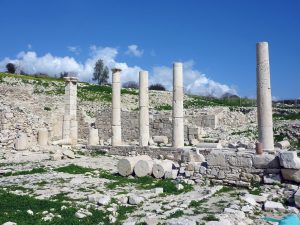
Amathus Sacred Grove of Aphrodite Cyprus

Amathus Sacred Grove of Aphrodite Cyprus

Geographic and Historical Setting Amathus, located on the southern coast of Cyprus near modern Limassol, was one of the most important ancient city-kingdoms of the island. Among its most significant religious features was the Sacred Grove of Aphrodite, a sanctuary associated with fertility, royal authority, and long-standing local traditions that predated classical Greek influence. Unlike urban temple complexes built in later periods, the sacred grove represented an earlier form of worship in which natural landscape and ritual space were closely connected. The site functioned as a center of spiritual life where religious practice was embedded within the rhythms of nature, agriculture, and seasonal renewal. pinterest-com Archaeological and literary evidence suggests that Amathus maintained a distinct cultural identity within Cyprus, blending indigenous traditions with influences from the eastern Mediterranean. The worship of Aphrodite at Amathus was deeply rooted in pre-Hellenic fertility cults that later merged with the Greek conception of the goddess. This layered religious history gave the sanctuary a unique character. Rather than serving solely as a mythological birthplace, as in Palaepaphos, Amathus became known as a living center of ritual activity that linked divine fertility with political and social order. Sacred Landscape and Ritual Environment The Sacred Grove at Amathus was not confined to a single temple building but extended across a natural setting that included trees, open spaces,…

Read more
Cypriot Syrtos Island Dance

Cypriot Syrtos Island Dance

If there is one dance that captures how Cyprus moves, remembers, and gathers, it is the Syrtos. Performed in an open circle, grounded rather than leaping, it has survived centuries of occupation, division, and social change without losing its core rhythm. The Syrtos is not a performance meant to impress from a distance. It is a shared action, designed to include rather than exclude, where the movement matters less than the connection it creates. To understand the Syrtos is to understand how Cypriots express identity without words. A Dance Built on Contact with the Ground The word Syrtos comes from the ancient Greek verb meaning “to drag” or “to pull,” and the name describes the movement precisely. Feet stay close to the earth. Steps glide rather than jump. The dance progresses sideways in a steady, unhurried flow that feels deliberate rather than showy. This grounded quality sets the Syrtos apart from the energetic, leaping dances found in mountainous parts of Greece. In Cyprus, where life historically revolved around agriculture and coastal settlements, the movement reflects stability and continuity rather than display. The body stays upright, the rhythm remains even, and the emphasis is on collective motion rather than individual flair. The Circle That Makes Everyone Equal The Syrtos is almost always danced in an open circle or gently curved line,…

Read more

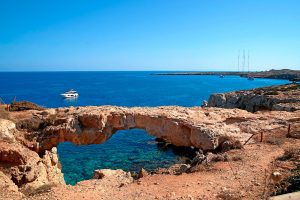
Cape Greco Nature Trails

Cape Greco Nature Trails

Cape Greco National Forest Park sits at the southeastern tip of Cyprus, between Ayia Napa and Protaras. This protected area covers 385 hectares of dramatic coastline where limestone cliffs drop into turquoise Mediterranean waters. The park became a National Forest Park in 1993 and forms part of the Natura 2000 network, recognized for its ecological importance across Europe. Cape Greco offers a network of interconnected nature trails that guide visitors through diverse coastal landscapes, past ancient ruins, and along some of the island's most spectacular viewpoints. Historical Background The area has been inhabited since ancient times, with evidence of Neolithic settlements and later Greek and Roman influences. The landscape formed millions of years ago through tectonic activity and erosion from sea and wind. The ruins of a temple dedicated to Aphrodite can be found along one of the trails, connecting hikers to the island's mythological past. The natural rock formations themselves tell the story of geological forces that shaped this coastline over countless millennia. The area was designated as a National Forest Park in 1993, providing formal protection for its unique ecosystems and cultural heritage. Conservation efforts focus on preserving the delicate balance between public access and environmental protection. The park's establishment reflected growing awareness of the need to safeguard Cyprus's natural treasures for future generations. The Nature Trail Network…

Read more