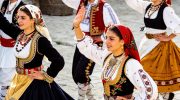
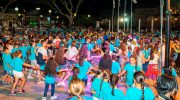
If there is one dance that captures how Cyprus moves, remembers, and gathers, it is the Syrtos. Performed in an open circle, grounded rather than leaping, it has survived centuries of occupation, division, and social change without losing its core rhythm. The Syrtos is not a performance meant to impress from a distance. It is a shared action, designed to include rather than exclude, where the movement matters less than the connection it creates. To understand the Syrtos is to understand how Cypriots express identity without words.
A Dance Built on Contact with the Ground
The word Syrtos comes from the ancient Greek verb meaning “to drag” or “to pull,” and the name describes the movement precisely. Feet stay close to the earth. Steps glide rather than jump. The dance progresses sideways in a steady, unhurried flow that feels deliberate rather than showy.
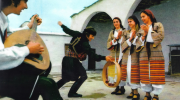
This grounded quality sets the Syrtos apart from the energetic, leaping dances found in mountainous parts of Greece. In Cyprus, where life historically revolved around agriculture and coastal settlements, the movement reflects stability and continuity rather than display. The body stays upright, the rhythm remains even, and the emphasis is on collective motion rather than individual flair.
The Circle That Makes Everyone Equal
The Syrtos is almost always danced in an open circle or gently curved line, moving counter-clockwise. This formation is not decorative. It is symbolic.
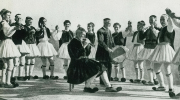
In a circle, no one stands above the others. Everyone faces the same direction. Each dancer depends on the next to maintain rhythm and balance. The structure creates instant inclusion, allowing people of different ages and abilities to join without disrupting the flow.
This is why the Syrtos appears at moments that matter: weddings, village festivals, religious feast days, and communal celebrations. The dance is not a backdrop to the event. It is the event.
Leadership Without Dominance
Although the circle suggests equality, the Syrtos still allows space for leadership, expressed quietly rather than forcefully. The front dancer, traditionally positioned at the right end of the line, guides the movement without commanding it.
This role is earned through experience rather than authority. The leader may introduce subtle variations, a deeper bend of the knee, a gentle turn, or a brief flourish of the feet. Often, a handkerchief links the first two dancers, not as decoration, but as a physical reminder that leadership remains connected to the group.
What matters is restraint. The line never fractures. The rhythm never belongs to one person alone. Individual expression exists only because the collective maintains the foundation beneath it. In this way, the Syrtos reflects a familiar Cypriot principle: distinction is welcomed, but only when it strengthens cohesion rather than replacing it.
Music That Moves at Human Speed
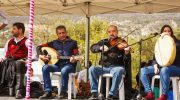
The music accompanying the Syrtos is deliberately measured. Traditionally led by violin and lute, sometimes joined by a frame drum, it is designed to travel across open courtyards and village squares without overwhelming the dancers.
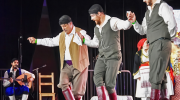
The tempo does not rush. It allows participants to settle into the steps, to feel the ground beneath them, and to synchronise naturally rather than mechanically. As the dance progresses, the music may grow richer, the phrasing more confident, but the pulse remains steady.
In many village settings, the music breathes with the dancers. A musician may respond to the energy of the circle, extending a phrase or repeating a passage until the movement feels complete. Spoken lines, improvised calls, or fragments of song often weave into the rhythm, turning the dance into a shared conversation rather than a fixed composition.
A Form Shaped by Shared History
What has allowed the Syrtos to endure is not rigidity, but adaptability. Across centuries marked by Byzantine rule, Ottoman administration, and British colonial presence, the dance remained embedded in everyday life rather than formal institutions.
Greek Cypriots and Turkish Cypriots danced closely related forms, often to the same melodies, sometimes at the same celebrations. The steps shifted slightly from region to region, yet the structure remained recognisable. The Syrtos absorbed influence without losing itself.
Even after the island’s division in the twentieth century, the dance did not disappear. It continued quietly at weddings, family gatherings, and community events, carried forward by repetition rather than preservation. People danced it because it still belonged to their lives, not because it had been labelled heritage.
From Ritual Movement to Living Symbol
Today, the Syrtos exists in two overlapping spaces. It is taught in schools, performed by folklore groups, and presented on festival stages as a marker of national culture. At the same time, it remains a spontaneous feature of celebrations, especially weddings, where guests are expected to join regardless of age, confidence, or skill.
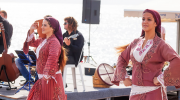
This coexistence prevents the dance from becoming ornamental. On stage, it is refined. In courtyards, it is forgiving. Each context feeds the other, ensuring the Syrtos stays practised rather than preserved, familiar rather than distant.
Why the Syrtos Still Matters
The Syrtos survives because it answers a social need. It allows people to participate without performance pressure. It creates belonging through repetition rather than explanation. It invites movement without demanding perfection.
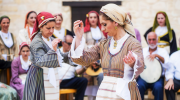
In a world increasingly oriented toward watching rather than joining, the Syrtos insists on involvement. You do not observe it from the edge for long. Someone takes your hand. The line opens. The rhythm carries you forward.
Around the circle you go, guided by steps learned not from instruction, but from proximity. On the same ground. At the same pace. Connected, for a while, by a movement that has held the island together for generations.