Explore Cyprus with Our Interactive Map

Explore our top stories and discover ideas worth your time.

Saint Barnabas Monastery

Saint Barnabas Monastery

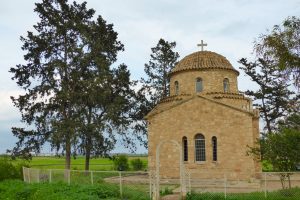
Near the ruins of ancient Salamis, a monastery complex marks the spot where one of Christianity's first apostles was buried in secret after being martyred for his faith. Saint Barnabas was a native of Cyprus who joined Paul on missionary journeys that brought Christianity to the island and converted its Roman governor. His discovery in a tomb 400 years after his death would change the course of Cypriot church history and establish the Orthodox Church of Cyprus as an independent institution. Barnabas holds a unique position in Christian history as the apostle who validated Paul's conversion and introduced him to the Christian community in Jerusalem. According to the Acts of the Apostles, Barnabas sold his property near Jerusalem and donated the proceeds to the early church, demonstrating his complete dedication to the new faith. He is considered the patron saint of Cyprus and is commemorated on June 11th in the Orthodox calendar. Historical Background According to Christian tradition, Barnabas traveled to Jerusalem to study law under Rabbi Gamaliel, the same teacher credited with instructing Paul. It is recorded in religious texts that while studying in Jerusalem, Barnabas witnessed the miracles performed by Jesus and became one of His followers. When Paul (then called Saul) returned to Jerusalem after what is described as a dramatic conversion on the road to Damascus,…

Read more
Panigyria Festivals and Village Traditions

Panigyria Festivals and Village Traditions

Village festivals in Cyprus, known as panigyria, are feast-day gatherings where worship, food, music, and shared space briefly restore villages to their fullest social life. Anchored to patron saints and seasonal rhythms, they pull families back from cities and the diaspora, turning squares and streets into places of blessing, hosting, and collective memory. This article explains how panigyria work from procession to shared tables, why each village’s celebration feels distinct, and how visitors can participate without disrupting the local rhythm. At a glance • What they are: village feast days tied to saints, seasons, or harvests• Where they thrive: rural and mountain villages across Cyprus• Best time: late spring through early autumn• What defines them: faith, food, music, shared space, and continuity• Why they matter: they keep village identity active, not symbolic A Festival Built on Return For most of the year, Cypriot villages move quietly. Families live apart, younger generations work in cities, and daily life stays contained behind closed doors. A festival changes that rhythm. A panigyri is a reason to return. People come back to their village not as visitors but as participants. Doors open. Food is prepared in quantities meant for sharing. The village square stops being a shortcut and becomes the centre again. What might look like a celebration from the outside is, at its…

Read more

Blue Flag Beaches of Cyprus

Blue Flag Beaches of Cyprus

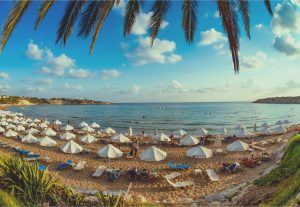
Cyprus earned 66 Blue Flags in 2025, with 64 beaches and 2 marinas recognized for exceptional quality and environmental standards. The Blue Flag certification represents one of the most prestigious international awards for beaches and marinas, granted by the Foundation for Environmental Education. Cyprus consistently ranks as having the cleanest bathing waters in Europe, achieving the highest scores in the Mediterranean year after year. The European Commission's 2024 report confirmed that Cyprus ranked first in the European Union for bathing water quality in both 2022 and 2023. This recognition stems from strict compliance with 33 coastal criteria and 38 marina specific standards covering water quality, environmental management, safety, and educational activities. The number of Blue Flags decreased slightly from 78 in 2024, with 16 flags revoked due to non compliance, demonstrating that certification requires continuous effort rather than one time achievement. What the Blue Flag actually means A Blue Flag beach must meet at least 30 stringent criteria across four categories: environmental education and information, water quality, environmental management, and safety and services. Water samples must be taken every two weeks rather than the monthly minimum required by European Union directives, with results posted on information boards at each beach to ensure transparency. The beach must contain no industrial or sewage waste influence and maintain low levels of escherichia coli…

Read more