Explore Cyprus with Our Interactive Map

Explore our top stories and discover ideas worth your time.

Stavrovouni Sacred Mountain Cyprus

Stavrovouni Sacred Mountain Cyprus

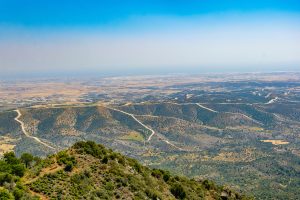
Rising 689 meters above the Mesaoria plain, Mount Stavrovouni has been a sacred site for over 2,000 years. The name derives from two Greek words: stavros (cross) and vouno (mountain), literally meaning "Mountain of the Cross." The monastery follows the strict ascetic rule of Saint Basil and maintains traditions similar to those of Mount Athos in Greece. The site is recognized as the earliest documented monastery in Cyprus. The oldest written reference appears in Byzantine records from the 4th century and confirms its establishment as a major religious center. A Russian monk named Abbot Daniel visited in 1106 and left detailed accounts of the monastery and its sacred artifacts in his travel memoirs. The monastery operates as a working religious community with approximately 20 monks dedicated to lifelong ascetic principles. Following Mount Athos traditions, the monastery prohibits women from entering its grounds, though female visitors can access the nearby chapel of Agia Varvara at the mountain's base. Historical Background Historical accounts and local traditions attribute the founding of the monastery to Helena, the mother of Emperor Constantine, in the early 4th century. While visiting the region, she is said to have identified various archaeological sites and artifacts associated with early Christian history, which led to the establishment of the mountain's first chapel. On her return to Constantinople, Helena’s ship encountered a…

Read more
The House of Aion Mosaics

The House of Aion Mosaics

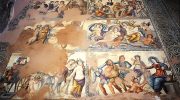
The House of Aion in Kato Paphos preserves a late Roman mosaic program designed to communicate ideas, not just decorate a room, using myth to argue for cosmic order, education, and limits on human ambition. Made in the 4th century AD during the empire’s rapid Christianisation, the floor reads as a coherent statement from a pagan elite defending continuity through refined symbolism rather than confrontation. This article explains where the building sits in ancient Paphos, how the five scenes build one argument, and what the mosaics reveal about power, belief, and artistic change in late antiquity. Paphos, Power, and Maloutena The House of Aion lies in the Maloutena district of ancient Nea Paphos, once the island's administrative and cultural centre under Roman rule. This was a prestigious neighbourhood, close to the seat of the Roman governor and surrounded by villas that reflected wealth, education, and political influence. Its location matters. The house was not hidden or marginal. It stood among the most powerful spaces in the city, signalling that the ideas expressed inside were meant to be seen, discussed, and shared by those at the top of provincial society. A Reception Room for Debate Although commonly called a “house,” the structure breaks with standard Roman domestic design. The main reception room, a large triclinium, sits directly near the entrance rather…

Read more

Kition Phoenician City

Kition Phoenician City

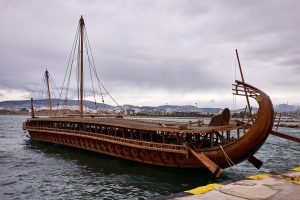
Kition was a city on the southeast coast of Cyprus, where modern Larnaca is today. It was founded in the late 13th century BC during the Late Bronze Age and remained inhabited until the Ptolemaic period. The city had many names: Kittim in the Bible, Kitiya in Phoenician, and Citium in Latin. Kition was an important port, connecting Cyprus with the Aegean, the Levant, and Egypt. The city spread over a large area under modern Larnaca, but only some parts have been dug up. The main archaeological areas are Kathari (Area II), about 500 meters north of Bamboula hill, and Bamboula, about 50 meters north of the Larnaca Archaeological Museum. Excavations here have uncovered temples, city walls, houses, and a 5th-century BC naval harbor with sheds for triremes (ancient warships). Kition’s importance was so well-known in ancient times that in Hebrew, Kittim came to mean all western peoples. The modern name Larnaca comes from the Greek word larnax, meaning sarcophagus, because many ancient tombs were found in the area. Historical Background Around 1300 BC, Mycenaean Greeks founded Kition to take advantage of local copper deposits during the Late Cypro II period. The early city had mudbrick walls for protection and typical Late Bronze Age buildings. Around 1200 BC, a wave of destruction swept through many cities at the end of…

Read more