Explore Cyprus with Our Interactive Map

Explore our top stories and discover ideas worth your time.

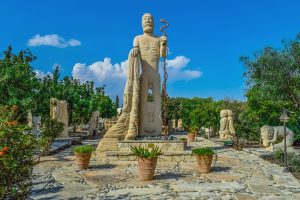
The Cypriot Limestone Kouros

The Cypriot Limestone Kouros

Cypriot limestone “kouroi” are Archaic-era standing male statues that look Greek at first glance but functioned differently, serving mainly as clothed votive figures placed in sanctuaries as lasting representations of worshippers and elite donors. Cyprus’s lack of marble pushed sculptors toward soft local limestone, shaping a calmer, more geometric style that was originally strengthened by bright paint rather than fine anatomy. This article explains how material, ritual purpose, and cross-Mediterranean influence combined to produce a distinctly Cypriot human figure tradition. Kouros in Name Only The word kouros comes from Greek and refers to youthful male statues that became widespread in the Aegean world during the Archaic period. Greek kouroi are usually nude, carved in marble, and designed to embody physical perfection and idealised youth. Cyprus adopted the broad idea of the standing male figure, but transformed it completely. Cypriot limestone figures are almost always clothed. They wear kilts, tunics, cloaks, or ceremonial garments influenced by Egyptian, Near Eastern, and East Greek styles. Rather than celebrating athletic bodies, these statues emphasise presence and status. They represent worshippers, priests, or elite donors, figures defined by their role within religious and civic life rather than by physical ideals. The stone that shaped the style One reason Cypriot sculpture looks the way it does lies beneath the ground. Cyprus has no natural marble sources.…

Read more

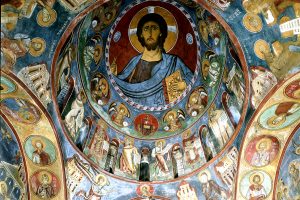
Painted Churches In the Troodos Region

Painted Churches In the Troodos Region

Ten small Byzantine churches scattered across the Troodos Mountains hold some of the finest medieval religious paintings in the Eastern Mediterranean. These UNESCO World Heritage sites preserve 500 years of artistic tradition in their vibrant frescoes. Nine of the ten churches stand in the Nicosia District, while one church, Timios Stavros in Pelendri, is located in the Limassol District. These structures date from the 11th to the 16th centuries and display Byzantine metropolitan art of the highest quality alongside unique local characteristics. The churches range from small rural chapels to larger monastery complexes like Agios Ioannis Lampadistis. Their simple exterior architecture contrasts sharply with the sophisticated paintings inside. This striking difference makes them easy to overlook from the outside, but stepping through their doors reveals walls completely covered in colorful religious scenes. Historical Background Cyprus became part of the Byzantine Empire in 965 AD when Emperor Nicephoros Phokas sent a fleet to repel Arab raids. For the next two centuries, Byzantine officials administered the island as a military province. Muslims either left or converted to Christianity, and a period of peace began. Despite high taxes, the island's silk and food trades prospered, and major cities like Kyrenia, Famagusta, Nicosia, and Limassol were founded or expanded. During this stable period, wealthy donors began endowing churches in the Troodos mountains. The region's…

Read more
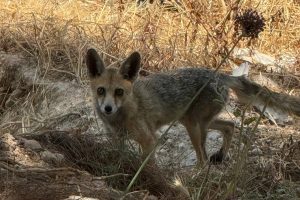
Cyprus Red Fox

Cyprus Red Fox

There is an animal on Cyprus that has been blamed for stolen chickens, celebrated in folktales, painted as the ultimate villain of the farmyard and yet, science tells us a very different story. The Cyprus fox, a unique island subspecies found nowhere else on Earth, is one of the most misunderstood creatures in the Eastern Mediterranean. Once you learn the truth about it, you may never look at a pair of amber eyes at dusk in quite the same way again. From the Family of Clever Ones The Cyprus fox belongs to the family Canidae the great clan that includes wolves, jackals, wild dogs, and domestic dogs. Within this family sits the genus Vulpes, the "true foxes," a group of about twelve species spread across the globe, from the tiny big-eared fennec fox of the Sahara to the ghost-white Arctic fox of the frozen north. Our island's fox is a member of Vulpes vulpes the red fox which is arguably the most successful and widespread wild carnivore on the planet, ranging from the Arctic Circle all the way down to North Africa, across Eurasia, and into North America. But the fox living in Cyprus is not simply a red fox that wandered over. It is a distinct island subspecies, formally described in 1907 by the American naturalist Gerrit Smith Miller,…

Read more