Explore Cyprus with Our Interactive Map

Explore our top stories and discover ideas worth your time.

Tourism-Driven Mobility Patterns Across Cyprus

Tourism-Driven Mobility Patterns Across Cyprus

Cyprus welcomed over 4 million tourists in 2024, marking a 5.1% increase from the previous year. This surge in visitors creates distinct movement patterns across the island, from concentrated coastal resort areas to scattered mountain villages. The way tourists navigate Cyprus differs dramatically from how residents travel, shaped by seasonal preferences, transportation choices, and destination priorities. Tourist arrivals cluster heavily in specific zones rather than spreading evenly across Cyprus. Paphos dominates visitor accommodation with 31.5% of tourists choosing to stay there, followed by Ayia Napa at 15.9%, Larnaca at 14.2%, Limassol at 12.4%, and Paralimni at 11.4%. This concentration reflects both infrastructure development and marketing efforts directed at international markets. The United Kingdom supplies 34% of all tourist arrivals, maintaining its position as Cyprus's primary source market. Israel follows with 10.5%, Poland contributes 8.3%, Germany adds 5.7%, Greece accounts for 4.5%, and Sweden provides 3.7%. Each nationality displays different movement preferences once on the island. British tourists tend toward longer stays in established resort areas, while Israeli visitors often favor shorter, more intensive trips. Travel purpose data reveals that 81.1% of tourists visit for leisure, 11.9% come to see friends and relatives, and 6.9% arrive for business. These different motivations create varied mobility patterns. Leisure tourists typically remain in coastal zones with occasional day trips, while those visiting friends and…

Read more

Avakas Gorge Cave

Avakas Gorge Cave

Avakas Gorge is a 3-kilometer-long limestone canyon located in the Akamas Peninsula, 16 kilometers west of Paphos. The gorge was created by the Avgas River, a seasonal stream that flows only in winter and spring. Over countless thousands of years, this modest river carved through layered limestone and created walls that reach 30 meters high in some sections. The gorge is part of the Natura 2000 protected area network and attracts roughly 100,000 visitors per year according to forestry authorities. What makes it special isn't just the height of the walls but how narrow the passage becomes. In places, the gorge squeezes down to only 4 meters wide with cliffs towering on both sides and a strip of sky visible overhead. This creates dramatic light effects as sun filters down through the gap. Historical Background The rock that forms Avakas Gorge is limestone from the Mamonia Complex and was deposited in warm seas during the Mesozoic era millions of years ago. This limestone contains layers of reef formations, shell fragments, and marine sediments that hardened into stone. When Cyprus rose from the ocean and these rocks emerged on land, they became vulnerable to erosion. Limestone is soft enough that water can dissolve it chemically and carve it physically. During the Pleistocene era, roughly 2 million to 12,000 years ago, the…

Read more
Temple of Astarte-Aphrodite at Tamassos

Temple of Astarte-Aphrodite at Tamassos

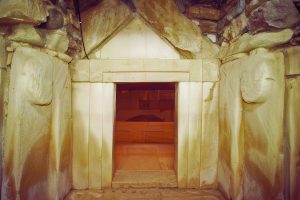
The Temple of Astarte-Aphrodite at Tamassos was a sacred site where different religious traditions met and blended. It reflects the merging of the Phoenician goddess Astarte with the Cypriot form of Aphrodite, showing how Cyprus functioned as a crossroads of belief in the ancient Mediterranean. The sanctuary reveals how cultures interacted not only through trade and politics, but also through shared and evolving religious ideas. A Sanctuary in the Heart of Cyprus Tamassos lay inland, near rich copper resources and important trade routes. Though far from the coast, it was deeply connected to the wider Mediterranean world. The presence of a sanctuary dedicated to Astarte-Aphrodite reflects these connections and the movement of people, goods, and beliefs across the island. The temple served the local population while also reflecting foreign influence, making it a powerful symbol of Cyprus’s layered cultural identity. Two Goddesses, One Sacred Presence Astarte was a major Phoenician goddess associated with fertility, love, war, and royal power. Aphrodite, though later known as the Greek goddess of love, had deep roots in earlier Cypriot and Near Eastern traditions. At Tamassos, these two divine figures were not seen as separate, but as different expressions of the same sacred force. This blending, known as religious syncretism, allowed worshippers from different backgrounds to recognise their own beliefs within a shared cult. Rather…

Read more