Explore Cyprus with Our Interactive Map

Explore our top stories and discover ideas worth your time.

Cyprus Island Identity as a Cultural Crossroads

Cyprus Island Identity as a Cultural Crossroads

Cyprus stands at a cultural, linguistic, and historic crossroads between Europe and Asia. Situated at the crossroads of Europe, Asia, and Africa, the island has been shaped by Greeks, Romans, Byzantines, Venetians, Ottomans, and the British. This strategic location has resulted in Cyprus being contested and occupied by several empires throughout history, including the Assyrians, Egyptians, Persians, and many others. As early as 370 BC, the island was inhabited and considered to be the crossroads between the east and west. The eastern Mediterranean island of Cyprus has long been a cultural thoroughfare. It was the starting, stopping, and midway hot spot for many ancient seafaring cultures including the Myceneans, the Minoans, the Phoenicians, the Greeks, and the Romans. The Bronze Age Trading Hub Cyprus experienced significant social and economic transformations during the Late Bronze Age, roughly from 1700 to 1100 BC. The island became more connected to the wider Mediterranean world driven by the trade in copper extracted from the Troodos Mountains, which stimulated the development of urbanized settlements across the island. At this time Cyprus was ruled by kings who corresponded with the leaders of other Mediterranean states like the pharaohs of the New Kingdom of Egypt, as documented in the Amarna letters. The first recorded name of a Cypriot king is Kushmeshusha, as appears on letters sent to…

Read more

Vouni Necropolis

Vouni Necropolis

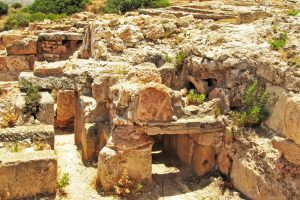
On gentle slopes near the medieval abbey of Bellapais in the Turkish-occupied part of Cyprus sits an extensive Bronze Age cemetery known to the world almost exclusively through its dead. The Vounous necropolis contains 164 rock-cut chamber tombs that served an unknown settlement for nearly five centuries, from approximately 2500 to 2000 BCE, preserving one of the finest collections of prehistoric pottery ever discovered on the island. Vounous presents archaeologists with an unusual challenge. Despite extensive searches that began in the 1930s and continue sporadically today, the settlement that used this cemetery has never been located. The site sits somewhere between the villages of Ozanköy and Çatalköy in the Kyrenia region, but the homes, workshops, and temples of the people buried here remain hidden beneath modern development or agricultural land. Historical Background The tombs at Vounous date to the Early and Middle Bronze Age, a period when Cyprus underwent major transformation. Around 2500 BCE, settlers from Anatolia arrived on the island, bringing new pottery styles, copper-working technology, plow agriculture, and the warp-weighted loom. These immigrants, identified as the Philia Culture, moved quickly to the foothills of the Troodos Mountains to exploit the rich copper deposits. The people who used Vounous cemetery were part of this cultural shift. Their pottery shows clear Anatolian influence, particularly the distinctive Red Polished ware that…

Read more
Cyprus Clay Pots Ceramics

Cyprus Clay Pots Ceramics

Cyprus has been shaping clay into beautiful vessels for over 7,000 years. The pottery tradition on this Mediterranean island represents one of the longest continuous craft practices in human history. From ancient times to modern workshops, Cypriot ceramics tell a story of skilled hands, local materials, and cultural exchange. The distinctive red clay pots, elegant jugs, and decorative vessels created here have become symbols of the island's creative spirit and its role as a crossroads between civilizations. Historical Context The ceramic story in Cyprus begins during the Neolithic period around 4400 BCE, when early settlers started working with the island's abundant clay deposits. These first potters created simple vessels with red and white decorations that were surprisingly uniform across the island. Unlike mainland pottery of the same era which showed regional variations, Cypriot ceramics developed a consistent style that hinted at shared cultural practices. The real transformation came during the Bronze Age, starting around 2600 BCE. Cyprus sat at a strategic location between Egypt, the Hittite empire, and Mycenaean Greece, which turned the island into a vital trading hub. Cypriot potters continued to handcraft their vessels even after the pottery wheel had been invented elsewhere. This traditional approach lasted until about 1500 BCE and produced ceramics of such high quality that they became sought-after commodities throughout the Mediterranean. Red Polished…

Read more