Explore Cyprus with Our Interactive Map

Explore our top stories and discover ideas worth your time.

Cave of the 40 Martyrs Troodos

Cave of the 40 Martyrs Troodos

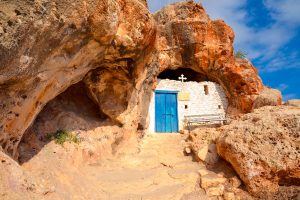
Hidden in the hills near Protaras, the Cave of the 40 Martyrs is a small chapel carved into limestone rock. This place brings together ancient faith, natural geology, and centuries of devotion in one simple, quiet space. The cave church, known locally as Ayioi Saranta, sits in a natural limestone formation on Fanou Hill. The name translates to the Forty Saints, a direct reference to the 40 Martyrs of Sebaste. This is not a grand cathedral with ornate decoration. It is a cave with a white wall, a blue door, and a stone dome above. Inside, rough rock walls hold a few icons and candles. The floor was paved, but otherwise the cave remains much as nature formed it. The Story of the 40 Martyrs The dedication of this cave connects to events that happened over 1,700 years ago. In 320 AD, forty Roman soldiers from the Legio XII Fulminata refused to abandon Christianity during the persecution under Emperor Licinius I. They were stationed near Sebaste in what is now Turkey. Their punishment was brutal. According to Bishop Basil of Caesarea, who documented the story in the 4th century, the soldiers were stripped naked and left to freeze on a frozen lake during a winter night. One soldier gave in to the cold and ran to the warm baths on…

Read more
Khirokitia Figurines: Stone Ancestors at Home

Khirokitia Figurines: Stone Ancestors at Home

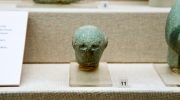
The stone figurines of Khirokitia are among Cyprus’s earliest human representations, carved over 9,000 years ago within one of the island’s first permanent farming settlements. Found in domestic and burial contexts, they were not decoration but durable objects that helped households maintain identity, lineage, and a living relationship with ancestors buried beneath the home. This article explains why the figures are intentionally abstract, why hard stone was chosen despite the labour, and what their placement reveals about memory and belonging at the dawn of settled life in Cyprus. Khirokitia Above the Maroni River The Neolithic settlement of Khirokitia lies on a steep hillside above the Maroni River in southern Cyprus. Occupied during the Aceramic Neolithic period, it represents the island’s first permanent agricultural society. Life here was organised around circular stone houses, shared courtyards, and a tightly knit social structure built on extended families. In this context, figurines were not decorative objects or isolated artworks. They were part of daily life, ritual practice, and memory. Their meaning comes not from how they look alone, but from where they were found and how they were used. Small Figures, Heavy Meaning More than two dozen anthropomorphic figurines have been recovered from Khirokitia, an unusually high number for a Neolithic site. Most are small, abstract, and deliberately simplified. Bodies are reduced to essential…

Read more

Greek Independence Day Cyprus

Greek Independence Day Cyprus

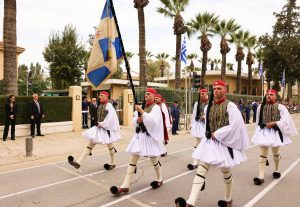
March 25 stands as a major public holiday in Cyprus, commemorating Greek Independence Day alongside the religious Feast of the Annunciation. The day celebrates the beginning of the Greek War of Independence in 1821 when Greeks rose against nearly 400 years of Ottoman rule. For Cyprus, this holiday holds special significance beyond historical solidarity, representing the deep cultural, linguistic, and religious bonds between Greek Cypriots and mainland Greece. The celebration is particularly important for Greek Cypriots, who see parallels between Greece's struggle for freedom and their own fight for independence from British rule that succeeded in 1960. The Historical Background of the Revolution Greece had been under Ottoman control since the mid-15th century when Constantinople fell in 1453. For nearly four centuries, Greeks maintained their cultural identity through language, Orthodox Christianity, and collective memory of their ancient heritage. The revolution was officially declared by Bishop Germanos of Patras on March 25, 1821, at the Agia Lavra Monastery near Kalavryta. The date was specifically chosen to coincide with the Feast of the Annunciation, blending the struggle for political freedom with religious significance. The revolutionary slogan "Eleftheria i Thanatos," meaning "Freedom or Death," became the rallying cry. This powerful phrase represented the determination of Greeks who pledged they would rather die than continue living under subjugation. The banner of revolution became the…

Read more