Explore Cyprus with Our Interactive Map

Explore our top stories and discover ideas worth your time.

St. Hilarion Castle

St. Hilarion Castle

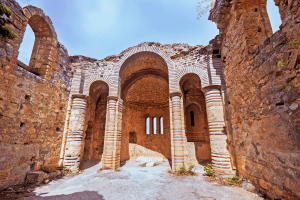
St. Hilarion Castle stands 732 meters above sea level in the Kyrenia mountain range of Cyprus. This medieval fortress features stone walls and towers that appear to grow directly from the rocky peaks. Located just off the main Kyrenia to Nicosia highway, the castle commands the mountain pass between the coast and the central plain. atlasobscura-com The castle is the best preserved of three Byzantine strongholds built along the Kyrenia mountain range, the others being Kantara to the east and Buffavento further west. The fortress consists of three main sections built at different elevations on the mountainside. The lower ward contained stables and living quarters for soldiers. The middle ward housed royal apartments, kitchens, a church, and a large cistern for water storage. The upper ward, surrounded by 1.4-meter-thick Byzantine walls made of rough masonry, served as the royal residence and includes Prince John's Tower perched on a rocky cliff. Historical Background The castle takes its name from an obscure Christian hermit who fled to Cyprus after the Arab conquest of the Holy Land in the 7th century. This saint, known for living in a cave on the mountain, is not the same as the more famous St. Hilarion, who was active in Palestine and died near Paphos in 371 AD. Local tradition holds that the hermit spent his final…

Read more
Cyprus Village Square Programs

Cyprus Village Square Programs

In Cyprus, summer does not fully arrive until the village square comes alive. As daylight softens and the heat loosens its grip on stone, quiet plateias begin to change character. Chairs appear as if by instinct. A few strings of lights are lifted overhead. Someone tests a violin line that hangs in the warm air for a second, then returns, clearer the next time. Little by little, the square becomes what it has been for centuries: a place where people gather not because they were told to, but because the evening feels incomplete without it. These village cultural programs are not staged spectacles designed for crowds. They are communal summer evenings shaped by habit, hospitality, and rhythm, where locals and visitors briefly share the same space, the same food, and the same dance floor. If you want to understand Cyprus beyond beaches and brochures, you do it here, in the square, when the night is still young, and the music has just begun. The Square as the Heart of Village Life For centuries, the village square has been the social centre of rural Cypriot life. Churches, coffee shops, and stone houses face inward, forming a natural stage where daily routines and special occasions intersect. Even in the quietest months, the square holds a kind of readiness. It is where greetings…

Read more

Traditional Percussion and Rhythm of Cyprus

Traditional Percussion and Rhythm of Cyprus

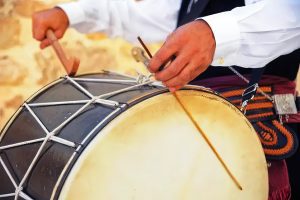
Traditional percussion in Cyprus is not decoration. It is structured. Long before written music or formal performance spaces, rhythm organised ritual, movement, and social life on the island. From village squares to wedding processions, the drum provided a shared pulse that told people when to gather, how to move, and when a moment mattered. Cypriot percussion did not evolve to impress an audience. It evolved to hold a community together. teriremproject-org Why Rhythm Comes First in Cypriot Music Cyprus sits at a cultural crossroads between the Eastern Mediterranean, Anatolia, and the Levant. Melodies travelled easily across these regions, but rhythm was what anchored them locally. Percussion gave Cypriot music its internal order, allowing dances, songs, and rituals to remain recognisable even as influences shifted over centuries. Unlike modern ensembles where rhythm supports melody, traditional Cypriot music often works the other way around. The drum sets the framework. Everything else responds. The Daouli: A Drum Built for the Open Air The most recognisable percussion instrument in Cyprus is the daouli, a large double-headed drum designed to be heard across open spaces. Its size and volume were practical. Village celebrations, processions, and agricultural festivals needed sound that could travel without amplification. The daouli is worn over the shoulder and played with two different sticks. One produces deep, grounding beats. The other delivers…

Read more