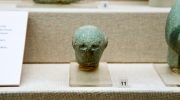
Khirokitia Figurines: Stone Ancestors at Home
The stone figurines of Khirokitia are among Cyprus’s earliest human representations, carved over 9,000 years ago within one of the island’s first permanent farming settlements. Found in domestic and burial contexts, they were not decoration but durable objects that helped households maintain identity, lineage, and a living relationship with ancestors buried beneath the home. This article explains why the figures are intentionally abstract, why hard stone was chosen despite the labour, and what their placement reveals about memory and belonging at the dawn of settled life in Cyprus. Khirokitia Above the Maroni River The Neolithic settlement of Khirokitia lies on a steep hillside above the Maroni River in southern Cyprus. Occupied during the Aceramic Neolithic period, it represents the island’s first permanent agricultural society. Life here was organised around circular stone houses, shared courtyards, and a tightly knit social structure built on extended families. dtcox-com In this context, figurines were not decorative objects or isolated artworks. They were part of daily life, ritual practice, and memory. Their meaning comes not from how they look alone, but from where they were found and how they were used. Small Figures, Heavy Meaning More than two dozen anthropomorphic figurines have been recovered from Khirokitia, an unusually high number for a Neolithic site. Most are small, abstract, and deliberately simplified. Bodies are reduced to…
Read more