Explore Cyprus with Our Interactive Map

Explore our top stories and discover ideas worth your time.

Cyprus Water Scarcity Desalination

Cyprus Water Scarcity Desalination

Cyprus faces one of Europe's most severe water scarcity challenges, with dam levels hovering around 12 percent of capacity as of early 2026. The island's 108 dams and reservoirs, built since the 1980s to capture winter rainfall, now hold just 35 million cubic meters compared to 75 million at the same time in 2025. -kibrisgenctv-com Climate change has accelerated drought cycles from once every 20 years to nearly every two years since 2007. The 2024-2025 hydrological year ranked among the driest since 1878, with only 312.5 millimeters of total rainfall. January 2025 recorded the lowest monthly rainfall in almost three decades. This crisis has forced Cyprus to become heavily dependent on desalination, which now supplies approximately 70 percent of the island's drinking water. The government has committed 196 million euros for water measures in 2026 alone, including 140 million euros specifically for purchasing desalinated water. The Shift From Dams to Desalination Technology Cyprus introduced large-scale desalination in 1997 with a 20,000 cubic meter per day reverse osmosis plant at Dhekelia. The facility was soon expanded to 40,000 cubic meters daily due to prevailing drought conditions. This marked a fundamental shift in Cyprus's water strategy. Prior to 1997, the island relied almost entirely on dam storage and groundwater extraction through boreholes. In 1991, Cyprus exploited 36.3 million cubic meters of water,…

Read more
Cape Greco Sea Cliffs And Caves

Cape Greco Sea Cliffs And Caves

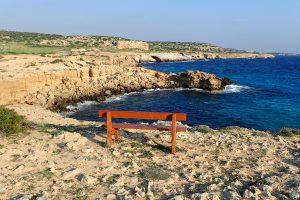
Cape Greco rises from the Mediterranean Sea at Cyprus's southeastern tip, where limestone cliffs drop sharply into turquoise waters, and erosion has carved spectacular sea caves that extend up to 80 metres into solid rock. terrabook-com Cape Greco, also known as Capo Greco or Kavo Greko, forms a rocky peninsula jutting into the Mediterranean between the resort towns of Ayia Napa and Protaras. The headland marks the easternmost point of both the Republic of Cyprus and the European Union, excluding outlying territories. gateresearch-com The area covers 385 hectares protected as National Forest Park under the Cyprus Forestry Department since 1993, with additional recognition as part of the Natura 2000 network for its European ecological significance. Historical Background The limestone cliffs at Cape Greco formed from sediments deposited when shallow seas covered the region millions of years ago. Marine organisms including mollusks, corals, and microscopic creatures contributed calcium carbonate that accumulated on the seabed and eventually compressed into rock layers. Tectonic activity lifted these sediments above sea level, creating the elevated plateau that characterizes the cape today. Wave erosion shaped the detailed features that make Cape Greco distinctive. Constant pounding by Mediterranean storms exploits weaknesses in the limestone, gradually hollowing out caves, cutting through narrow points to form arches, and creating vertical channels where waves compress and release with explosive force.…

Read more
Ancient Kourion in Cyprus

Ancient Kourion in Cyprus

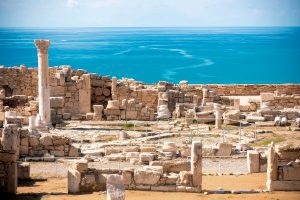
Ancient Kourion sits on a limestone cliff nearly 100 meters high along the southwestern coast of Cyprus, overlooking Episkopi Bay. The site was first inhabited during Neolithic times, with the earliest evidence dating back to 4,500 to 3,900 BC, but the town itself was founded in the 13th century BC by the Argives. orangecyprushome.com The city-kingdom was built on the hills of the area and overlooked and controlled the fertile valley of the river Kouris. Archaeological finds suggest that Kourion was associated with the Greek legend of Argos of Peloponnese, and its inhabitants believed they were descendants of Argean immigrants. The site stands as one of Cyprus's most impressive archaeological areas, preserving remains that span from the Bronze Age through the Byzantine period. The ruins tell stories of prosperity, political intrigue, natural disaster, and religious transformation. Historical Background According to Herodotus, Kourion was founded by Argives in the Late Bronze Age and was named for Koureus, the son of Cinyras, the first king of Cyprus. The Assyrian kings Sargon II and Esarhaddon mentioned Damasu, king of Kuri, in their records. During the Cypriot uprising against Persia in the 5th century BC, its king Stasanor betrayed his country, lending his support and troops to the Persians. However, Kourion later supported Alexander the Great's fight against the Persians in the 4th century…

Read more