Explore Cyprus with Our Interactive Map

Explore our top stories and discover ideas worth your time.

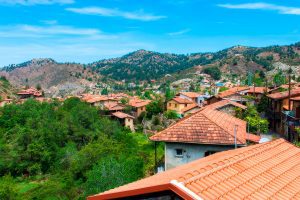
Kakopetria Gorge Cyprus

Kakopetria Gorge Cyprus

Kakopetria Gorge forms around the meeting point of two permanent mountain streams in the Troodos range. The Karkotis and Garillis rivers converge in this valley at 667 meters elevation, creating the Klarios River that flows 24.75 kilometers to Morphou Bay. The gorge sits in the heart of the Solea Valley, 55 kilometers from both Nicosia and Limassol, surrounded by dense pine forests and traditional stone villages that have preserved their character for centuries. chooseyourcyprus.com The gorge takes form along the banks of two rivers that maintain year-round flow, unusual for Cyprus where most streams run dry during summer. The Karkotis originates from the northwestern slopes of Papoutsa peak, while the Garillis flows from the northeastern slopes of Mount Troodos. Hundreds of springs feed both rivers as they descend through the mountains before joining at Kakopetria village. The continuous water flow created the Solea Valley, one of Cyprus's most fertile mountain regions. Artificial canals branch from the rivers, directing water to surrounding villages for irrigation and domestic use. The reliable water supply supports extensive fruit orchards, vegetable gardens, and vineyards that thrive in conditions rare elsewhere on the island. The area forms part of the Natura 2000 network of protected sites, designated code CY2000012 under European conservation directives. The designation recognizes the valley's importance for diverse natural habitats and agricultural landscapes…

Read more
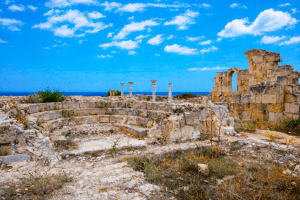
Kampanopetra Basilica

Kampanopetra Basilica

The Basilica of Kampanopetra is a large Early Christian church complex located at the archaeological site of ancient Salamis, near modern Famagusta in the Turkish-occupied part of Cyprus. Built during the late 5th or early 6th century CE, the basilica served the city of Constantia, the name given to Salamis after it was rebuilt following devastating earthquakes in 332 and 342 CE. The complex consists of four major sections arranged in a linear sequence. From west to east, these include a large western courtyard, a second western atrium connected to a narthex (entrance hall), the main three-aisled basilica, and an eastern atrium. The entire structure measures approximately 152 meters in length and reaches nearly 38 meters at its widest point. This makes it one of the largest Early Christian basilicas in Cyprus. The name "Kampanopetra" has been interpreted in different ways. Some sources translate it as "stone by the monks' cells," while others suggest it means "stone bell." The name likely refers to features or traditions associated with the site during medieval times when a small monastic community continued to use portions of the ruined basilica. Historical Background Salamis was one of Cyprus's most important cities throughout antiquity. According to legend, it was founded around the 11th century BCE by Teucer, a hero from the Trojan War who was exiled…

Read more
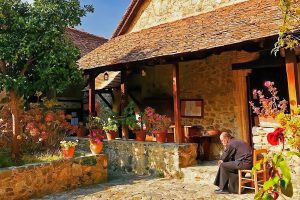
Monastery of Saint John Lampadistis

Monastery of Saint John Lampadistis

The Monastery of Saint John Lampadistis, located in the Marathasa Valley of the Troodos Mountains near the village of Kalopanayiotis, is one of the most distinctive monuments within the UNESCO World Heritage group known as the Painted Churches of the Troodos Region. Its importance lies not only in its remarkable frescoes but also in its unusual architectural composition. Unlike single-phase churches, this monastic complex combines three interconnected churches built in different periods, all enclosed beneath a later protective roof. This layered structure makes the monastery a rare example of architectural continuity, reflecting the gradual development of religious space in response to changing spiritual, artistic, and community needs. tui-co-uk The monastery is dedicated to Saint John Lampadistis, a local Cypriot saint whose life is associated with piety, endurance, and miraculous healing. According to tradition, he lived in the region during the Byzantine period and became a figure of popular devotion after his death. His tomb within the complex transformed the monastery into a pilgrimage center, attracting worshippers seeking spiritual assistance. The religious importance of the site ensured its continued maintenance and expansion over centuries, leading to the creation of a complex that embodies both local religious tradition and broader Byzantine artistic influence. Architectural Composition and Structural Evolution The most remarkable feature of the Monastery of Saint John Lampadistis is the combination…

Read more