Explore Cyprus with Our Interactive Map

Explore our top stories and discover ideas worth your time.

Sanctuary of Opaon Melanthios

Sanctuary of Opaon Melanthios

A rural shrine dedicated to a local healing deity (Melanthios), illustrating the existence of indigenous Cypriot gods worshipped alongside the Greek pantheon. google-com The Sanctuary of Opaon Melanthios stands as a profound example of Cyprus's religious syncretism, where an indigenous deity associated with shepherds and rural healing was venerated in harmony with Greek gods like Pan and Apollo. Situated on the 'Petros Anthropos' hill north of Amargeti in the Paphos district, this rural shrine highlights the island's unique spiritual landscape, blending local Cypriot traditions with Hellenistic influences. As a healing deity, Opaon Melanthios, whose name translates to "Dark Shepherd", was invoked for protection over flocks, health, and fertility, reflecting the agrarian society's reliance on divine intervention for well-being and prosperity. This site underscores Cyprus's role as a cultural crossroads, where native gods coexisted with imported pantheons, fostering a resilient worship that endured from the Archaic period through Roman times, and continues to intrigue archaeologists today. A Rural Shrine of Syncretism The Sanctuary of Opaon Melanthios, perched on a modest hill overlooking the verdant valleys of Amargeti, embodies the quiet devotion of Cyprus's rural communities to a deity who bridged local folklore and Greek mythology. Chatgpt-reconstruction Covering a small area of rocky terrain dotted with ancient olive trees, the site features remnants of a temple structure, altars, and votive deposits that…

Read more
Ancient Amathus, Cyprus

Ancient Amathus, Cyprus

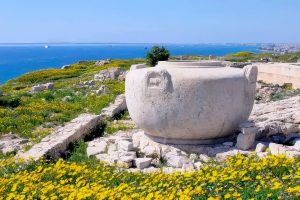
Amathus is one of the oldest royal cities on the island of Cyprus. Situated on the southern coast, just 11 kilometers east of modern Limassol, it sits among sandy hills and coastal cliffs overlooking the Mediterranean Sea. googleusercontent.com The city dates back to around 1100 BC, making it over three thousand years old. For centuries, it was one of the most powerful and wealthy kingdoms on the island. Today, its ruins tell a story of trade, religion, myth, and survival that stretches across dozens of generations. Historical Background The first people to settle in Amathus were the Eteocypriots, an indigenous group who lived on Cyprus before both the Greeks and the Phoenicians arrived. They chose a rocky coastal hill for a reason: it offered a natural harbor below and a defensible position above. The earliest signs of human presence at the site date to around 1100 BC, which places its founding right at the start of the Iron Age in the Eastern Mediterranean. The name itself likely comes from the Greek word "amathos," which simply means "sand," a fitting reference to the dunes and sandy hills surrounding the city. Legend, however, tells a different story. According to myth, the city was founded by a king called Cinyras, who named it after his mother, Amathous. Other myths connect the place to…

Read more
Religious Life in Cyprus

Religious Life in Cyprus

Religious life in Cyprus centers on Orthodox Christianity, which defines cultural identity for approximately 90 percent of Greek Cypriots even among those who rarely attend services. The Church of Cyprus holds autocephalous status, meaning it governs itself independently while remaining in communion with other Orthodox churches worldwide. This independence, granted at the Council of Ephesus in 431 AD, has survived centuries of foreign occupation including Frankish Crusaders, Venetian merchants, Ottoman Turks, and British colonizers. The church functioned not just as religious institution but as guardian of Greek language, culture, and national identity during periods when political sovereignty was impossible. pursuingveritas-com Orthodox practice structures daily life through home iconostases with burning oil lamps, morning and evening prayers, feast day celebrations, and approximately 180 annual fasting days. The liturgical calendar organizes social activities, agricultural work, and family gatherings around major celebrations including Easter, the Dormition of the Virgin Mary on August 15, and hundreds of local patron saint festivals called panigyria. Ancient Christian Foundations on the Island Christianity reached Cyprus in 45 AD when the Apostle Paul traveled with Barnabas, a native Cypriot, and Mark the Evangelist from Syrian Antioch. They arrived first at Salamis on the eastern coast before crossing westward to Paphos, where they converted Sergius Paulus, the Roman proconsul governing Cyprus. This conversion made Cyprus the first territory in…

Read more