Traditional Cypriot clothing is not just about what people wore. It is about how they lived, what they valued, and how they understood their place in the world. Across villages, towns, and generations, dress functioned as a visible language, communicating age, status, profession, and regional identity without a single word being spoken.
This article explores how Cypriot attire developed over time, what made it distinct, and why these garments still matter today, not as costumes, but as cultural memory woven into fabric.
- An island shaped by layers, stitched into cloth
- Materials that came from the land itself
- Colour, dye, and meaning
- The male silhouette: strength, status, and movement
- Women’s dress as social storytelling
- Embroidery as a record of place
- Regional variation, not uniform tradition
- Clothing in movement: festivals and dance
- From everyday wear to a cultural symbol
- Preservation without freezing the past
- Why traditional attire still matters
An island shaped by layers, stitched into cloth
Cyprus has always stood at the crossroads of civilisations, and its clothing reflects this layered history. Byzantine restraint, Venetian refinement, Ottoman opulence, and later European influence all left their marks on the way Cypriots dressed. Rather than replacing one another, these influences accumulated.
Early garments emphasised structure and modesty, shaped by Orthodox tradition and practical rural life. Later, luxury fabrics, embroidery, and layered silhouettes entered daily wear, especially in towns. Clothing became a way to absorb change while maintaining continuity, adapting foreign elements into something recognisably Cypriot.
Materials that came from the land itself
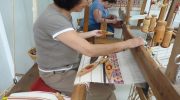
Traditional attire grew directly out of the island’s environment. Cotton, silk, linen, and wool were not imported ideas but local resources, cultivated, spun, dyed, and woven in villages across the island. Almost every household participated in textile production, especially women preparing dowries.

Weaving was not a side activity. It was a central domestic skill. Looms stood in courtyards and rooms, producing fabrics for everyday work and ceremonial occasions alike. Certain regions became known for specific materials, such as silk from Paphos or durable cotton cloth from the Mesaoria plain. Clothing carried the geography of its origin in its texture and colour.
Colour, dye, and meaning
Colour in Cypriot dress was never decorative by chance. Reds symbolised vitality, fertility, and celebration. Dark blues and blacks signalled practicality, maturity, or mourning. Rare shades, such as deep purples, carried associations of wealth and prestige.

Dyeing was a skilled profession, using plants, roots, and minerals to achieve lasting colour. Some garments underwent long, labour-intensive processes to deepen tones and soften fabric, especially men’s trousers. These methods ensured clothing could endure hard use while still carrying symbolic weight.
The male silhouette: strength, status, and movement
The most iconic element of traditional male attire is the vraka, wide pleated trousers gathered at the waist. Their exaggerated volume was not accidental. The amount of fabric used signalled wealth and social standing, while the cut allowed freedom of movement for work, travel, and dance.

Men layered shirts, vests, and sashes over the vraka, creating a structured but flexible silhouette. Sashes served both decorative and practical purposes, offering back support and a place to carry tools. Headwear and footwear varied by region, climate, and profession, completing an outfit that balanced function with visible identity.
Women’s dress as social storytelling
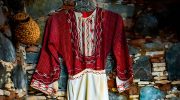
Women’s traditional clothing carried a meaning that extended well beyond appearance. Layered garments conveyed information about age, marital status, and community belonging, often at a glance. The sayia, a long outer garment worn over an underdress and loose trousers, remained central to rural life for generations, valued for both modesty and durability.
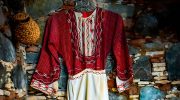
Details mattered. The quality of fabric, the density of embroidery, and the way garments were fastened or layered communicated family standing and personal circumstance. In towns, particularly from the 19th century onward, women began adopting more fitted jackets and European-influenced silhouettes. These shifts reflected changing ideas of class, urban identity, and public presence, yet traditional embroidery, lacework, and head coverings ensured that local character remained visible within new forms.
Embroidery as a record of place
Embroidery in Cyprus functioned as a visual archive. Motifs, stitches, and colour combinations were rarely random, instead reflecting regional techniques passed carefully from one generation to the next. Skilled hands repeated familiar patterns until they became identifiers of place as much as decoration.
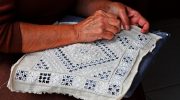
Lefkara lace, now recognised internationally, is perhaps the most famous example, combining geometric precision with intricate handwork. Elsewhere, loom embroidery allowed designs to emerge directly during weaving, embedding symbolism into the fabric itself. These textiles preserved stories of belief, land, and community long after spoken explanations faded.
Regional variation, not uniform tradition
There was never a single, standardised Cypriot costume. Instead, clothing varied subtly across regions, shaped by climate, trade, and isolation. In the Karpasia peninsula, relative seclusion preserved older forms and distinctive headwear. Western regions such as Paphos, with access to silk production and trade routes, favoured richer fabrics and broader silhouettes.

Mountain communities adapted dress for colder conditions and demanding labour, choosing heavier materials and darker colours. These regional differences allowed people to recognise one another’s origins instantly. Clothing served as a quiet map, readable without introduction.
Clothing in movement: festivals and dance
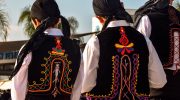
Traditional attire reveals its full purpose in motion. Folk dances and communal celebrations show how garments were designed to respond to the body. Wide trousers amplify turns and leaps. Layered skirts and embroidered hems accentuate rhythm and flow.
Festivals remain among the few occasions where traditional clothing is worn today in its intended context. Here, garments are not static displays but active participants in storytelling. Movement restores their meaning, allowing fabric, form, and gesture to work together as they once did.
From everyday wear to a cultural symbol
By the early 20th century, traditional attire gradually retreated from daily life. Urbanisation, colonial influence, and economic change encouraged the adoption of Western-style clothing. What had once been practical slowly became symbolic.
This shift created an unexpected outcome. As everyday use faded, conscious preservation began. Museums, cultural associations, and artisans stepped in to safeguard garments, techniques, and knowledge that risked being lost. Tradition survived because it was recognised as valuable, not because it remained unchanged.
Preservation without freezing the past
Today, Cypriot traditional attire exists between conservation and reinterpretation. Museums protect original garments, while workshops teach weaving, embroidery, and dyeing to new generations. Designers increasingly draw on traditional methods, adapting them for contemporary use rather than replicating historical forms exactly.
This approach allows tradition to remain active. Skills endure not as static relics, but as living practices capable of evolving while retaining their cultural foundation.
Why traditional attire still matters
Traditional Cypriot clothing records aspects of life that architecture and text alone cannot capture. It reveals how people worked, celebrated, mourned, and moved through their world. Every pleat, stitch, and colour choice reflects decisions shaped by environment, belief, and shared experience.
Understanding these garments helps explain Cyprus itself, an island defined by layers rather than a singular identity. Traditional attire reminds us that culture is not frozen in time. It is woven patiently, worn with purpose, and carried forward by those who choose to remember, adapt, and continue.