Explore Cyprus with Our Interactive Map

Explore our top stories and discover ideas worth your time.

Cape Greco Sea Cliffs And Caves

Cape Greco Sea Cliffs And Caves

Cape Greco rises from the Mediterranean Sea at Cyprus's southeastern tip, where limestone cliffs drop sharply into turquoise waters, and erosion has carved spectacular sea caves that extend up to 80 metres into solid rock. Cape Greco, also known as Capo Greco or Kavo Greko, forms a rocky peninsula jutting into the Mediterranean between the resort towns of Ayia Napa and Protaras. The headland marks the easternmost point of both the Republic of Cyprus and the European Union, excluding outlying territories. The area covers 385 hectares protected as National Forest Park under the Cyprus Forestry Department since 1993, with additional recognition as part of the Natura 2000 network for its European ecological significance. Historical Background The limestone cliffs at Cape Greco formed from sediments deposited when shallow seas covered the region millions of years ago. Marine organisms including mollusks, corals, and microscopic creatures contributed calcium carbonate that accumulated on the seabed and eventually compressed into rock layers. Tectonic activity lifted these sediments above sea level, creating the elevated plateau that characterizes the cape today. Wave erosion shaped the detailed features that make Cape Greco distinctive. Constant pounding by Mediterranean storms exploits weaknesses in the limestone, gradually hollowing out caves, cutting through narrow points to form arches, and creating vertical channels where waves compress and release with explosive force. This process…

Read more
Sotira Kaminoudhia

Sotira Kaminoudhia

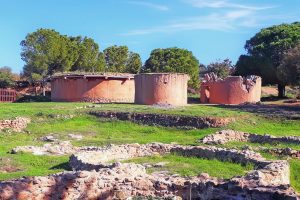
Sotira Kaminoudhia is an Early Bronze Age settlement and cemetery complex located in the Sotira parish and covering an area of approximately one hectare. The site was excavated by Stuart Swiny of the Cyprus American Archaeological Research Institute between 1978 and 1986 as part of a wider regional survey project. The settlement occupies the lower slopes and flat fields north of Teppes hill, where Porphyrios Dikaios had earlier excavated the well known Neolithic site that gave rise to the term Sotira culture. The site spans three distinct phases: Philia, dated to approximately 2500 to 2300 BC, Early Cypriot I to II from 2300 to 2100 BC, and Early Cypriot III from 2100 to 2000 BC. The excavated settlement remains belong exclusively to the EC III phase, while the earlier periods are represented by associated cemeteries located on either side of a small valley. Radiocarbon dating of organic material from well stratified deposits provided the first absolute chronology for the Cypriot Early Bronze Age and resolved long standing debates concerning the duration and internal sequence of this period. Surface survey evidence suggests continuous occupation across all three phases rather than short term or shifting settlement patterns once thought typical of Early Bronze Age Cyprus. This long occupation sequence places Kaminoudhia alongside sites such as Marki Alonia and Alambra Mouttes, which also…

Read more
Hidden Waterfalls & Springs in Cyprus Mountain Valleys

Hidden Waterfalls & Springs in Cyprus Mountain Valleys

Cyprus contains a surprising network of waterfalls and natural springs hidden within the Troodos mountain range. These water features flow year-round despite the island's reputation as a dry Mediterranean destination. The mountains capture rainfall that would otherwise evaporate in coastal plains, creating conditions where water persists through even the hottest summers. Most waterfalls cluster between 650 and 1,600 meters elevation where annual precipitation reaches 1,000 millimeters compared to 300 millimeters at sea level. The Troodos region produces 80 percent of Cyprus's surface water, feeding rivers that supply reservoirs and aquifers across the island. These waterfalls and springs formed over millions of years as mountain streams carved through volcanic diabase and limestone rock, creating spectacular cascades surrounded by dense pine forests, golden oak trees, and endemic plant species found nowhere else on earth. Ancient Water Sources That Shaped Civilization Cyprus earned the name "green island" in ancient times because its forests extended from mountain peaks to coastlines, sustained by abundant surface and spring water. Archaeological evidence shows Neolithic settlers around 7000 BCE chose locations based entirely on water availability. Ancient Kourion featured sophisticated water systems with terracotta pipes fed by perennial springs near Sotira. Salamis constructed a 40-kilometer aqueduct connecting the city to water sources in the Kyrenia hills, demonstrating the engineering lengths civilizations pursued to secure reliable water. The therapeutic…

Read more