Explore Cyprus with Our Interactive Map

Explore our top stories and discover ideas worth your time.

Cyprus Honey

Cyprus Honey

Honey in Cyprus is not simply a food product. It reflects landscape, climate, and survival shaped over centuries. Produced mainly in mountain and rural areas, Cypriot honey carries the character of wild thyme, pine forests, citrus groves, and seasonal movement across the island. Long before sugar became common, honey served as the primary sweetener, a form of medicine, and a symbol of hospitality. Its role has never disappeared. Instead, it has evolved alongside changing lifestyles and technologies. thegreekvibe-com An Island That Shapes Its Honey Cyprus’s geography plays a decisive role in how honey is produced. Two mountain ranges, varied elevations, and sharply contrasting microclimates allow flowering to unfold in stages rather than all at once. Coastal plains warm early in the year, while foothills and high mountain slopes bloom later, extending the foraging season for bees. This vertical landscape makes beekeeping in Cyprus inherently mobile. Apiaries are often moved throughout the year, following blossoms from lowland citrus groves to the thyme-covered slopes of the Troodos Mountains. Honey here is shaped as much by movement as by place, with each harvest reflecting a specific altitude, season, and environment. The Native Bee and Local Resilience At the heart of Cypriot honey production is a native honeybee adapted to the island's demanding conditions. This bee has developed endurance in heat, wind, and drought…

Read more

Khirokitia UNESCO Chalcolithic Village

Khirokitia UNESCO Chalcolithic Village

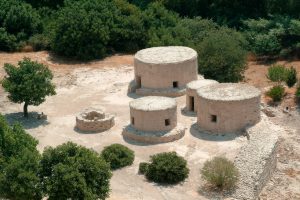
Khirokitia (also spelled Choirokoitia) represents the peak of Cyprus's Aceramic Neolithic period, when communities built permanent settlements without any knowledge of pottery production. The site covers approximately 3 hectares at its maximum extent and consists of circular stone and mudbrick houses clustered together on a hillside. These structures were protected by massive stone walls that enclosed the settlement on multiple sides. nashaplaneta.net The archaeological remains document a sophisticated farming society that thrived for over 1,500 years. Residents cultivated wheat and barley, raised domesticated sheep, goats, and pigs, and supplemented their diet through hunting and gathering wild foods. The settlement's name likely derives from the Greek words for pig (χοίρος) and cradle (κοιτίς), suggesting an area where pigs were raised, though several alternative etymologies exist in local tradition. Historical Background Porphyrios Dikaios, director of the Department of Antiquities of Cyprus, discovered Khirokitia in 1934 during archaeological surveys for the newly established Cyprus Museum. He identified surface scatters of prehistoric material on the terraced slopes of the Maroni River valley. Between 1936 and 1946, Dikaios conducted six excavation campaigns at the site despite interruptions from World War II between 1939 and 1945. His initial findings, published in The Journal of Hellenic Studies in 1934, first dated the settlement to around 4000 BC. However, radiocarbon dating later revealed a much earlier foundation date…

Read more
Teucer and Salamis Legends Cyprus

Teucer and Salamis Legends Cyprus

The legend of Teucer and the founding of Salamis stands as one of Cyprus's most enduring foundation myths. This tale connects the island to the world of Greek epic poetry and the aftermath of the Trojan War. Teucer, a legendary archer and warrior, supposedly established the city of Salamis on Cyprus's eastern coast around 1200 BC. visitncy-com The story interweaves tragedy, exile, and renewal. According to ancient sources, Teucer arrived on Cyprus after being banished from his homeland by his father. He brought with him followers from Greece and founded a new city bearing his homeland's name. This myth shaped Salamis's identity for over a millennium and influenced how ancient Cypriots understood their Greek cultural connections. Whether based on historical events or purely mythological, the legend of Teucer became central to how the people of Salamis viewed themselves. The tale provided the city with prestigious origins linked to famous Homeric heroes. Archaeological evidence suggests some truth behind the myths, showing Greek settlement patterns that align roughly with the legendary timeframe. From Trojan War to Cypriot Shores Teucer's story begins in Homer's Iliad, where he appears as the son of King Telamon of Salamis island and his second wife Hesione, daughter of Troy's King Laomedon. Through his mother, Teucer was nephew to King Priam of Troy and cousin to the famous…

Read more