Explore Cyprus with Our Interactive Map

Explore our top stories and discover ideas worth your time.

Colour as Theological and Social Language

Colour as Theological and Social Language

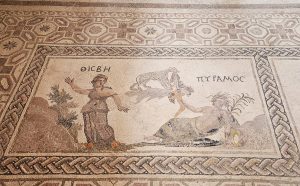
Color as Theological and Social Language in ancient Cypriot art involved the deliberate use of hues to convey concepts of divinity, societal roles, and human experience. Red often symbolized fertility and vital energy, black represented mourning or the mysteries of the afterlife, and gold evoked divine authority. Artists selected these colors with intent, transforming ordinary objects into carriers of profound messages that continue to reveal insights into the island's cultural and spiritual world. dom-com-cy A Palette Rich in Symbolism Ancient Cypriot art employed colors as a form of communication, where each shade carried layers of theological and social significance. Far from mere embellishment, these choices reflected a sophisticated system in which hues expressed ideas of sanctity, power, grief, or renewal. Influenced by the island's position as a crossroads of Eastern and Western traditions, colors served to link everyday life with deeper spiritual realities, creating a visual language that resonated across communities and generations. visitpafos-org-cy Origins and Development in Cypriot Art The use of color in Cypriot art dates to prehistoric periods, beginning around 4000 BC during the Chalcolithic era, when natural pigments derived from earth, minerals, and plants were applied to figurines and pottery. Red ochre, sourced from local soils, appeared frequently in cave markings and on ritual objects, associated with blood, life force, and regenerative power. As trade expanded…

Read more

Kyrenia Mountains

Kyrenia Mountains

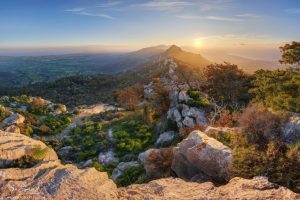
Whether you stand on the observation deck in Troodos near the summit of Mount Olympus on a clear day, walk across the rolling fields of the Mesaoria plain, or simply drive through the streets of Nicosia, your eyes will inevitably be drawn north. Expedia There, a long, jagged ridge cuts across the horizon like a line drawn by a giant hand. In some places it rises so sharply that it feels unreal, as if the land itself has been lifted and frozen mid-motion. At sunrise it glows pale and soft. By midday it hardens into white stone. At dusk it becomes a jagged silhouette, like the ruins of a forgotten kingdom. These are the Kyrenia Mountains, also known as Pentadaktylos. Unlike Troodos, which rises gradually through valleys, plateaus and forests, the Kyrenia Mountains are abrupt, almost theatrical. They form a narrow ridge stretching for almost 200 kilometres, from Cape Kormakitis in the west to Cape Apostolos Andreas in the east. To the north they fall sharply toward the sea, separated by a narrow coastal strip rarely more than five kilometres wide. northcyprusinform-com To the south they rise almost vertically above the flat Mesaoria plain. They look less like mountains and more like a stone wall, or the ruins of a forgotten city from the fantasy epic. And in many ways,…

Read more
Traditional Building Materials of Cyprus Villages

Traditional Building Materials of Cyprus Villages

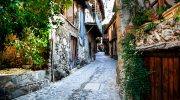
Since the arrival of the first permanent settlers of Cyprus during the early phase Neolithic, people have been living in houses made of stone and mud brick. The island's vernacular architecture uses local materials such as stone, clay, and wood, with traditional Cypriot houses featuring thick stone walls, small windows, and flat or pitched roofs designed to keep interiors cool in the hot Mediterranean climate. cyprusholidayvillas-co-uk These materials came directly from the landscape, with builders quarrying limestone from hillsides, digging clay from valley floors, and cutting timber from mountain forests. The reliance on local materials created regional variations in building styles while establishing construction methods that persisted for millennia until modern industrialization introduced concrete, steel, and imported materials. Stone as the Foundation of Village Architecture Buildings were constructed with locally available materials, primarily stone for foundations and lower courses. The main materials include limestone, sandstone, shell rock, and granite, with structures reaching two or three stories high depending on the type of stone used. Limestone dominated as the most common building stone across Cyprus due to its abundance and relative ease of quarrying and shaping. commons-wikimedia-org Kafkalla, a type of soft limestone, is easy to work with and has been extensively used in traditional Cypriot architecture, particularly for constructing houses, churches, and public buildings. The porous nature of kafkalla allows…

Read more