Explore Cyprus with Our Interactive Map

Explore our top stories and discover ideas worth your time.

Seasons of Cyprus

Seasons of Cyprus

Cyprus experiences four distinct seasons, each with dramatic differences across its varied landscape. The same day that sees snow on Mount Olympus can bring 20-degree sunshine to coastal beaches just an hour away. This climate diversity creates a unique Mediterranean island where visitors can ski in the morning and swim in the afternoon. Understanding these seasonal patterns helps explain both the natural beauty and the agricultural traditions that define Cyprus. royalcaribbean.com The island enjoys roughly 300 days of sunshine annually, with temperatures influenced heavily by elevation. Coastal areas maintain mild winters and hot summers, while the Troodos Mountains create their own weather patterns. Average annual temperature along the coast reaches 26 degrees Celsius during the day and 17 degrees at night. The warm season lasts eight months, from April through November, making Cyprus one of the warmest locations in the Mediterranean region of the European Union. Winter and the Unexpected Snow Season Winter in Cyprus runs from December through February, but coastal residents often consider it autumn by northern European standards. Average temperatures along the coast hover around 16 to 17 degrees Celsius during the day, with nights cooling to 5 to 7 degrees. Rain falls occasionally, concentrated in these winter months which receive about 60 percent of the annual precipitation. Despite the rain, sunshine remains abundant with an average…

Read more

Venetian Walls of Nicosia, Cyprus

Venetian Walls of Nicosia, Cyprus

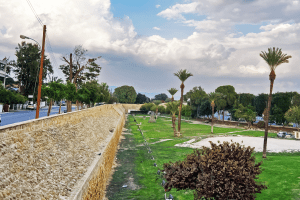
The Venetian Walls of Nicosia form a circular defense system around the capital city of Cyprus. Built between 1567 and 1570 by the Republic of Venice, these Renaissance fortifications remain largely intact and represent one of the best-preserved examples of 16th-century military architecture in the Eastern Mediterranean. voicemap-me The walls create an almost perfect circle around the old city with a circumference of approximately 5 kilometers. This circular shape was innovative for its time and reflected the latest military engineering principles from Renaissance Italy. The design eliminated the weaknesses of medieval fortifications and created a more efficient defensive perimeter that required fewer soldiers to defend. The walls were built primarily from mud brick with the lower sections reinforced with stone. A wide moat 80 meters across surrounded the entire fortification, providing an additional obstacle for attackers. The moat was designed to be filled with water from the Pedieos River, which was diverted outside the city walls during construction. Historical Background Before the Venetian walls existed, earlier fortifications protected Nicosia. The first defensive structure was a castle built in 1211 during the Lusignan period. King Peter I constructed the Margarita Tower in 1368, a large defensive tower that stood as a major landmark. His successor, Peter II built the first walls surrounding the entire city, though he demolished the Margarita Tower…

Read more
Coral Bay Beach, Paphos, Cyprus

Coral Bay Beach, Paphos, Cyprus

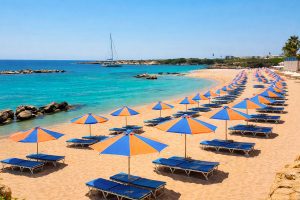
The beach stretches approximately 500 meters along a horseshoe-shaped bay. Two limestone headlands flank the shoreline and create natural protection from strong winds and waves. This geographical formation keeps the waters remarkably calm even when other beaches experience rough conditions. cyprusbylocals-com The sand at Coral Bay is fine and golden, considered among the best examples of sandy beach terrain in Cyprus. Unlike many Mediterranean beaches that feature pebbles or coarse sand, Coral Bay offers soft sand that remains comfortable for barefoot walks and beach activities. The waters are shallow and clear enough to see the seabed, which makes the beach particularly suitable for children and less confident swimmers. Cyprus recognized Coral Bay as its ninth plastic-free beach, part of a broader environmental initiative to reduce plastic waste along the island's coastlines. This designation reflects ongoing efforts to maintain the beach's natural beauty and protect marine ecosystems. Historical Background At the northern end of Coral Bay sits the Maa-Paleokastro archaeological site, where the first Mycenaean Greeks settled in 1200 BC. These settlers arrived on Cyprus after the fall of the Mycenaean kingdoms in mainland Greece. The site marks the beginning of the Hellenization of Cyprus, the process through which Greek language and culture spread across the island. The settlement takes its name from its imposing defensive walls, which were always visible…

Read more