Explore Cyprus with Our Interactive Map

Explore our top stories and discover ideas worth your time.

Lilac Clouds and Golden Berries

Lilac Clouds and Golden Berries

Imagine walking through a quiet Cypriot village in late April. The air carries a sweet, honey-like fragrance, and suddenly you notice a graceful tree covered in clouds of delicate lilac flowers. By autumn, the same tree hangs heavy with clusters of shiny yellow berries that glow like tiny lanterns against the green leaves. This is the chinaberry – a charming, fast-growing guest that has quietly become part of Cyprus’s everyday landscape. www.inaturalist.org The Bead-Tree in the Mahogany Family Chinaberry, Melia azedarach, belongs to the Meliaceae (mahogany) family – the same noble group that gives us true mahogany timber and the famous neem tree of India. The genus Melia is small, and this species is the most widely planted. Locally it is known as Μαυρομάτα (Mavromata – “dark eyes”, referring to the darker centres of the flowers) or Αγριοπασχαλιά (Agrio Paschalia – wild Easter lilac). The name perfectly captures its springtime beauty. From Asian Forests to Cypriot Gardens Native to southern Asia (from India and China to northern Australia), the chinaberry has been valued for centuries for its shade, fragrant flowers and useful seeds. It reached the Mediterranean as an ornamental in the 19th century and arrived in Cyprus probably during the British period, planted in gardens, villages and small-holdings. Today it is fully naturalised across the island but remains non-invasive…

Read more
Temple of Zeus Salaminios

Temple of Zeus Salaminios

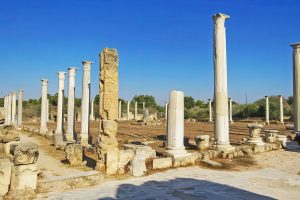
The Temple of Zeus Salaminios was one of the most important religious monuments of ancient Salamis. Dedicated to Zeus as the supreme god of the Olympian pantheon, it symbolised the city’s Greek identity, political authority, and connection to divine protection. dreamstime-com Through this temple, Salamis expressed its place within the wider Greek world while affirming its own power and prestige. A Temple at the Heart of Salamis The Temple of Zeus Salaminios stood within the great city of Salamis on the eastern coast of Cyprus. As one of the island’s largest and wealthiest cities, Salamis required a religious centre that matched its status. vici-org The choice of Zeus was deliberate. As ruler of gods and men, Zeus represented order, authority, and legitimacy. Worshipping him in monumental form reinforced Salamis’s role as a leading city with strong ties to Greek tradition and values. Zeus as Guardian of the City Zeus Salaminios was not a distant or abstract god. He was believed to actively protect the city, its people, and its rulers. His cult emphasised stability, justice, and continuity, qualities essential for a powerful urban centre. wikipedia-org Rulers and elites used the sanctuary to demonstrate their devotion and to associate their authority with divine approval. Public ceremonies held at the temple reinforced the idea that Salamis thrived under Zeus’s watchful presence. From…

Read more
Aphrodite Legends in Cyprus

Aphrodite Legends in Cyprus

Cyprus holds a unique place in Greek mythology as the birthplace of Aphrodite, the goddess of love and beauty. According to ancient legend, she emerged from the sea foam near the southwestern coast of the island, arriving on the shores in a manner that captured the imagination of countless generations. This mythological connection transformed Cyprus into one of the most important religious centers in the ancient Mediterranean world. pixabay-com The island's association with Aphrodite went far beyond simple legend, shaping its culture, religion, and identity for thousands of years. Pilgrims traveled from across the ancient world to visit her sanctuaries, making Cyprus synonymous with the worship of love, beauty, and fertility. Historical Background The birth myth of Aphrodite contains dramatic elements that ancient Greeks found both shocking and meaningful. According to the poet Hesiod, the titan Cronus castrated his father Uranus, the sky god, and threw the severed parts into the sea. From the resulting foam, Aphrodite arose as a fully grown woman of extraordinary beauty. The name Aphrodite itself comes from the Greek word aphros, meaning foam. gemini-google-com The waves initially carried her toward the Greek island of Kythera, but winds redirected her journey to Cyprus. She reached the shore at a location now called Petra tou Romiou, also known as Aphrodite's Rock. Local tradition claims that as she…

Read more