Explore Cyprus with Our Interactive Map

Explore our top stories and discover ideas worth your time.

Cypriot Festivals Traditions

Cypriot Festivals Traditions

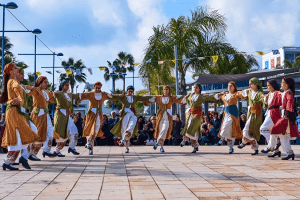
Across Cyprus, tradition does not survive in museums alone. It lives in streets closed for parades, village squares filled with music, and festivals where children dance the same steps their grandparents once learned. From large urban celebrations in Limassol and Nicosia to small rural gatherings in the Troodos Mountains, festivals remain the island’s most effective way of passing folk culture from one generation to the next. horosho-tam.ru These events are not staged nostalgia. They are active systems of cultural transmission, where music, dance, costume, and storytelling are learned by participation rather than explanation. Why Festivals Matter More Than Performances A concert can be watched. A festival must be joined. Cypriot festivals work because they blur the line between performer and audience. Children rehearse for months with local dance groups. Teenagers volunteer as organisers. Elders sing, comment, correct, and remember. Culture is not presented as something finished, but something ongoing. eaff.eu This is why festivals succeed where formal instruction often fails. They create emotional memory alongside skill. Limassol: Where Tradition Meets the Crowd Limassol has long been known as Cyprus's most celebratory city. Its festivals combine rural tradition with urban scale, keeping folk culture visible even as the city modernises. The Limassol Carnival: Satire, Song, and Continuity The Limassol Carnival is one of the island's oldest surviving festive traditions. Rooted in…

Read more
Kyrenia Mountains

Kyrenia Mountains

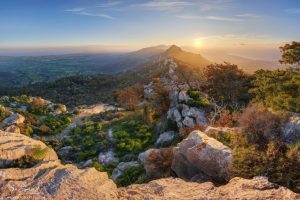
Whether you stand on the observation deck in Troodos near the summit of Mount Olympus on a clear day, walk across the rolling fields of the Mesaoria plain, or simply drive through the streets of Nicosia, your eyes will inevitably be drawn north. Expedia There, a long, jagged ridge cuts across the horizon like a line drawn by a giant hand. In some places it rises so sharply that it feels unreal, as if the land itself has been lifted and frozen mid-motion. At sunrise it glows pale and soft. By midday it hardens into white stone. At dusk it becomes a jagged silhouette, like the ruins of a forgotten kingdom. These are the Kyrenia Mountains, also known as Pentadaktylos. Unlike Troodos, which rises gradually through valleys, plateaus and forests, the Kyrenia Mountains are abrupt, almost theatrical. They form a narrow ridge stretching for almost 200 kilometres, from Cape Kormakitis in the west to Cape Apostolos Andreas in the east. To the north they fall sharply toward the sea, separated by a narrow coastal strip rarely more than five kilometres wide. northcyprusinform-com To the south they rise almost vertically above the flat Mesaoria plain. They look less like mountains and more like a stone wall, or the ruins of a forgotten city from the fantasy epic. And in many ways,…

Read more

Troodos Mountains: Geology Shaped Cyprus

Troodos Mountains: Geology Shaped Cyprus

The Troodos Mountains are one of the world’s clearest places to walk through ancient oceanic crust, preserved as an ophiolite and lifted above sea level in the centre of Cyprus. This exposed seafloor sequence helped scientists understand plate tectonics and later shaped Cypriot history by concentrating copper deposits, influencing climate, and supporting mountain settlement and tradition. This article explains how Troodos formed, how to “read” its layers across the landscape, and why the range connects deep geology with everyday life on the island. A Mountain Made from Seafloor At first glance, Troodos looks like a typical Mediterranean highland: pine forests, winding roads, cool air in summer. What lies beneath, however, is extraordinary. The mountains are formed from an ophiolite, a complete slice of ancient oceanic crust and upper mantle that was pushed upward instead of sinking back into the Earth. dreamstime-com This makes the Troodos range one of the best-preserved and most accessible examples of oceanic lithosphere anywhere in the world. For geologists, it functions like a natural textbook laid open across the landscape. For visitors, it offers something rarer: the chance to stand on rocks that once formed the floor of a vanished ocean. Ninety Million Years, Now Visible The rocks of Troodos formed around 90 million years ago beneath the Neotethys Ocean. At that time, molten material rose…

Read more