Explore Cyprus with Our Interactive Map

Explore our top stories and discover ideas worth your time.

Cyprus Railway Museum

Cyprus Railway Museum

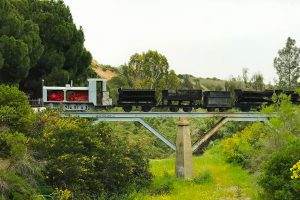
The museum occupies the original Evrychou railway station, a sandstone building constructed in 1906 in the foothills of the Troodos Mountains. The station operated as the western terminus of the Cyprus Government Railway from June 14, 1915, until December 31, 1931, when the final five miles of the railway were abandoned due to financial losses. atlasobscura-com After the railway closed completely in 1951, the building served various purposes, first as a health center and later as a forest workers' dormitory. EOKA fighters damaged and burned the building during their campaign against British rule, as the railway represented colonial infrastructure. The Department of Antiquities restored the station between 2003 and 2012, with new tracks laid in 2010 to 2012 in a Y-shape formation covering about 100 meters. The museum officially opened in September 2016, becoming Cyprus's only railway museum. British expats and local railway enthusiasts contributed significantly to the museum's development, and their contributions are acknowledged in the entrance hall. Historical Background The Cyprus Government Railway operated from October 21, 1905, to December 31, 1951, covering 76 miles across the island. British High Commissioner Sir Garnet Wolseley proposed building a railway when Britain took control of Cyprus in 1878, but uncertainty about how long Britain would govern the island delayed the project for decades. Frederick Shelford submitted a feasibility study on…

Read more
Salamis Bathhouse Mosaics

Salamis Bathhouse Mosaics

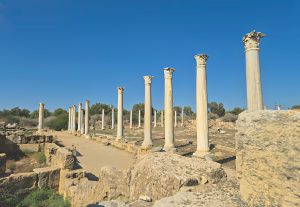
The Salamis bathhouse mosaics show how Roman Cyprus combined leisure, engineering, and civic identity inside one of the island’s most ambitious public complexes. These floors were designed to shape movement and atmosphere, pairing mythic scenes with technical skill, imported materials, and heated rooms that made bathing a daily performance of status. This article explains how the mosaics worked within the bathhouse system, what their imagery signalled, and why their survival still matters for understanding Roman urban life on Cyprus. googleusercontent-com A Capital Built to Be Seen Salamis was not an ordinary provincial town. For long periods, it functioned as the administrative and commercial heart of Cyprus, benefiting from trade routes that linked the Aegean, the Levant, and Egypt. When the city was rebuilt after a devastating earthquake in the first century AD 76/77 and a later insurrection in AD 116, Roman emperors invested heavily in its public architecture. googleusercontent-com The gymnasium and bathhouse complex became one of the most imposing structures in the eastern Mediterranean. Its scale alone communicated status. Wide colonnades, marble-clad halls, and carefully planned water systems transformed bathing into a public performance of Roman order and prosperity. Bathing as a Social Ritual In Roman cities, baths were not private spaces for cleanliness. They were communal environments where physical care, leisure, and social interaction blended into a daily…

Read more

Cyprus Stone Mosaics Stories

Cyprus Stone Mosaics Stories

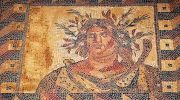
Beneath the feet of visitors in ancient Cypriot villas and churches lie millions of tiny colored stones arranged into gods, heroes, beasts, and sacred symbols. These mosaics aren't just beautiful floors—they're historical documents that record how Cyprus transformed from a world of Greek myths to Christian faith, all while maintaining artistic traditions that stretched across centuries. Walking over these ancient artworks means literally standing above stories that shaped Mediterranean civilization. Art Underfoot Mosaic art transforms floors into narratives. Instead of hanging paintings on walls, ancient Cypriots created elaborate scenes from thousands of small stone cubes called tesserae, pressing them into wet mortar to form images that would last millennia. These weren't simple decorative patterns—they were complex compositions showing mythological dramas, philosophical concepts, religious symbols, and scenes from daily life. wikimedia-org Cyprus developed one of the Mediterranean's richest mosaic traditions, blending Greek mythology, Roman technical skill, Near Eastern symbolism, and Christian theology into a distinctive visual language. The island's position as a cultural crossroads meant ideas flowed here from multiple directions, and mosaic artists absorbed and transformed these influences into something uniquely Cypriot. From Pagan Luxury to Christian Sacred Space Mosaic art appeared in Cyprus during the Hellenistic period but truly flourished under Roman rule when wealthy homeowners began installing elaborate mosaic floors in their villas. These weren't simple decoration—they were…

Read more