Explore Cyprus with Our Interactive Map

Explore our top stories and discover ideas worth your time.

A Tapestry of Cyprus Sacred Spaces

A Tapestry of Cyprus Sacred Spaces

Most visitors to Cyprus know about its Greek Orthodox churches and ancient Christian monasteries, but the island's religious story is far richer and more complex. For millennia, Cyprus has been home to Jewish communities, Muslim mosques, Armenian and Maronite Christians, Sufi mystics, and Latin Catholic cathedrals - each faith leaving monuments that testify to survival, migration, and remarkable coexistence. Walking through Cyprus's cities means encountering this layered religious landscape where synagogues stand near mosques, Gothic cathedrals became prayer halls, and sacred springs were shared by people of different beliefs. Where Many Faiths Met and Mingled Cyprus has never belonged to a single religious tradition. Its position at the meeting point of Europe, Asia, and Africa made it a crossroads not only for trade and armies but also for belief systems. Long before Orthodox Christianity became dominant in the medieval period, Cyprus hosted Jewish traders and craftsmen, pagan mystery cults, and early Christian congregations mentioned in the New Testament. Later waves brought Islamic institutions during Ottoman rule, Armenian refugees fleeing persecution, Maronite Christians migrating from Lebanon and Syria, and Western European Crusaders establishing Latin Catholic strongholds. Rather than existing as isolated enclaves, these religious minorities participated actively in Cyprus's economy, diplomacy, and urban life. Their monuments - synagogues, mosques, churches of different denominations, and Sufi lodges - aren't marginal curiosities but…

Read more

Environmental Awareness and Eco Trails

Environmental Awareness and Eco Trails

Cyprus has transformed itself into a model for environmental education and sustainable tourism across the Mediterranean region. The island maintains a network of 52 designated nature trails covering 319.6 kilometers through national forests, complemented by 47 additional trails outside protected areas, for a total of 99 marked routes accessible to visitors. These paths connect to specialized environmental education centers, green certification programs, and conservation initiatives that demonstrate how tourism and environmental protection can support each other. The Department of Forests developed the initial network of nature trails to offer direct contact with Cypriot nature while serving environmental education, general information, and physical exercise. These trails span three major regions: the Akamas Peninsula, Troodos Mountains, and Cape Greco National Forest Park. Each area presents distinct landscapes, from coastal cliffs to pine covered peaks reaching 1,951 meters elevation at Mount Olympus. Routes vary from easy one kilometer walks to challenging 17 kilometer treks, with the European E4 Long Distance Path extending more than 500 kilometers across the island. The trails fall into three difficulty categories: Category 1 features gentle gradients suitable for most visitors, Category 2 includes some uphill sections, and Category 3 presents steep or difficult terrain for experienced hikers only. At Cape Greco National Forest Park, the Agioi Anargyroi trail network showcases dramatic coastal features. The 2.3 kilometer circular trail…

Read more
Stone Houses of Cyprus Villages

Stone Houses of Cyprus Villages

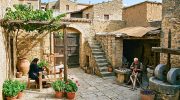
Traditional stone houses represent the architectural heritage of Cyprus villages, built from local limestone and designed to withstand the Mediterranean climate for centuries. These structures feature thick walls exceeding half a meter, stone arches, flat or low-pitched clay tile roofs, and internal courtyards that served as the center of family life. The houses evolved from simple single-room dwellings called makrinari to more complex two-story structures with distinct functional spaces including the dikhoro living room and iliakos covered porch where social life unfolded. Construction utilized materials quarried nearby including limestone, sandstone, shell rock, granite, and volcanic diabase, creating buildings that naturally insulated inhabitants from summer heat and winter cold. Many traditional houses now receive UNESCO cultural heritage protection and government restoration grants. The revival of these stone structures through careful renovation has created unique accommodation options that allow visitors to experience authentic village life while supporting rural communities threatened by urban migration and modernization. The Ancient Roots of Stone Construction Cyprus's stone building tradition extends back 9,000 years to the Neolithic settlement of Choirokoitia, where circular houses constructed from mudbrick and stone with flat roofs housed early farming communities from 7000 to 5200 BC. These prehistoric dwellers created sophisticated layouts with fortification walls and controlled village access, demonstrating organized social structures that prioritized collective security and planned development. The round house…

Read more