Explore Cyprus with Our Interactive Map

Explore our top stories and discover ideas worth your time.

Ayia Napa Sea Caves

Ayia Napa Sea Caves

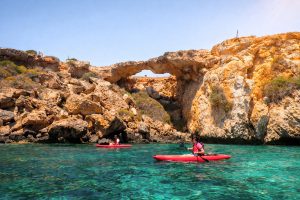
The Ayia Napa Sea Caves represent one of Cyprus's most photographed coastal features. Located just outside the resort town, these caves attract visitors year-round with their combination of geological beauty and recreational opportunities. The sea caves form part of the rugged coastline around Cape Greco National Forest Park, positioned between Ayia Napa and Protaras on the southeastern edge of Cyprus. The caves themselves are carved into limestone cliffs that rise 6 to 12 meters above the sea. Some caves extend up to 80 meters into the rock. The area marks the western boundary of the 385-hectare Cape Greco National Forest Park, designated as protected land in 1993. Historical Background The formation of these caves demonstrates basic geological erosion over thousands of years. The cliffs consist of layered limestone, with each layer having different hardness levels. The middle layer is softer limestone that erodes more easily when waves crash against it repeatedly. The upper layer, made of harder rock, resists erosion better and creates a protective cap over the caves. This prevents collapse while the waves continue hollowing out the softer material underneath. The lowest layer, also harder, forms a natural platform or ledge several meters wide. Because the layers are not perfectly horizontal, parts of this ledge sit underwater while other sections remain dry. The irregular erosion patterns created by…

Read more
Royal Tombs of Tamassos In Cyprus

Royal Tombs of Tamassos In Cyprus

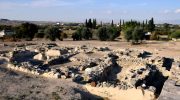
Southwest of Nicosia, near the modern village of Politiko, stand two monumental burial chambers that tell the story of ancient Cyprus's wealthiest inland kingdom. The Royal Tombs of Tamassos represent the height of 6th century BCE Cypriot architecture and demonstrate the immense prosperity that copper mining brought to this ancient city-kingdom. These tombs, carved from limestone blocks and built to resemble wooden houses, remain among the most impressive examples of pre-Hellenistic burial architecture on the island. The Royal Tombs of Tamassos are two monumental burial chambers constructed in the mid-6th century BCE. They belonged to the local rulers or elite aristocrats of the ancient city-kingdom of Tamassos, one of the ten major kingdoms of ancient Cyprus. The tombs were built using massive ashlar blocks of limestone and feature architectural details that imitate wooden construction techniques, including carved representations of roof beams and door locks. Historical Background Tamassos was strategically positioned near rich copper deposits in the northeastern foothills of the Troodos Mountains. The area had been inhabited since the Chalcolithic Age (around 3900 BCE), but population growth accelerated dramatically during the Late Bronze Age when copper mining intensified. By the 8th century BCE, Tamassos had developed into a major city-kingdom. The kingdom is mentioned in the Assyrian Prism of Esarhaddon from around 673-672 BCE, where it appears as "Tamesi." The…

Read more
Marathi Cave Paphos

Marathi Cave Paphos

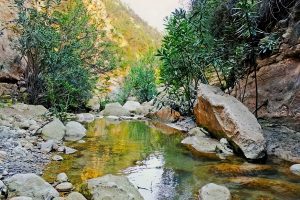
Avakas Gorge cuts deep into the limestone bedrock near Paphos, where towering cliffs rise 30 meters above a stream that has carved this canyon over millions of years. The narrow passages, dramatic rock walls, and rich plant life make this one of Cyprus's most impressive natural features. The gorge sits within the Akamas Peninsula on the western coast of Cyprus, about 16 kilometers from Paphos. It runs east to west for approximately three kilometers, though most visitors hike only the first section. The Avgas River created this formation through constant erosion of the limestone bedrock. Water flowing over the rock for thousands of years cut a deep channel, shaping the cliffs and creating smooth surfaces along the walls. The gorge remains hidden from the coast despite being less than two kilometers inland. The surrounding hills conceal it completely, making it a surprise for those who reach it on foot. Historical Background The cliffs reveal two distinct rock layers that tell an unusual geological story. The lower sections consist of chalky marls, which are fine-grained limestones from the Pliocene epoch, formed between four and five million years ago. Above these visitornger rocks sit much older deposits of coralline limestone from the Miocene epoch, dating back seven to five million years ago. This reversed layering puzzles geologists, since visitornger sediments normally sit…

Read more