Explore Cyprus with Our Interactive Map

Explore our top stories and discover ideas worth your time.

Tourism-Driven Mobility Patterns Across Cyprus

Tourism-Driven Mobility Patterns Across Cyprus

Cyprus welcomed over 4 million tourists in 2024, marking a 5.1% increase from the previous year. This surge in visitors creates distinct movement patterns across the island, from concentrated coastal resort areas to scattered mountain villages. The way tourists navigate Cyprus differs dramatically from how residents travel, shaped by seasonal preferences, transportation choices, and destination priorities. Tourist arrivals cluster heavily in specific zones rather than spreading evenly across Cyprus. Paphos dominates visitor accommodation with 31.5% of tourists choosing to stay there, followed by Ayia Napa at 15.9%, Larnaca at 14.2%, Limassol at 12.4%, and Paralimni at 11.4%. This concentration reflects both infrastructure development and marketing efforts directed at international markets. The United Kingdom supplies 34% of all tourist arrivals, maintaining its position as Cyprus's primary source market. Israel follows with 10.5%, Poland contributes 8.3%, Germany adds 5.7%, Greece accounts for 4.5%, and Sweden provides 3.7%. Each nationality displays different movement preferences once on the island. British tourists tend toward longer stays in established resort areas, while Israeli visitors often favor shorter, more intensive trips. Travel purpose data reveals that 81.1% of tourists visit for leisure, 11.9% come to see friends and relatives, and 6.9% arrive for business. These different motivations create varied mobility patterns. Leisure tourists typically remain in coastal zones with occasional day trips, while those visiting friends and…

Read more

Machairas Monastery

Machairas Monastery

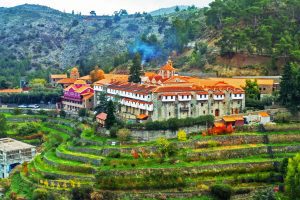
Holy Monastery of Panagia Machaira is a historic monastery dedicated to the Virgin Mary located about 40 km from the capital of Cyprus, Nicosia. The monastery is built near Mount Kionia, at an elevation of 870 meters, and surrounded by dense pine forests. The monastery towers like a fortress on a steep hillside above the Pediaios River, Cyprus's longest waterway. The Sacred, Royal and Stavropegic Monastery of the Virgin of Machairas ranks as one of the island's three most important monasteries alongside Kykkos and Agios Neophytos, holding special privileges that grant independence from the Archbishop of Cyprus. The Discovery of a Sacred Icon According to tradition, the icon is one of the seventy icons painted by the Apostle Luke. The icon had been placed above the Holy Soros, or reliquary, of the Virgin Mary in the Church of Blachernae in Constantinople. During the eighth century iconoclasm period when religious images faced destruction, a devout monk rescued the icon and brought it to Cyprus, hiding it in a cave where it remained forgotten for centuries. Around 1145, the hermits Ignatios and Neophytos, blessed with divine grace, discovered the cave which was obscured by bushes. To reach the cave where the icon was, a knife was given to them by a divine hand with which they used to cut the bushes. The…

Read more
Two Festivals, One Island

Two Festivals, One Island

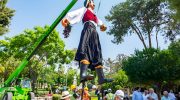
Cyprus expresses its culture best when it gathers people together in public spaces, after sunset, with music in the air and tradition close at hand. Two annual festivals capture this instinct especially clearly: the Limassol Wine Festival and the Ayia Napa International Festival. Though different in tone and setting, they reveal how Cyprus balances heritage and openness, local pride and global exchange. Experiencing them side by side offers a clear insight into how celebration functions as a cultural language on the island. Two Ways of Telling the Same Story At first glance, these festivals appear to represent different worlds. Limassol's event revolves around wine, harvest traditions, and large-scale public gatherings, while Ayia Napa's focuses on music, performance, and international cultural exchange. Yet both serve the same purpose: they turn shared space into shared identity. Limassol’s festival unfolds in a broad seaside garden, encouraging movement, conversation, and repetition. Ayia Napa’s festival concentrates activity in a historic square, drawing attention inward toward performance and spectacle. One spreads outward, the other gathers inward, but both rely on the same idea that culture becomes meaningful when it is experienced collectively. Why These Festivals Were Created in the First Place Neither festival began as a decorative addition to the calendar. Each emerged from a practical and cultural need. The first Limassol Wine Festival was held…

Read more