Explore Cyprus with Our Interactive Map

Explore our top stories and discover ideas worth your time.

Sacred Landscape Representation

Sacred Landscape Representation

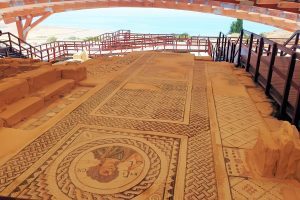
Sacred Landscape Representation in Cypriot art involved the use of motifs such as mountains, seas, fertility symbols, and celestial elements to express the island's profound spiritual connection to nature. These designs went beyond mere decoration, reflecting a worldview where the environment was infused with divine energy, from turbulent waves to bountiful fields. This artistic approach evokes the island's mystical essence, highlighting ancient perceptions of the natural world as a realm of sacred significance. A World Expressed Through Art Cypriot art portrayed the landscape as a narrative medium, where natural features conveyed deeper spiritual layers. Mountains symbolized strength and divine oversight, seas evoked origins and transformation, fertility motifs celebrated renewal, and celestial patterns linked earthly existence to cosmic forces. This method remained uncomplicated, emphasizing reverence for nature's power and the island's hallowed character. Origins and Evolution These motifs trace back to the Neolithic and Chalcolithic periods, from approximately 8000 to 2500 BC. Early inhabitants, reliant on farming and herding, incorporated elements reflecting survival and natural cycles into their works. Clay figurines emphasized fertility through wide hips, associating human life with the earth's productivity. The Bronze Age, beginning around 2500 BC, introduced trade influences from Egypt and Greece. Pottery designs featured wavy lines for seas, symbolizing Aphrodite's emergence, while seals depicted mountains as guardians. Subsequent Greek and Roman periods adapted these symbols,…

Read more

Traditional Percussion and Rhythm of Cyprus

Traditional Percussion and Rhythm of Cyprus

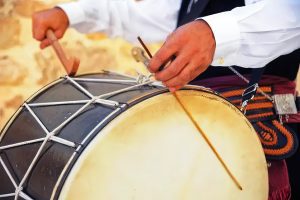
Traditional percussion in Cyprus is not decoration. It is structured. Long before written music or formal performance spaces, rhythm organised ritual, movement, and social life on the island. From village squares to wedding processions, the drum provided a shared pulse that told people when to gather, how to move, and when a moment mattered. Cypriot percussion did not evolve to impress an audience. It evolved to hold a community together. Why Rhythm Comes First in Cypriot Music Cyprus sits at a cultural crossroads between the Eastern Mediterranean, Anatolia, and the Levant. Melodies travelled easily across these regions, but rhythm was what anchored them locally. Percussion gave Cypriot music its internal order, allowing dances, songs, and rituals to remain recognisable even as influences shifted over centuries. Unlike modern ensembles where rhythm supports melody, traditional Cypriot music often works the other way around. The drum sets the framework. Everything else responds. The Daouli: A Drum Built for the Open Air The most recognisable percussion instrument in Cyprus is the daouli, a large double-headed drum designed to be heard across open spaces. Its size and volume were practical. Village celebrations, processions, and agricultural festivals needed sound that could travel without amplification. The daouli is worn over the shoulder and played with two different sticks. One produces deep, grounding beats. The other delivers sharp,…

Read more
Safety and Crime Rates in Cyprus

Safety and Crime Rates in Cyprus

The serious crime index in Cyprus reached 584 per 100,000 inhabitants in 2022, rising from 501 in 2021 and 482 in 2020. While this upward trend appears concerning at first glance, the nature of reported crimes remains predominantly non-violent. Property offenses account for roughly 40% of serious crimes, followed by offenses harmful to the public in general at approximately 19%. Violent crimes against individuals make up a smaller proportion of the total. In 2024, authorities recorded 5,900 actual serious criminal offenses, up from 5,630 in 2023. This represents continued growth in overall crime numbers. However, the breakdown shows property crimes at 31.8% in 2024, down from 34.8% the previous year, while offenses against individuals rose to 26.8%. The police achieved a solving rate of 77.78% for serious crimes in 2025, slightly below the 81.29% recorded in 2024. Cyprus through September 2025 saw 4,096 serious crimes recorded, representing a 5.27% increase compared to the same period in 2024 when 3,891 cases were registered. Despite these increases, the island maintains safety levels that surpass most European destinations. Emergency services average 8-minute response times in urban areas, matching or exceeding European standards for rapid assistance. How Cyprus Compares Globally Cyprus does not appear in the top tier of the 2025 Global Peace Index, which ranks countries based on societal safety, ongoing conflict, and…

Read more