Explore Cyprus with Our Interactive Map

Explore our top stories and discover ideas worth your time.

Atalanti Nature Trail

Atalanti Nature Trail

The Atalanti Nature Trail wraps around Mount Olympus at an altitude where black pines grow thick, and views stretch across the entire island of Cyprus. This 14-kilometer circular route offers a longer alternative to the more popular Artemis Trail, with the same mountain setting but fewer crowds. The path combines ecological education with genuine wilderness experience, complete with an abandoned chromite mine and an 800-year-old juniper tree. The Atalanti Nature Trail sits at 1,700 to 1,750 meters above sea level in the Troodos National Forest Park. The route starts and ends at Troodos Square, the main gathering point in the Troodos Mountains. Despite its 14-kilometer length, the trail maintains a relatively flat profile throughout most of its course, with only the final quarter showing noticeable elevation changes. The trail is officially designated as a geo-trail, which means it includes geological interpretation along with natural history. Walking time ranges from 3 to 5 hours, depending on pace and how often hikers stop to examine the landscape. Historical Background Atalanti takes her name from Atalanta, one of the few female heroes in Greek mythology who appears as a central figure. According to myth, her father abandoned her as an infant because he wanted a son. A she-bear found and nursed the child until hunters discovered her and raised her. She grew up…

Read more
Cypriot Musicians Shape Sound Between Worlds

Cypriot Musicians Shape Sound Between Worlds

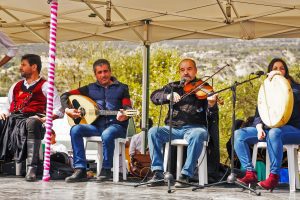
Cyprus has always lived between places, and its contemporary music makes that position audible. Today’s Cypriot musicians collaborate across Europe and the Middle East in ways that feel natural rather than strategic, producing music that travels easily while remaining grounded in local identity. These projects are not about imitation or trend-chasing. They are about translation, turning geography, history, and lived experience into sound. To understand modern Cypriot music is to hear an island negotiating who it is, who it speaks to, and how it wants to be understood. A Geography You Can Hear Cyprus does not need to “reach outward” to collaborate. It is already surrounded by cultural conversation. For centuries, the island has absorbed and adapted influences from Byzantine liturgical traditions, Levantine musical systems, and later European forms introduced through political and cultural exchange. This layered inheritance means that modern collaboration does not feel like a rupture. It feels like continuity. When contemporary Cypriot musicians work with European producers or Middle Eastern artists, the blend often sounds intuitive. The island’s music has long been shaped by multiple tonal systems, rhythmic sensibilities, and storytelling traditions. Modern technology and global networks simply make those exchanges more visible. Collaboration as Cultural Anchoring, Not Fusion for Its Own Sake At first glance, this trend might look like stylistic fusion. In reality, something more…

Read more

Historic British Law Courts of Cyprus

Historic British Law Courts of Cyprus

The British Colonial Law Courts building stands at the heart of North Nicosia, where it has dispensed justice for over a century. Built on the ruins of a medieval palace, this colonial structure embodies the layered history of Cyprus. The Law Courts building occupies Sarayönü Square, also known as Atatürk Square, in central North Nicosia. For centuries, this location served as the island's administrative center.  The building complex includes the main law courts, along with the Nicosia Post Office, a police station, and several government offices. The rectangular structure features an internal courtyard with several attached buildings and separate structures, all surrounded by a low sandstone wall with iron railings. The British coat of arms remains visible on the southeast corner of this wall. Historical Background The site has served as a seat of power for over 700 years. The Lusignan dynasty, French rulers of Cyprus, built their third royal palace here in the 15th century. Originally constructed as the residence of Sir Hugh de la Baume, the Constable of Cyprus, the building became a royal palace after the Mamluks burned the second palace during their campaigns against Cyprus between 1424 and 1426. The royal family moved in after alterations in 1427. When the Venetians captured Cyprus in 1489, they modified the palace and used it as the governor's mansion,…

Read more