Explore Cyprus with Our Interactive Map

Explore our top stories and discover ideas worth your time.

Khirokitia UNESCO Chalcolithic Village

Khirokitia UNESCO Chalcolithic Village

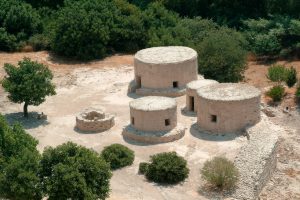
Khirokitia (also spelled Choirokoitia) represents the peak of Cyprus's Aceramic Neolithic period, when communities built permanent settlements without any knowledge of pottery production. The site covers approximately 3 hectares at its maximum extent and consists of circular stone and mudbrick houses clustered together on a hillside. These structures were protected by massive stone walls that enclosed the settlement on multiple sides. The archaeological remains document a sophisticated farming society that thrived for over 1,500 years. Residents cultivated wheat and barley, raised domesticated sheep, goats, and pigs, and supplemented their diet through hunting and gathering wild foods. The settlement's name likely derives from the Greek words for pig (χοίρος) and cradle (κοιτίς), suggesting an area where pigs were raised, though several alternative etymologies exist in local tradition. Historical Background Porphyrios Dikaios, director of the Department of Antiquities of Cyprus, discovered Khirokitia in 1934 during archaeological surveys for the newly established Cyprus Museum. He identified surface scatters of prehistoric material on the terraced slopes of the Maroni River valley. Between 1936 and 1946, Dikaios conducted six excavation campaigns at the site despite interruptions from World War II between 1939 and 1945. His initial findings, published in The Journal of Hellenic Studies in 1934, first dated the settlement to around 4000 BC. However, radiocarbon dating later revealed a much earlier foundation date of…

Read more

Marriage and Birth Traditions of Cyprus

Marriage and Birth Traditions of Cyprus

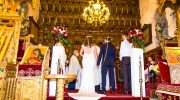
Marriage and birth stand as the most significant life transitions in traditional Cyprus society, each marked by elaborate rituals that involve entire communities. Wedding customs symbolize separation from childhood families and entry into adult society, while birth traditions welcome new members into both family and village. Orthodox Christianity frames these milestones through sacraments of marriage and baptism, but older customs dating to pre-Christian times persist beneath the religious overlay. The preservation and transmission of these customs falls mainly to new couples, their families, musicians who perform traditional songs, and folkloric groups that keep practices alive through demonstration and participation. Engagement and Marriage Preparations The engagement is usually arranged by the families of the bride and groom, who agree on the dowry, the wedding date, and other details. The groom's family visits the bride's family with gifts such as jewelry, clothes, and money. The bride and groom exchange rings and wear them on their right hands until the wedding day. In earlier times, marriages in Cyprus used to be arranged through the services of matchmakers known as proxenitra who facilitated negotiations between families. Upon engagement, the groom's family accepts the task of making traditional sesame-coated breads called glistarkes that the bride's family hands out as wedding invitations. These round breads carry symbolic meaning related to fertility and abundance. The ceremonial bread…

Read more
Sanctuary of Apollo at Vouni

Sanctuary of Apollo at Vouni

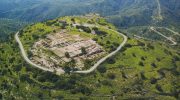
The Sanctuary of Apollo at Vouni embodies the fusion of religious devotion and political authority in ancient Cyprus, where the god of light, prophecy, and healing was venerated within the walls of a grand palace built by a pro-Persian ruler. Located on a hilltop in northwestern Cyprus near the ancient city of Soli, this site dates to the 5th century BC and highlights the island's strategic role in the Persian Empire's influence over the Mediterranean. As part of the Vouni Palace complex, the sanctuary served not only as a spiritual center but also as a symbol of the pro-Persian administration's power, blending local Cypriot traditions with Achaemenid and Hellenic elements. Dedicated to Apollo, the sanctuary facilitated rituals that reinforced loyalty to the Persian-backed king, integrating worship into daily political life. This site underscores Cyprus's position as a cultural crossroads, where religion legitimized rule, and its ruins today offer insights into how faith and governance intertwined in a pro-Persian context, amid the island's turbulent history of Greek and Persian rivalries. https://www.youtube.com/watch?v=Uh_6ywWkWSY A Religious Site in the Palace Complex The Sanctuary of Apollo occupied the highest terrace of the Vouni Palace, a fortified hilltop complex overlooking the sea and the ancient city of Soli, providing both defensive advantages and symbolic elevation for divine worship. Spanning a rocky area on the southern extremity,…

Read more