Explore Cyprus with Our Interactive Map

Explore our top stories and discover ideas worth your time.

Olive Cultivation and Oil Production Cyprus

Olive Cultivation and Oil Production Cyprus

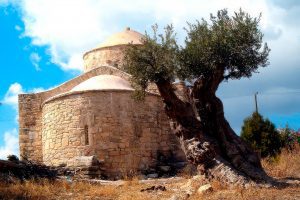
Olive trees shape Cyprus in ways that go far beyond agriculture. They define rural landscapes, anchor village life, and sit quietly at the centre of everyday cooking, ritual, and memory. From ancient stone presses to modern organic mills, olive cultivation on the island reflects continuity rather than reinvention. This is not a story of industrial scale, but of endurance. To understand Cyprus is to understand how olives are grown, harvested, pressed, and woven into daily life, generation after generation. sustainablefoodtrust.org2 More Than Agriculture: The Olive as a Way of Life Across Cyprus, olive trees are not confined to large estates or monoculture farms. They appear along field boundaries, beside houses, in courtyards, and on shared village land. Many families harvest their own olives each year, even if production is small, creating an agricultural culture that is deeply personal rather than purely commercial. dom.com_.cy3 Unlike countries that dominate global olive oil markets, Cyprus produces modest quantities. What it lacks in volume, it makes up for in intimacy. Olive cultivation here is less about export-driven efficiency and more about maintaining a relationship between people, land, and season. A History Rooted in the Earliest Settlements Olives have been part of Cypriot life for thousands of years. Archaeological evidence shows that wild olives were used by early communities during the Neolithic period, with deliberate…

Read more

Pentozali Cyprus Dance

Pentozali Cyprus Dance

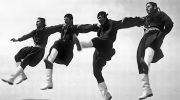
The Pentozali is one of the most powerful dances ever to cross the sea between Crete and Cyprus. Born in the mountains of western Crete as a dance of resistance and endurance, it later became part of Cyprus’s festival life, folk education, and stage tradition. When performed on Cypriot soil today, the Pentozali is not treated as a foreign import, but as a shared expression of strength, memory, and collective identity within the wider Hellenic world. This is not a dance meant to decorate an evening. It is meant to command attention. A Dance Built on Movement, Not Decoration Pentozali belongs to the family of pidichtos dances, a term that refers to leaping, high-impact movement rather than flowing steps. The body does not glide. It strikes, lifts, stamps, and suspends itself in the air. The posture is upright and direct, with little ornamentation, because the focus is on force and timing rather than elegance. The dance is usually performed in an open circle or semi-circle, with dancers linked at the shoulders. That formation creates both physical stability and a sense of collective strength. Everyone moves as one unit, but the attention belongs to the leader at the front of the line, whose improvisations set the intensity of the performance. Why Leadership Matters in Pentozali Unlike many communal dances, Pentozali places…

Read more
Kantara Castle Cyprus

Kantara Castle Cyprus

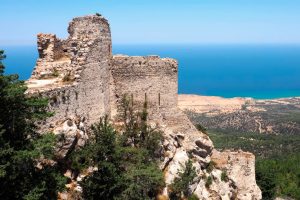
Kantara Castle is a Byzantine and medieval fortress located in the eastern Kyrenia mountain range in the Turkish-occupied part of Cyprus. The name comes from the Arabic word “qantara,” meaning bridge or arch, though some sources translate it as observation point. The castle sits at the easternmost position of three famous mountain castles in Cyprus, with Buffavento Castle to the west and St. Hilarion Castle further west. The castle occupies a strategic position with views over both the northern coast and the Mesaoria Plain. On clear days, visitors can see the Karpasia Peninsula, Famagusta Bay, and distant mainland coasts. This commanding location made Kantara essential for Cyprus’s defense for nearly 500 years. Historical Background The exact construction date remains unknown, but most historians place the Byzantine construction around 965 AD after Arab raiders were pushed back from Cyprus. For centuries, coastal populations had faced repeated attacks, and mountain watchtowers were needed to spot approaching ships and warn inland settlements. wikipedia-org Before the fortress existed, an Orthodox monastery dedicated to St. Mary of Kantara stood on the site. Defensive walls were gradually added, turning the religious complex into a military stronghold. This mix of sacred and defensive use was common during unstable periods. Kantara formed part of a signal network with the other Kyrenia mountain castles. Guards could see neighboring fortresses…

Read more