Explore Cyprus with Our Interactive Map

Explore our top stories and discover ideas worth your time.

Famagusta Cultural Heritage Museum

Famagusta Cultural Heritage Museum

The Famagusta Cultural Heritage Museum stands as a solemn witness to one of Cyprus's most painful chapters. Built in 1998 on the edge of the United Nations buffer zone in Deryneia, this center offers visitors a rooftop view across barbed wire into Varosha, the abandoned resort district that has remained frozen in time since August 1974. pixabay-com The Cultural Centre of Occupied Famagusta operates as both a museum and an observation point. The facility houses a multipurpose room where visitors watch audiovisual presentations about Famagusta before the 1974 Turkish invasion, when it served as the island's premier tourist destination and cultural hub. The museum displays photographs, posters, and artifacts documenting daily life in Famagusta when the city was home to 40,000 residents. Historical Background Deryneia village sits 2 kilometers south of Famagusta, positioned directly on the dividing line that has split Cyprus since 1974. The village lost approximately 75% of its territory to the Turkish occupation, including the lower part of the settlement known as Kato Deryneia and most of its agricultural land. Before 1974, residents could walk to the sea in minutes. After the invasion, barbed wire and military posts blocked their access. serene-property-com The village population includes about 1,000 refugees who fled from other areas during the invasion and settled in Deryneia. Another 3,000 former residents of Kato…

Read more
Omodos Traditional Village & Monastery

Omodos Traditional Village & Monastery

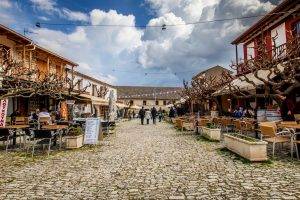
Omodos is a historic mountain village in Cyprus’s Troodos range, known for its Byzantine monastery, traditional architecture, and wine-making heritage. Located 42 kilometers northwest of Limassol at an elevation of 800 meters, the village lies within the Krasochoria district, the traditional wine-producing region of Cyprus. Its location in this wine heartland has shaped the local economy and identity for centuries. Shutterstock-com The village centers around a large cobblestone square, possibly the largest in Cyprus at 3,000 square meters, dating back to 1910. Stone houses with red-tiled roofs, wooden balconies, and flower-filled courtyards line narrow streets that wind through the settlement. The architecture reflects a careful balance between preservation and modern use, with many traditional homes now serving as guesthouses, wine cellars, and small museums. Globeguide-com Historical Foundation According to local legend, the village formed around a miraculous discovery. Residents from the neighboring villages of Ano and Kato Koupetra, which no longer exist, observed a mysterious fire appearing in the bushes at night. When they investigated at dawn, they found no trace of fire. After this event repeated over several nights, they excavated the site and uncovered a small cave that contained a wooden cross. A chapel was built above the cave to house the sacred relic, and this structure became the foundation of the Monastery of the Cross. Orthphoto-net The…

Read more

Ayios Nikolaos Sea Cave

Ayios Nikolaos Sea Cave

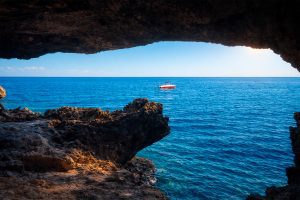
Cape Greco is a headland located between Ayia Napa and Protaras at the southern end of Famagusta Bay. The area covers 385 hectares and was designated as a National Forest Park under the administration of Cyprus's Forestry Department. The coastline here features dramatic limestone cliffs that reach 30 feet (roughly 10 meters) in height and contains numerous sea caves carved by wave action. cloveayianapa-com The caves are formed from layered limestone that was deposited in warm seas millions of years ago. The rock consists of hard and soft layers that erode at different rates. Waves constantly pound against the cliffs and dissolve the softer limestone faster than the harder layers above and below. This differential erosion creates the caves, arches, and tunnels that characterize the Cape Greco coastline. Historical Background The formation process began thousands of years ago when sea levels and wave patterns were different. Water enters cracks in the limestone and widens them through both mechanical force and chemical dissolution. Seawater contains salt and is slightly acidic, which helps dissolve calcium carbonate in the limestone. The caves show an almost horizontal layer of soft limestone that waves eroded easily. The overlying harder layer protected the caves from collapse and created roof structures. The lower layer is also harder and forms a several-meter-wide ledge. At some locations, this ledge…

Read more