Explore Cyprus with Our Interactive Map

Explore our top stories and discover ideas worth your time.

Work Culture and Employment Opportunities in Cyprus

Work Culture and Employment Opportunities in Cyprus

The country sits at the crossroads of three continents. This strategic position has shaped its economy into a diverse hub for international business. Cyprus joined the European Union in 2004 and adopted the euro in 2008, which strengthened its position as a business center. vkcyprusgroup-com The economy grew by 3.6% in 2025, outpacing most eurozone countries. This growth stems from strong performance in tourism, information technology, financial services, and shipping. The island hosts over 1,500 active job listings at any given time, with companies actively seeking both local and international talent. Cyprus offers several practical advantages for workers. The corporate tax rate stands at 12.5%, one of Europe's lowest. English is widely spoken in business settings, particularly in cities like Nicosia and Limassol. The climate provides sunshine year-round, and the cost of living remains moderate compared to other EU nations. Understanding the Cypriot Work Environment Workplace culture in Cyprus blends European professionalism with Mediterranean warmth. Companies value relationship-building and personal connections as much as technical competence. Trust develops through consistent interaction, and many business relationships extend beyond office hours into social settings. The standard working week spans 38 to 40 hours across five days. Most offices operate from 8:00 AM to 5:00 PM, though some businesses follow split schedules with afternoon breaks. Employees can expect 20 days of paid annual…

Read more

Traditional Weaving in Cyprus

Traditional Weaving in Cyprus

Basket weaving dates from ancient times in Cyprus when baskets served a range of specific practical purposes from carrying agricultural produce to storing food. The practice of weaving was highly developed during Byzantine times and has been passed down through generations to the present day. mavink-com The Materials and Methods of Making Baskets Basket makers traditionally harvest materials from Cyprus's bountiful countryside. Water reeds, grasses, rushes, bamboo, terebinth branches, and stems from aquatic plants all serve as raw materials. The village of Akrotiri became particularly famous for its soft baskets woven from marsh reeds. Men and women in villages across the island would balance techniques and artistry to create beautiful baskets both for their own use and to earn a living. medwet.org The weaver can make very interesting and complex designs and patterns, which takes a lot of practice and patience to learn. Weavers color the straw with different vegetable colorings to make the various colored strands to weave from. Each weaver has their own way of working, creating intricate designs differently from other people. The baskets are made from a special kind of straw, which can also be used to make bread baskets and caskets with lids. porkhov-muzeum-ucoz-ru A typical basket can take up to three hours to complete. The process begins with harvesting the appropriate materials when they…

Read more
Kourion Theatre

Kourion Theatre

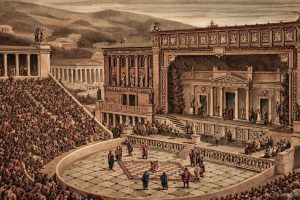
The Theatre of Kourion is one of the most impressive ancient theatres in Cyprus. It was built in the Late Hellenistic period and later enlarged under Roman rule. The theatre shows how important performances and public gatherings were in ancient times. Its location on a cliff overlooking the Mediterranean Sea highlights both careful city planning and an appreciation for natural beauty. The theatre could hold up to 3,500 spectators and was used for plays and other public events for many centuries. trapvisitor-com The History of Kourion and Its Theatre Kourion was one of the most important city-kingdoms in ancient Cyprus. Tradition says it was founded by Greeks from Argos in the Peloponnese in the 13th century BCE, during the Mycenaean expansion. Archaeological evidence supports links with Argos, and the city’s people saw themselves as descendants of Greek settlers. wikipedia-org The city sat on hills above the fertile Kouris River valley, giving it both rich farmland and strong defenses. This location helped Kourion become a major political and economic center during the Classical, Hellenistic, and Roman periods. The theatre was first built at the end of the 2nd century BCE under Ptolemaic rule. The original building was fairly small. In the early 2nd century AD, under Roman Emperor Trajan, it was greatly expanded. More seats were added, and the architecture was…

Read more