Explore Cyprus with Our Interactive Map

Explore our top stories and discover ideas worth your time.

Western Kingdom of Paphos

Western Kingdom of Paphos

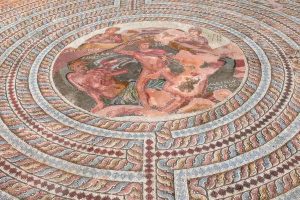
Paphos refers to two distinct but connected ancient cities in southwestern Cyprus. Palaipaphos (Old Paphos), located at modern Kouklia village, was the original seat of the kingdom and the center of Aphrodite worship from the 12th century BC. Nea Paphos (New Paphos), founded around 320-310 BC at the modern coastal city of Paphos, served as the administrative and commercial capital during Hellenistic and Roman periods. www.sovereign.com The archaeological complex encompasses both sites and was inscribed on the UNESCO World Heritage List in 1980. The Sanctuary of Aphrodite at Palaipaphos dates to Mycenaean times and functioned as one of the most important pilgrimage destinations in the ancient Greek world. The Archaeological Park at Kato Paphos preserves Roman villas with elaborate mosaic floors, a Hellenistic theater, fortifications, public buildings, and the Tombs of the Kings necropolis. Together, these sites document over 2,500 years of continuous religious and political significance. Historical Background According to Greek stories, the hero Agapenor from Arcadia founded Paphos after the Trojan War and built a temple to Aphrodite around 1200 BC. Archaeology confirms Mycenaean people lived there, supporting this date. This makes it one of the earliest Greek religious sites in Cyprus. The sanctuary was unusual because it did not have a human statue of the goddess. Instead, people worshipped a conical stone, possibly a meteorite, as a…

Read more
Endemic Euphorbia Species in Cyprus

Endemic Euphorbia Species in Cyprus

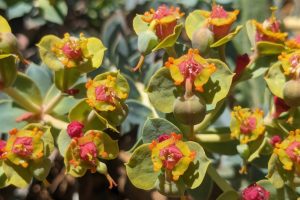
Tucked away in the rugged hills and mountains of Cyprus, two special plants — Euphorbia veneris and Euphorbia lemesiana — bring subtle beauty to rocky spots. These endemic spurges, found nowhere else, whisper stories of ancient gods and recent discoveries. But what makes them thrive in such harsh places, and why are they like hidden treasures waiting to be found? www.inaturalist.org What Are These Tough Little Island Natives? Euphorbia veneris and Euphorbia lemesiana are both small, wild plants from the spurge family, a group known for their milky sap and simple flowers. They're perennials that come back each year, perfectly adapted to Cyprus's dry, sunny landscapes, adding quiet charm to the island's wild corners. How Did These Plants Spring from Cyprus's Mythical and Fiery Past? The Euphorbia genus gets its name from Euphorbus, an ancient Greek doctor around 12 BC, whose name meant "well-fed" — a funny twist since these plants are toxic. Euphorbia veneris honors Venus (Aphrodite), the goddess born from Cyprus's seas, linking it to the island's mythical roots. Described in 1963, it's a nod to Cyprus's geological history from ancient ocean floors pushed up by tectonic forces. Euphorbia lemesiana, named after Limassol (Lemesos), was discovered more recently in 2015 as part of the Eastern Mediterranean spurge group, evolving in isolation amid the island's volcanic past. www.inaturalist.org Picture…

Read more

Alampra Bronze Age Copper Town

Alampra Bronze Age Copper Town

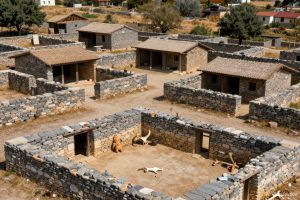
Alampra Mouttes stands as one of Cyprus’s most significant Middle Bronze Age settlements. Located in central Cyprus near the modern village of Alampra, this archaeological site provides rare evidence of prehistoric urban life and early copper metallurgy between 1900 and 1650 BC. The excavated remains reveal a substantial community that occupied a strategic position close to copper ore deposits at the foothills of the Troodos Mountains. Wikipedia-com The archaeological site occupies the northeast facing flank of a ridge between two hills called Mouttes and Spileos. The settlement consists of multi room rectangular houses built from local limestone and flint, with walls still standing in several areas. During its period of occupation, Alampra functioned as a largely self sufficient agricultural and metallurgical community. The site lies about 8 kilometers east of Marki Alonia, another major Bronze Age settlement, and sits at the point where the volcanic pillow lava foothills of the Troodos Massif meet the calcareous limestone of the central Mesaoria plain. Historical Background Archaeological interest in Alampra began in the 19th century, but the first systematic investigation took place in 1924 when Swedish archaeologist Einar Gjerstad excavated a prehistoric house he named Mavroyi, meaning red earth. For decades, this remained the only precisely documented building in Cyprus from the long period between the Chalcolithic and the end of the Middle…

Read more