Explore Cyprus with Our Interactive Map

Explore our top stories and discover ideas worth your time.

Stavrovouni–Lefkara Protected Landscape

Stavrovouni–Lefkara Protected Landscape

The Stavrovouni-Lefkara Hills region forms a distinctive landscape in southeastern Cyprus where forested mountain slopes meet traditional agricultural communities. The Stavrovouni Forest has an extent of approximately 19 square kilometres, with its highest peak reaching 688 metres at the center, where the historic monastery stands. alltrails-com This protected landscape extends from the Stavrovouni Forest in the east through the rolling hills surrounding the villages of Pano and Kato Lefkara. The terrain features pine-covered ridges, rocky outcrops, cultivated terraces, and valleys carved by seasonal streams. There are over 200 types of plants in the Stavrovouni Forest, 22 of them being endemic. The area serves as an important ecological corridor connecting different habitat types and supporting diverse wildlife populations across varying elevations and microclimates. From Ancient Pilgrimage Routes to Conservation Priority The Stavrovouni region holds centuries of human history alongside its natural heritage. According to tradition, Stavrovouni Monastery was founded by Saint Helena and Saint Constantine around AD 327-329, establishing this mountain as a sacred site from early Christian times. The monastery's presence influenced settlement patterns and land use throughout the surrounding hills for over 1,600 years. Traditional agriculture developed in the lower elevations, with villages like Lefkara becoming renowned for lace-making and silverwork. The forest areas provided timber, charcoal, and grazing land for local communities. British colonial authorities began formal forest…

Read more
Traditional Cypriot Cooking with Olive Oil, Lemon, and Herbs

Traditional Cypriot Cooking with Olive Oil, Lemon, and Herbs

Traditional Cypriot cooking relies on three essential ingredients: olive oil, lemon, and fresh herbs such as mint, oregano, and parsley. This simple trinity defines the island's approach to food, creating dishes that emphasize natural flavors rather than complex techniques. Traditionally, cumin and coriander seeds make up the main cooking aromas of the island. somanyhorses-ru Olive oil serves as the primary fat for salad dressings and vegetable preparations, though not for cooking meat dishes. Lemon juice appears in nearly every savory dish, from marinades to finishing touches. Fresh herbs grow abundantly across Cyprus, with mint being particularly important. Mint grows abundantly in Cyprus, and locals use it for everything, particularly in dishes containing ground meat. This cooking philosophy developed over centuries of Mediterranean agriculture and remains central to Cypriot identity today. Ancient Roots of Olive Cultivation Greece started to produce its own olives on Minoan Crete and Cyprus in the Late Bronze Age. Historians suggest that in Cyprus, people were among the first in the world to learn how to extract oil from olives, with the first tools dating back to around the 12th to 6th centuries BCE. kiprinform-com These early implements consisted of stone millstones turned by donkeys that crushed olives between plates to yield oil. Archaeological evidence shows that Cyprus exported olive oil to Egypt, the Middle East, Greece,…

Read more

Vouni Necropolis

Vouni Necropolis

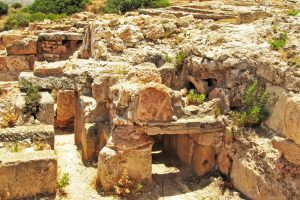
On gentle slopes near the medieval abbey of Bellapais in the Turkish-occupied part of Cyprus sits an extensive Bronze Age cemetery known to the world almost exclusively through its dead. The Vounous necropolis contains 164 rock-cut chamber tombs that served an unknown settlement for nearly five centuries, from approximately 2500 to 2000 BCE, preserving one of the finest collections of prehistoric pottery ever discovered on the island. wikipedia-org Vounous presents archaeologists with an unusual challenge. Despite extensive searches that began in the 1930s and continue sporadically today, the settlement that used this cemetery has never been located. The site sits somewhere between the villages of Ozanköy and Çatalköy in the Kyrenia region, but the homes, workshops, and temples of the people buried here remain hidden beneath modern development or agricultural land. Historical Background The tombs at Vounous date to the Early and Middle Bronze Age, a period when Cyprus underwent major transformation. Around 2500 BCE, settlers from Anatolia arrived on the island, bringing new pottery styles, copper-working technology, plow agriculture, and the warp-weighted loom. These immigrants, identified as the Philia Culture, moved quickly to the foothills of the Troodos Mountains to exploit the rich copper deposits. shutterstock-com The people who used Vounous cemetery were part of this cultural shift. Their pottery shows clear Anatolian influence, particularly the distinctive Red Polished…

Read more