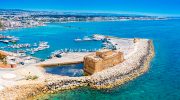
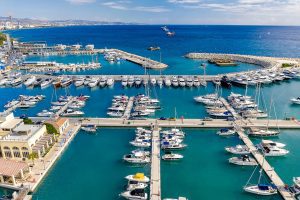
Cyprus has always occupied a strategic position between continents, and during the medieval period this geography transformed the island into one of the most heavily fortified maritime strongholds in the Mediterranean. Control of Cyprus meant control of ports, sea lanes, and access to trade routes linking Europe, the Middle East, and North Africa. As a result, successive powers reshaped its coastline with castles, harbor defenses, and naval infrastructure, turning the island itself into a living system of maritime control.
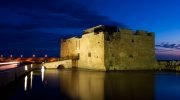
This is not a story of isolated fortresses. It is the story of how the sea dictated power, architecture, and survival in medieval Cyprus.
- Why the Sea Defined Power in Medieval Cyprus
- Foundations Laid Before the Crusades
- The Lusignan Kingdom and the Fortification of Harbors
- Pressure, Raids, and the Limits of Medieval Defenses
- Venetian Rule and a New Military Philosophy
- Reinventing Fortresses for the Age of Cannons
- How Maritime Control Worked Day to Day
- The Ottoman Conquest and the End of Medieval Control
- Why These Fortresses Still Matter
- Experiencing Cyprus’s Maritime Fortresses Today
- A Coastline Shaped by Power and the Sea
Why the Sea Defined Power in Medieval Cyprus
In the medieval Mediterranean, maritime power was less about open naval battles and more about control of access. Harbors, fortified ports, and coastal strongholds determined who could trade, resupply fleets, or launch attacks. Cyprus’s location made it uniquely valuable, sitting at the intersection of east–west and north–south sea routes.
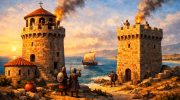
Rather than relying on a single dominant port, rulers developed a network of coastal defenses. Each fortified harbor supported the others, allowing ships to move safely while creating overlapping zones of protection. Cyprus became both a gateway for commerce and a barrier against hostile fleets.
Foundations Laid Before the Crusades
Long before Western European rulers arrived, Byzantine authorities had already recognised the vulnerability of Cyprus’s coastline. As Arab naval raids intensified from the seventh century onward, early forts and watchtowers were constructed to monitor the horizon and protect key anchorages.
These early defenses were practical rather than monumental. Their purpose was warning and delay, not prolonged siege resistance. However, they established a defensive mindset that later rulers would expand rather than replace. The idea that Cyprus’s safety depended on the sea was already firmly established.
The Lusignan Kingdom and the Fortification of Harbors
When the Lusignan dynasty took control of Cyprus in the late twelfth century, the island became the most important Crusader stronghold after the loss of mainland territories in the Levant. For the Lusignans, survival depended on holding the ports.
Kyrenia and Control of the Northern Coast
Kyrenia Castle emerged as a key maritime fortress during this period. Originally Byzantine in origin, it was expanded into a powerful rectangular stronghold overlooking one of the island’s most sheltered harbors. Its thick walls and corner towers allowed it to function as both a naval defense point and a symbol of royal authority.
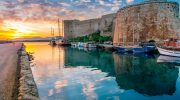
Together with inland mountain castles, Kyrenia formed part of a wider surveillance system. Ships approaching from Anatolia could be detected early, giving coastal defenses time to respond.
Famagusta and the Wealth of the Eastern Mediterranean
Famagusta’s rise was dramatic. After the fall of Acre in 1291, merchants, refugees, and religious orders flooded into the city, transforming it into one of the richest ports in the Mediterranean. Wealth on this scale demanded protection.
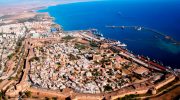
The Lusignans constructed the original harbor citadel, which the Venetians later radically remodeled into the stronghold known today as Othello Castle. Chains could be drawn across the harbor entrance, physically blocking enemy vessels while allowing authorities to control trade. This combination of commerce and defense defined Famagusta’s power.
Pressure, Raids, and the Limits of Medieval Defenses
By the fourteenth century, Cyprus faced increasing instability. Genoese forces seized Famagusta and held it for nearly a century, severely weakening the Lusignan Crown’s centralized control. At the same time, Mamluk fleets from Egypt attacked Cypriot ports in response to piracy and Crusader raids.
These conflicts exposed the limits of traditional medieval fortifications. Tall walls designed to deter attackers proved vulnerable to sustained naval pressure and emerging siege technologies. Cyprus’s defenses needed to evolve, or they would fail.
Venetian Rule and a New Military Philosophy
When Venice assumed control of Cyprus in 1489, the island became part of a vast maritime empire. For the Venetians, Cyprus was not simply a possession. It was a frontline defensive base protecting eastern trade routes.
Venetian administrators approached defense systematically. They relied on professional military engineers, centralized planning, and long-term investment. Under Venetian rule, Cyprus was transformed into a carefully designed defensive machine rather than a collection of feudal strongholds.
Reinventing Fortresses for the Age of Cannons
Gunpowder warfare forced a fundamental rethink of military architecture. Cannons could shatter high stone walls, rendering older castles obsolete. Venetian engineers responded with radical new designs.
Walls were lowered and massively thickened, often reinforced with earth to absorb impact. Rounded or angular bastions projected outward, allowing defenders to fire along the base of walls and eliminate blind spots. Defense became about geometry as much as stone.
Famagusta and the Martinengo Bastion
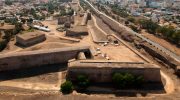
Famagusta’s fortifications became a showcase of Renaissance military engineering. The Martinengo Bastion, with its arrow-shaped form and protected artillery platforms, represented some of the most advanced defensive thinking of the period. It allowed a relatively small garrison to resist overwhelming forces far longer than expected.
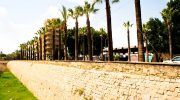
Nicosia’s Star-Shaped Walls
Although inland, Nicosia was rebuilt as part of the same maritime strategy. Its eleven-bastion star-shaped wall system ensured that control of the coast was supported by a secure administrative center. These fortifications remain among the best-preserved examples of Renaissance military architecture in the Mediterranean.
How Maritime Control Worked Day to Day
Fortresses alone could not control the sea. Venetian strategy combined static defenses with active surveillance. Coastal watchtowers signaled approaching fleets, while fortified harbors used chains, gates, and controlled entry points to regulate movement.
Cyprus’s ports also functioned as logistical hubs. Fleets resupplied, repaired ships, and found safe anchorage, allowing Venice to project power far beyond the island itself. Cyprus acted simultaneously as shield and staging ground.
The Ottoman Conquest and the End of Medieval Control
Between 1570 and 1571, the Ottoman Empire launched and completed a massive invasion of Cyprus. Despite Venice’s advanced fortifications, the scale of the assault was decisive. Nicosia fell after a brutal siege, and Kyrenia surrendered soon after.
Famagusta resisted for nearly a year. Its modern defenses allowed a small force to delay one of the largest armies of the age, turning the siege into a symbol of determined resistance. When the city finally fell in 1571, it marked the end of Western maritime hegemony on the island and the start of a new imperial era.
Why These Fortresses Still Matter
Cyprus’s medieval naval fortresses are not simply remnants of war. They are records of how technology, geography, and political ambition interacted over centuries. Each wall and bastion reflects changing ideas about power and control of the sea.
Today, these sites shape how Cyprus understands its own past. They appear in education, cultural identity, and tourism, reminding visitors that the island has always existed in dialogue with the Mediterranean.
Experiencing Cyprus’s Maritime Fortresses Today
Many of these sites remain accessible and reveal different aspects of Cyprus’s naval history:
- Kyrenia Castle offers views over a working harbor and houses the Shipwreck Museum, linking medieval defense to ancient seafaring.
- Famagusta’s walls and Othello Castle form one of the most complete fortified cities in the Mediterranean.
- Paphos Castle illustrates how even smaller ports were integrated into wider defensive systems.
- Limassol Castle connects coastal defense with everyday urban life.
Each site tells a different chapter of the same maritime story.
A Coastline Shaped by Power and the Sea
The medieval maritime powers of Cyprus did more than defend territory. They transformed the island into a strategic key that shaped Mediterranean history. From Lusignan harbor citadels to Venetian cannon-resistant bastions, Cyprus’s coastline became a record of evolving military thought.
Today, these fortresses stand not as symbols of conflict alone, but as evidence of Cyprus’s enduring role as a crossroads of civilizations. To understand them is to understand the island itself, shaped by trade, strategy, and the constant presence of the sea.