Explore Cyprus with Our Interactive Map

Explore our top stories and discover ideas worth your time.

Floss Silk Tree

Floss Silk Tree

Imagine walking through a sunny park in Nicosia or Limassol when a tree catches your eye with its trunk covered in sharp thorns and branches bursting with pink flowers like fluffy cotton candy. Perhaps one of the most bizarre trees you'll encounter is the floss silk tree this South American visitor that's found a home in Cyprus, hiding surprises in its spiky exterior that make you wonder what other secrets it holds. Konstantin-Solovev Getting to Know This Exotic Guest The floss silk tree is a large, deciduous tree known for its striking appearance and fluffy seeds. It's part of the broader world of flowering plants, fitting into the Malvaceae family alongside everyday wonders like cotton and hibiscus, all sharing a love for warm climates and showy blooms. A Journey from Rainforests to Island Parks Native to the lush tropical forests of South America, where ancient peoples used its fibers for ropes and padding, this tree crossed oceans during the age of exploration. In Cyprus, it likely arrived in the early 20th century under British influence, planted as an ornamental to add flair to gardens and streets, much like other far-flung arrivals that helped shape our island's green landscape over the last century. Spikes, Blooms, and Fluffy Surprises What stands out most is its swollen, bottle-shaped trunk armored with large, conical…

Read more
Black Locust Of Cyprus

Black Locust Of Cyprus

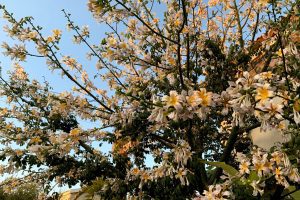
Imagine walking through an older Cypriot village or along a rural roadside in late May, when the air suddenly fills with a sweet, heavy perfume reminiscent of orange blossom. Looking up, you see long, drooping clusters of creamy-white flowers hanging like fragrant tassels from the branches of a graceful, thorny tree. This is the black locust of Cyprus – a fast-growing, nitrogen-fixing beauty that has quietly become part of the island’s living heritage. www.inaturalist.org The False Acacia of the Legume Family Black locust, Robinia pseudoacacia, belongs to the vast Fabaceae (legume) family – the same group as carob, peas and beans. It is a deciduous tree famous for its ability to enrich poor soils by fixing nitrogen from the air. Locally it is known as Ροπίνια η ψευδοακακία (Ropínia i pseudoakakía), literally “false acacia Robinia”, because its pinnate leaves and pea-like flowers resemble true acacias even though it is not closely related. From American Forests to Cypriot Roadsides Native to the Appalachian Mountains and Ozarks of the eastern United States, black locust was one of the first North-American trees brought to Europe in the early 17th century. It reached Cyprus during the British period (late 19th–early 20th century) and was widely planted for durable timber, excellent honey production, erosion control on degraded land, and quick shade in villages and towns.…

Read more

Gallery Kypriaki Gonia, Cyprus

Gallery Kypriaki Gonia, Cyprus

Gallery Kypriaki Gonia stands as one of Larnaca's most established independent art spaces. Located at 45 Stadiou Street in central Larnaca, this gallery has operated continuously since 1993. The name "Kypriaki Gonia" translates to "Cypriot Corner," which accurately reflects its core mission to showcase art by local and international artists. The gallery maintains a focus on both traditional and contemporary artistic approaches, giving visitors exposure to different styles and periods of Cypriot art. googlemaps-com Over three decades, the gallery has built a reputation for consistent quality in its exhibition program. It provides a platform where established artists can present major bodies of work and emerging artists can gain visibility. The space operates as a commercial gallery while also functioning as a cultural venue that contributes to Larnaca's artistic infrastructure. Historical Context By 2013, Gallery Kypriaki Gonia celebrated its 20th anniversary with a significant group exhibition. This show brought together works by 70 Cypriot and foreign artists across multiple media, including paintings, sculpture, ceramics, etchings, and photography. The exhibition received the auspices of the Mayor of Larnaca, and the opening ceremony was performed by Petros Christodoulou. All works were offered at modest prices of up to 200 euros, with 50 percent of revenue directed to the Larnaca Municipality Community Store. This charitable component demonstrated the gallery's commitment to community service alongside…

Read more