Explore Cyprus with Our Interactive Map

Explore our top stories and discover ideas worth your time.

Black Locust Of Cyprus

Black Locust Of Cyprus

Imagine walking through an older Cypriot village or along a rural roadside in late May, when the air suddenly fills with a sweet, heavy perfume reminiscent of orange blossom. Looking up, you see long, drooping clusters of creamy-white flowers hanging like fragrant tassels from the branches of a graceful, thorny tree. This is the black locust of Cyprus – a fast-growing, nitrogen-fixing beauty that has quietly become part of the island’s living heritage. www.inaturalist.org The False Acacia of the Legume Family Black locust, Robinia pseudoacacia, belongs to the vast Fabaceae (legume) family – the same group as carob, peas and beans. It is a deciduous tree famous for its ability to enrich poor soils by fixing nitrogen from the air. Locally it is known as Ροπίνια η ψευδοακακία (Ropínia i pseudoakakía), literally “false acacia Robinia”, because its pinnate leaves and pea-like flowers resemble true acacias even though it is not closely related. From American Forests to Cypriot Roadsides Native to the Appalachian Mountains and Ozarks of the eastern United States, black locust was one of the first North-American trees brought to Europe in the early 17th century. It reached Cyprus during the British period (late 19th–early 20th century) and was widely planted for durable timber, excellent honey production, erosion control on degraded land, and quick shade in villages and towns.…

Read more
Cyprus Archaeological Museums

Cyprus Archaeological Museums

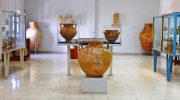
Most people think of museums as dusty repositories of old things, but Cyprus's archaeological museums are different - they're time machines that transform scattered ruins into coherent human stories. From Stone Age tools to sunken Roman ships, these institutions preserve not just artifacts but memory itself, showing how an island at the crossroads of three continents became a meeting place of cultures, faiths, and civilizations. Stepping inside, visitors encounter objects once held by real people whose lives weren't so different from the present day. Guardians of an Island's Memory Cyprus's archaeological museums form a network across the island, each one telling the story of its region while contributing to a larger narrative of continuity and change. These aren't just buildings with display cases - they're active archaeological institutions involved in excavations, conservation, research, and education. They preserve artifacts spanning over 11,000 years of human presence, from prehistoric farming villages to early Christian basilicas. wikipedia-com Rather than overwhelming visitors with monumental sculpture and temple columns alone, Cypriot museums emphasize daily life. Displays include pottery and cooking tools, jewelry and amulets, farming equipment and fishing gear, religious symbols and children's toys. This human-centered approach makes ancient life feel familiar rather than remote, showing that people across millennia shared the same basic needs, hopes, and fears we experience today. How Cyprus Learned to…

Read more

Makronissos Tombs

Makronissos Tombs

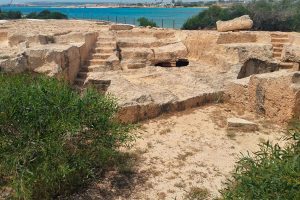
Carved into solid rock on a small peninsula west of Ayia Napa, the Makronissos Tombs are a window into ancient Cyprus. These 19 underground burial chambers date back over 2,000 years and reveal how people lived, died, and honored their dead during the Hellenistic and Roman periods. kiprguru-com The Makronissos Tombs form an ancient necropolis, a city of the dead, where families buried their relatives between the 4th century BCE and the 4th century CE. Each tomb consists of a stepped pathway that descends into the rock, leading to a rectangular chamber sealed by stone slabs. Inside, the chambers feature three stone benches carved along the walls and a central rectangular trench slightly lower than the floor. The site also includes a small sanctuary built from large irregular stone blocks and remnants of an ancient quarry that operated nearby. The quarry unfortunately damaged some tombs, but enough survived to tell us about burial practices in ancient Cyprus. The Ancient Settlement of Thronon According to historical records, an ancient settlement called Thronon existed in the Ayia Napa area, along with several smaller communities. These settlements thrived until the Early Christian period but were abandoned around the 7th century CE during the Arab raids that swept across the Eastern Mediterranean. The tombs at Makronissos served as the final resting place for people…

Read more