Explore Cyprus with Our Interactive Map

Explore our top stories and discover ideas worth your time.

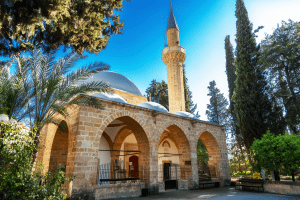
Arabahmet Mosque (Nicosia)

Arabahmet Mosque (Nicosia)

Arabahmet Mosque is a 16th-century Ottoman mosque located in the Arab Ahmet Quarter of Nicosia. Built in the late 1500s shortly after the Ottoman conquest of Cyprus in 1571, the mosque was named after Arab Ahmet Pasha, one of the commanders who led the Ottoman army during the invasion. He also served as Governor General of Rhodes. shutterstock-com The mosque is the only one in Cyprus to feature typical Turkish-style domes. A large central dome about 6 meters across covers the main prayer hall, three smaller domes protect the entrance porch, and four more tiny domes sit at the building's corners. This design follows the classical Anatolian style of placing a dome on a square building. Historical Background Arab Ahmet Pasha was a senior military officer in the Ottoman forces that conquered Cyprus. After the successful invasion, the neighborhood where his mosque stands became one of the most important residential areas in Ottoman Nicosia. High-ranking Turkish officials, judges (kadis), and governors (pashas) chose to live here for two practical reasons. severis-org First, the area was close to the old Ottoman Saray, which had been the Lusignan Palace before the conquest. Officials could walk to work easily. Second, Arab Ahmet Quarter caught the evening breeze coming from Morphou Bay in the west, making the coolest part of the city during hot…

Read more
Cultural and Heritage Travel Planning

Cultural and Heritage Travel Planning

Cyprus offers exceptional cultural heritage concentrated in a small Mediterranean island. Three UNESCO World Heritage Sites showcase Byzantine art, Roman mosaics, and Neolithic settlements spanning over 9,000 years of continuous habitation. The island sits at the crossroads of Europe, Asia, and Africa, creating a unique blend of Greek, Byzantine, Ottoman, and British influences. Cultural travelers find well-preserved monuments, traditional villages practicing ancient crafts, and living Orthodox traditions. The compact geography allows visiting multiple historical periods and cultural expressions within short distances. This concentration of heritage makes Cyprus particularly efficient for travelers seeking deep cultural immersion without extensive travel between sites. The Three UNESCO World Heritage Sites Paphos became Cyprus's first UNESCO World Heritage Site in 1980. The Paphos Archaeological Park covers most of the ancient Greek and Roman city with exceptional Roman mosaics from the 3rd and 4th centuries. The House of Dionysus, House of Theseus, House of Aion, and House of Orpheus display preserved mosaic floors depicting mythological scenes with remarkable detail and color. The Tombs of the Kings, carved from solid rock in the 4th century BC, features underground chambers where Ptolemaic aristocrats were buried. Entrance fees are 4.50 euros for the Archaeological Park and 2.50 euros for the Tombs of the Kings. wikimedia-org The Painted Churches in the Troodos Region were listed in 1985, with ten Byzantine…

Read more

Cyprus Omens Divination Traditions

Cyprus Omens Divination Traditions

Cyprus maintains vibrant divination and superstition traditions that blend ancient Greek practices with Christian Orthodox beliefs and Ottoman influences. The most iconic practice remains kafemanteia or coffee fortune telling, where patterns left by Cyprus coffee grounds reveal past and future events. These traditions persist across both Greek and Turkish Cypriot communities, demonstrating how folklore unites the divided island. Both young and old Cypriots observe omens and follow superstitious rituals, some from habit taught since childhood, others with genuine belief. The practices serve social and psychological functions, providing comfort during uncertainty while creating bonds through shared cultural knowledge passed between generations, typically from grandmother to granddaughter. The ancient art of reading coffee cups After drinking thick Cyprus coffee, the drinker places the saucer over the cup, makes a wish, and flips the entire assembly upside down. The cup rests on the saucer for several minutes while grounds settle and create patterns on the cup's interior. A designated reader, often an older woman called kafetzou, interprets shapes formed by the residue. The top half of the cup typically shows the future while the bottom half reveals the past. tarot9-ru Some readers claim the left side indicates bad news while the right side brings good tidings. White designs formed by empty spaces represent positive developments, while dark patterns created by concentrated grounds signal…

Read more