Explore Cyprus with Our Interactive Map

Explore our top stories and discover ideas worth your time.

Ayia Irini Sanctuary 

Ayia Irini Sanctuary 

Nestled near the northwestern coast of Cyprus, close to Morphou Bay, stands one of the Mediterranean's most important archaeological discoveries.  Ayia Irini was a sacred sanctuary that served the people of ancient Cyprus for over a thousand years, from 1200 B.C. until around 500 B.C. The site became famous after excavations revealed thousands of terracotta statues left as offerings to the gods.   Today, it remains a testament to how people in ancient Cyprus expressed their religious beliefs through art and ritual. The sanctuary's discovery transformed our understanding of Cypriot religion and culture during the Iron Age, making it one of the most studied sacred sites of the ancient Mediterranean. From Bronze Age Shrine to Iron Age Center of Devotion The sanctuary's history began in the Late Bronze Age around 1200 B.C. and continued until the end of the Cypro-Archaic period. The site underwent significant transformations throughout its long existence.  Originally, it consisted of rectangular houses built with mud brick walls on stone foundations. These buildings were arranged around a large open court, with some structures serving as living spaces and storerooms for the priests, while others were dedicated to religious ceremonies. The sanctuary was flooded multiple times, and at the beginning of Cypro-Archaic II, it was covered with layers of sand and gravel. Rather than abandon the site, the community…

Read more
Cavo Greco Sunrise Viewpoint, Cyprus

Cavo Greco Sunrise Viewpoint, Cyprus

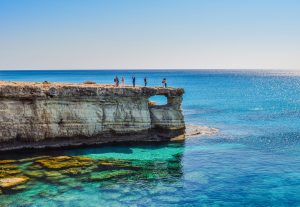
The Cavo Greco sunrise viewpoint sits at the southeastern edge of Cyprus, positioned at 95 meters above sea level on a small limestone mountain within Cape Greco National Forest Park. This protected area spans 385 hectares between the resort towns of Ayia Napa and Protaras. The viewpoint marks the easternmost point of both the Republic of Cyprus and the European Union, offering unobstructed panoramas of the Mediterranean Sea, Famagusta Bay, and the surrounding coastline. Visitors come here primarily for the spectacular sunrise displays that occur daily, with the sun rising directly from the sea in vibrant colors that illuminate the limestone cliffs and turquoise waters below. Historical Background The limestone cliffs and formations seen today were created through a combination of tectonic activity and the erosive forces of the sea and wind over millions of years. The karst topography has produced numerous caves and natural arches throughout the area. The cape was known as Cape Pedalion in antiquity, and according to Strabo the trapezoidal hill lying above it was sacred to Aphrodite. Archaeological evidence shows the area has been inhabited since Neolithic times, with one of the oldest settlements in Cyprus discovered here in 1992. Cape Greco was designated as a National Forest Park in 1993 to preserve its unique ecosystems and prevent further degradation. Between 1910 and 1920, the…

Read more
Cyprus Metal Crafts Through Ages

Cyprus Metal Crafts Through Ages

Cyprus holds a unique position in metalworking history. The island gave its name to copper itself, with the Latin term "cuprum" deriving from "Cyprus." For over 6,000 years, Cypriot artisans have shaped metals into tools, weapons, jewelry, and decorative objects. The tradition spans from simple Chalcolithic copper tools around 4000 BCE to Byzantine gold treasures and modern handcrafted silver jewelry. This heritage connects ancient mining operations in the Troodos Mountains with contemporary workshops where craftspeople maintain techniques passed down through generations. Historical Background The metal story in Cyprus begins during the Chalcolithic period when early settlers discovered native copper deposits. By 3000 BCE, Cypriots were already working copper to create artifacts of high quality that circulated throughout the Mediterranean. Archaeological evidence shows that copper smelting started during the third millennium BCE, transforming the island into a major production center. The Bronze Age brought massive expansion. Cyprus became the largest copper supplier around the Mediterranean, with the island's strategic location between three continents making it a vital trading hub. Ancient texts from Babylon, Mari, and Alalakh dating to the 19th through 17th centuries BCE mention copper from Alashiya, the Bronze Age name for Cyprus. The Ulu Burun shipwreck discovered off Turkey's southwestern coast carried over 10 tons of Cypriot copper ingots when it sank in the late 14th century BCE, demonstrating…

Read more