Explore Cyprus with Our Interactive Map

Explore our top stories and discover ideas worth your time.

Lefkara Lace (Lefkaritika)

Lefkara Lace (Lefkaritika)

Lefkara Lace (Lefkaritika) is a world-renowned handmade lace tradition from Cyprus, distinguished by its geometric precision, white-on-white stitching, and centuries-old transmission through female artisans. Originating in the village of Lefkara, this craft blends intricate patterns that symbolize nature and life, creating delicate textiles prized for their elegance and cultural depth. Recognized by UNESCO as intangible cultural heritage in 2009, it represents Cyprus's enduring artisanal legacy, where women's hands have woven history into fabric for generations. A Timeless Craft of Elegance and Skill Lefkara lace, known locally as Lefkaritika, embodies the island's rich textile heritage, a form of needlework where fine linen threads are drawn and stitched into intricate designs that appear almost ethereal against a white background. Produced exclusively in the villages of Pano and Kato Lefkara in the Larnaca District, this lace features geometric motifs inspired by nature, such as rivers, daisies, and almond blossoms, arranged in symmetrical patterns that require exceptional precision and patience. The craft's white-on-white aesthetic, using unbleached cotton or linen, creates subtle shadows and textures that play with light, giving pieces a luminous quality. This tradition not only produces beautiful items like tablecloths, doilies, and clothing but also serves as a cultural symbol of Cypriot ingenuity, where women's artistry has sustained communities through economic and social changes. The process begins with "dafna," a counted thread…

Read more

Vouni Necropolis

Vouni Necropolis

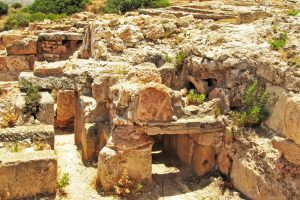
On gentle slopes near the medieval abbey of Bellapais in the Turkish-occupied part of Cyprus sits an extensive Bronze Age cemetery known to the world almost exclusively through its dead. The Vounous necropolis contains 164 rock-cut chamber tombs that served an unknown settlement for nearly five centuries, from approximately 2500 to 2000 BCE, preserving one of the finest collections of prehistoric pottery ever discovered on the island. Vounous presents archaeologists with an unusual challenge. Despite extensive searches that began in the 1930s and continue sporadically today, the settlement that used this cemetery has never been located. The site sits somewhere between the villages of Ozanköy and Çatalköy in the Kyrenia region, but the homes, workshops, and temples of the people buried here remain hidden beneath modern development or agricultural land. Historical Background The tombs at Vounous date to the Early and Middle Bronze Age, a period when Cyprus underwent major transformation. Around 2500 BCE, settlers from Anatolia arrived on the island, bringing new pottery styles, copper-working technology, plow agriculture, and the warp-weighted loom. These immigrants, identified as the Philia Culture, moved quickly to the foothills of the Troodos Mountains to exploit the rich copper deposits. The people who used Vounous cemetery were part of this cultural shift. Their pottery shows clear Anatolian influence, particularly the distinctive Red Polished ware that…

Read more
Paphos Archaeological Park

Paphos Archaeological Park

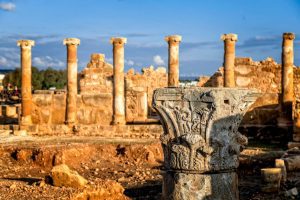
Paphos Archaeological Park, known in antiquity as Nea Paphos, represents one of the most significant archaeological landscapes in the eastern Mediterranean. Established in the late fourth century BCE during the Hellenistic period, the city was deliberately founded as a political and administrative center under the Ptolemaic rulers who controlled Cyprus after the campaigns of Alexander the Great. Its coastal position provided both strategic and economic advantages, linking the island to major maritime routes that connected the Greek world, Egypt, and the Near East. When the Romans annexed Cyprus in 58 BCE, Nea Paphos retained its prominence and became the island’s capital, a role that further strengthened its political, commercial, and cultural influence. The city’s development under successive Hellenistic and Roman administrations illustrates its adaptability and importance within broader imperial systems, making it a key example of urban life in antiquity. The archaeological remains reveal a carefully organized urban center designed to support governance, religion, trade, and social life. Streets, residential areas, and public structures were arranged according to principles common in Hellenistic and Roman urban planning, emphasizing accessibility and civic order. Public spaces such as administrative buildings, marketplaces, and entertainment venues were positioned to encourage interaction and collective identity. This structured environment reflects a society that valued civic organization and shared public life. The city was not only a settlement…

Read more