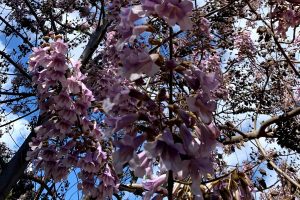
Purple Trumpets in the Cypriot Spring
Imagine driving through the gentle hills near Paphos or Limassol in early April, when the air is still cool and the light turns golden. Suddenly, tall, bare-branched trees burst into clouds of soft lavender-purple bells that look like giant foxgloves hanging in the breeze. These are the Paulownia trees of Cyprus – fast-growing newcomers from the Far East that bring a touch of royal elegance to the island’s modern landscape. The Empress Tree Family Paulownia belongs to its own small family, Paulowniaceae, closely related to the foxgloves and snapdragons you might see in a cottage garden. These are deciduous trees that grow with astonishing speed. The main species planted in Cyprus are Paulownia tomentosa (the classic princess or empress tree) together with the even faster-growing P. elongata and P. fortunei. Locally they are known as Παυλώνια (Pavlónia), a direct transliteration of the scientific name. The genus honours Princess Anna Pavlovna of Russia (1795–1865), whose beauty and grace the flowers were said to resemble when the tree was first introduced to Europe. From Asian Forests to Cypriot Plantations Native to central and eastern China and parts of Korea, Paulownia has been treasured for centuries in its homeland for its lightweight, strong timber and beautiful timber used in everything from furniture to musical instruments. It reached Europe in the 19th century as…
Read more