Explore Cyprus with Our Interactive Map

Explore our top stories and discover ideas worth your time.

Whispers from the Wild Stalks

Whispers from the Wild Stalks

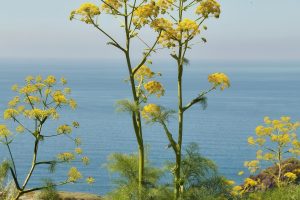
Imagine wandering through the sun-drenched fields of Cyprus, where a plant towers like a sentinel from ancient myths, its yellow blooms catching the breeze. This article invites you on a gentle journey to discover the giant fennel, a resilient Cypriot native that bridges legends of fire-thieves and hidden fungal treasures, leaving you pondering the quiet wonders hidden in everyday landscapes. www.inaturalist.org A Gentle Giant's Greeting The giant fennel, known scientifically as Ferula communis, is a member of the vast carrot family, Apiaceae, which includes familiar herbs like parsley and dill. It's a perennial plant that dies back each summer only to burst forth anew, standing tall in open meadows and reminding us of nature's enduring cycles in the Mediterranean world. Echoes from Mythical Times In the mists of ancient history, giant fennel played starring roles in Greek legends that echoed across the sea to Cyprus. Prometheus, the daring Titan, famously hid stolen fire from the gods inside its hollow stem to gift humanity warmth and light. Followers of Dionysus, the god of wine and revelry, wielded staffs made from its stalks wrapped in ivy and topped with pine cones as symbols of joy and fertility during ecstatic festivals. www.inaturalist.org On Cyprus itself, historical accounts from 19th-century explorers describe locals crafting stools and decorative items from its sturdy wood, a practice…

Read more

Church of Timios Stavros in Pelendri

Church of Timios Stavros in Pelendri

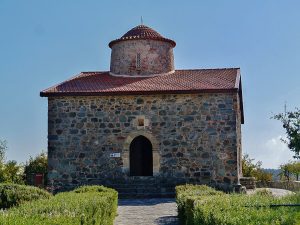
Church of Timios Stavros in Pelendri is a 12th-century Byzantine chapel in Cyprus's Troodos Mountains that evolved into a multi-part complex, famed for its Palaiologan frescoes blending spiritual depth with artistic refinement. Part of the UNESCO-listed Painted Churches, it showcases the island's medieval religious heritage through layered architecture and vivid paintings. This site captures how faith adapted over time, offering insights into Cyprus's enduring spiritual traditions. wikipedia-org An Evolving Byzantine Chapel in the Mountains Timios Stavros exemplifies the organic development of Byzantine religious architecture in Cyprus, starting as a modest single-aisled chapel and expanding into a domed, multi-section structure that reflects centuries of theological and cultural shifts. Dedicated to the Holy Cross, a symbol central to Orthodox Christianity representing salvation and divine power, the church served as a spiritual focal point for mountain communities. Its location in the lush Marathasa Valley, surrounded by pine forests and terraced fields, underscores the Troodos region's role as a refuge for monastic and village life, where sacred spaces blended seamlessly with the natural environment. The site's evolution mirrors broader patterns in Cypriot ecclesiastical building, where practicality met piety, creating resilient havens amid the island's turbulent history of invasions, earthquakes, and political changes. The church's design emphasizes functionality suited to the high-altitude climate, with thick stone walls sourced from local quarries to withstand heavy rains…

Read more
Kyrenia Mountains

Kyrenia Mountains

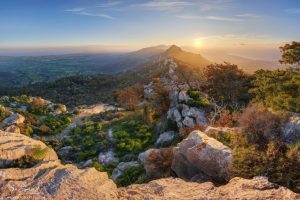
Whether you stand on the observation deck in Troodos near the summit of Mount Olympus on a clear day, walk across the rolling fields of the Mesaoria plain, or simply drive through the streets of Nicosia, your eyes will inevitably be drawn north. Expedia There, a long, jagged ridge cuts across the horizon like a line drawn by a giant hand. In some places it rises so sharply that it feels unreal, as if the land itself has been lifted and frozen mid-motion. At sunrise it glows pale and soft. By midday it hardens into white stone. At dusk it becomes a jagged silhouette, like the ruins of a forgotten kingdom. These are the Kyrenia Mountains, also known as Pentadaktylos. Unlike Troodos, which rises gradually through valleys, plateaus and forests, the Kyrenia Mountains are abrupt, almost theatrical. They form a narrow ridge stretching for almost 200 kilometres, from Cape Kormakitis in the west to Cape Apostolos Andreas in the east. To the north they fall sharply toward the sea, separated by a narrow coastal strip rarely more than five kilometres wide. northcyprusinform-com To the south they rise almost vertically above the flat Mesaoria plain. They look less like mountains and more like a stone wall, or the ruins of a forgotten city from the fantasy epic. And in many ways,…

Read more