On a warm spring morning anywhere on Cyprus, perched on a stone wall or a swaying pine branch, a small black-and-white bird fills the air with a strange buzzing rattle of a song. This is the Cyprus Wheatear – and this island is the only place in the world where it breeds. That alone makes it worth getting to know.
What Kind of Bird Is It?
The Cyprus Wheatear belongs to a group called wheatears, small, energetic birds found from the Arctic to the Sahara, almost always in open rocky landscapes. About thirty species exist worldwide, and they are all recognised by the same thing: a bright white flash on the rump as they fly.
The scientific name of the whole group, Oenanthe, comes from the ancient Greek words for wine and flower, because these birds traditionally returned to the Mediterranean each spring at the same time the vines began to bloom. The English name ‘wheatear’ is far less romantic – it simply means ‘white bottom’ in old English. Same bird, very different poetry.
From Subspecies to Star: A Bird Finds Its Identity
For most of the twentieth century, nobody thought the Cyprus Wheatear deserved its own species status. Scientists classified it as just a local variety of the Pied Wheatear, a similar-looking bird from the Middle East. It was only in 1982 that researchers finally made the case for it being something entirely its own – pointing to differences in size, song, and one particularly unusual feature: male and female Cyprus Wheatears look almost identical. In most wheatear species, the sexes are strikingly different. Here, they match. That alone set the Cyprus bird apart.
Today it is firmly recognised as one of three bird species on Earth that exist nowhere else but Cyprus – alongside the Cyprus Warbler and the Cyprus Scops Owl.
Bold Colours, Bolder Personality
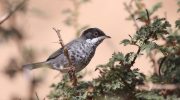
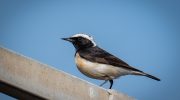
About the size of a sparrow, the Cyprus Wheatear is smart-looking: jet black wings and face, crisp white crown and belly, with a warm buff wash on the chest. Both sexes dress alike – unusual in the bird world.
What makes it truly stand out, though, is its character. Unlike most of its rocky-hillside relatives, this bird loves trees. It hunts from high branches, darts into the air to catch insects, and sings from treetops five to ten metres off the ground. Its song sounds far more like an electric grasshopper than anything you’d expect from a bird – a rapid, buzzing rattle that carries through the forest long before you spot the singer.
Did You Know?
Σκαλιφούρτα – A Cypriot Name for a Cypriot Bird
Σκαλιφούρτα (Skalifourta) or Πετρόκλης της Κύπρου (Petroklis tis Kyprou). The word “σκαλιφούρτα” (or sometimes σκαλαφούρτα) is a Cypriot dialect name of popular, folk origin, closely tied to the bird’s behaviour and appearance:
Σκάλι / Σκαλίζω – The first part likely refers to the bird’s habit of scratching or pecking at the ground (“σκαλίζω” = to scratch/dig lightly) or to its tendency to perch on stones and rocks (“σκαλώνει” = clings or settles on high/rocky spots).
Φούρτα / Φούρτακας – The second part probably relates to the bird’s distinctive plumage or the way it moves its tail. The tail is strikingly black-and-white, which in older local naming traditions was associated with similar black-and-white-tailed rock-loving birds (sometimes called “ασπροκώλες” = white-rumped ones in folk speech).
In short, “σκαλιφούρτα” is a vivid, home-grown Cypriot nickname that captures how this little bird darts among stones, flicks its contrasting tail, and forages energetically on the ground – exactly the lively character that generations of Cypriots have observed and named in their everyday language.
The total population of Cyprus Wheatears sits somewhere between 100,000 and 200,000 individuals. The birds spend winter in the open grasslands of Sudan and Ethiopia, returning to Cyprus from late March. Males always arrive first, a week or so ahead of the females, to claim the best territories before the breeding season begins in earnest.
Why It Still Matters
BirdLife International has formally recognised Cyprus as an Endemic Bird Area – one of the most important in Europe – largely because of birds like this one. The Cyprus Wheatear is listed as Least Concern on the global conservation scale, and its numbers look stable. But researchers keep a watchful eye: urban sprawl, intensive farming, and shifting insect populations driven by climate change are all worth monitoring for a bird that depends entirely on one small island to reproduce.
For many Cypriots, the return of the Skalifourta each spring is as sure a sign of the season as almond blossom. It is a bird that belongs here, in every sense of that word.
How to Find One
When: March to October – present all over the island. Best for song and display: April, May and June.
Where: Everywhere from the Troodos forests to coastal hillsides and village gardens. Look along old stone walls, rocky scrubland, and open woodland edges.
Tip: Hear it before you see it. The buzzing, rattling song is unmistakable. Males sing for hours from exposed high perches – treetops, wires, tall rocks.
Worth Knowing
There is something quietly wonderful about an animal that has chosen one island as its whole world – that has evolved here, adapted here, and returned here every spring across thousands of years. The Cyprus Wheatear is not a flashy creature. It is small, and its song is strange. But it is entirely irreplaceable.
To see one is to understand something true about Cyprus: that this island, at the crossroads of three continents, is not just a place things pass through. It is a place where life found its own voice. The Cyprus Wheatear is part of that voice.