On a warm spring evening in Cyprus, as the last light fades over an olive grove and the first stars appear, a small, haunting sound rises from the trees – a soft, rhythmic double whistle, repeated over and over into the dark. You might not see the creature making it, but you will certainly hear it, and once you know what it is, you will never forget it. That sound belongs to one of Cyprus’s most treasured and exclusive residents: the Cyprus Scops Owl, Otus cyprius – a bird that exists nowhere else on Earth.
- A Tiny Owl with a Big Claim to Fame
- An Island Secret, Long Overlooked
- What Makes It Unmistakably Cypriot
- Five Surprising Things About This Little Owl
- Mythology, Legend, and a Name Called Out in the Dark
- A Bird Woven into the Fabric of Cyprus Today
- How and Where to Experience the Thoupi
- Why This Small Owl Matters More Than Its Size Suggests
A Tiny Owl with a Big Claim to Fame
Owls belong to one of nature’s most ancient and successful bird groups, the order Strigiformes, which has been flying through the world’s nights for over 60 million years. There are more than 200 species of owls alive today, spread across every continent except Antarctica. The genus Otus – the scops owls – is the largest group within this family, with around 60 species worldwide, found from Europe and Africa all the way to Asia and the Pacific islands. Most are small, secretive, insect-eating birds of the night, perfectly designed to vanish into tree bark during the day and come alive after dark.
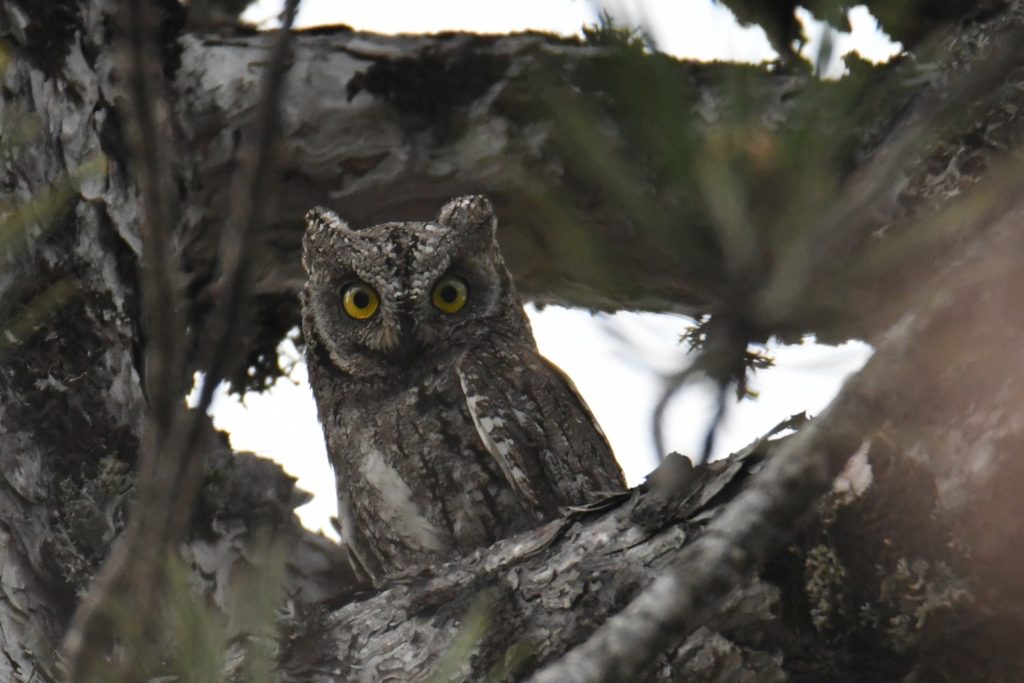
The Cyprus Scops Owl (Otus cyprius) is a small owl endemic to Cyprus. It was long considered simply a darker island variety of the Eurasian Scops Owl (Otus scops), which breeds across southern Europe and winters in Africa. But as scientists looked more closely at its appearance, behaviour, and particularly its voice, something fascinating emerged: this little owl had quietly become its own species.
An Island Secret, Long Overlooked
The first formal scientific description of the Cyprus bird was made in 1901, when Hungarian zoologist Julius von Madarász described it as Scops cypria from a specimen collected at Livadia in Cyprus. Yet for decades, the scientific community largely set it aside, grouping it with its mainland relatives without much further investigation. The endemic Cyprus Scops Owl Otus (scops) cyprius had been treated as a subspecies of the widespread Eurasian Scops Owl O. scops since at least the 1940s.
It was only in the twenty-first century, when researchers began combining detailed measurements, plumage analysis, DNA testing, and acoustic study, that the evidence became undeniable. Recent studies have shown that its song and plumage are sufficiently distinct from those of the mainland species to suggest that Cyprus birds most probably do not breed with Eurasian Scops Owls at all. BirdLife International, the global authority on bird classification, formally recognised it as a full species, and Cyprus suddenly found itself with a brand new endemic bird – one that had been hiding in plain sight, or rather, singing in plain hearing, all along.
What Makes It Unmistakably Cypriot
The Cyprus Scops Owl is a small, dark owl, intricately marked with black streaks and fine barring. Bright yellow eyes are set in a pale face ringed with black. The ear tufts can be prominent, especially when seen on a day roost, but sometimes are nearly invisible. In size it is roughly that of a large sparrow – about 20 centimetres tall – and its bark-like patterning makes it extraordinarily difficult to spot when it presses itself against a tree trunk during the day.
The Cyprus Scops Owl differs from the Eurasian Scops Owl in that it has a double-noted song (versus a single note), it lacks a rufous morph, and it shows consistent plumage differences, appearing darker than Eurasian Scops Owls.
Its prey consists mostly of large insects such as crickets, grasshoppers, beetles and moths, as well as other invertebrates such as spiders and earthworms.
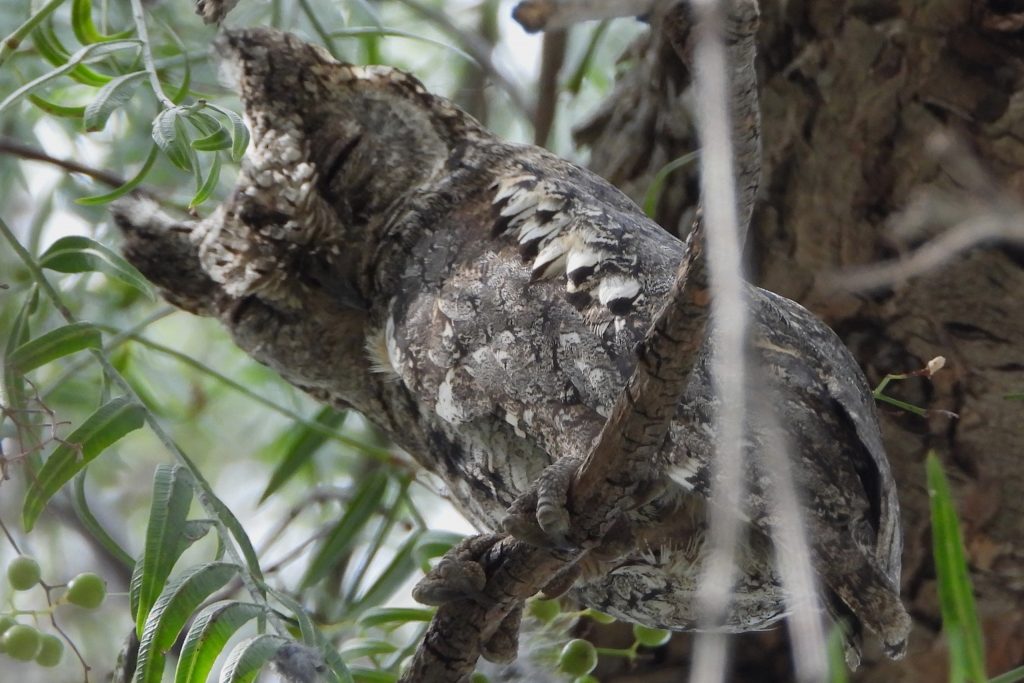
The Cyprus Scops Owl is reported to occur in rural areas, woodlands, and forests on the island from sea level up to 1,900 metres, which is essentially the entire island, right up to the heights of the Troodos Mountains.
Five Surprising Things About This Little Owl
- It’s a full species – and a recent one. For most of recorded natural history it was lumped in with its European cousin. Its recognition as a distinct species is a twenty-first century discovery, making it one of Europe’s newest endemic birds.
- Its song is its identity. The double whistle – “tou-wit, tou-wit” – is the most reliable way to find one. Cypriots have a local name for it: Θουπί (Thoupi), which is itself an imitation of the call.
- It’s almost impossible to see, but impossible not to hear. On a quiet spring night in a Cypriot village, the call of the Thoupi echoes from the gardens and olive groves with remarkable persistence, repeating hundreds of times per hour throughout the night.
- It has no competition – and no help. The nesting habits of this species are of particular interest, as it is a cavity-nesting endemic on an island that lacks any species of woodpeckers, and Calabrian pines rarely develop cavities until they are old. Without woodpeckers to create holes in trees, this owl must rely on natural decay and old buildings for its nest sites.
- Migratory visitors can’t take over. Given that large numbers of Eurasian Scops Owls pass through Cyprus on spring migration, and that they breed in adjacent countries, it seems probable that they would colonise the island, but for the presence of cyprius. That they do not do so, and that cyprius retains its distinctive song and plumage, suggests that strong isolating mechanisms exist.
Mythology, Legend, and a Name Called Out in the Dark
Cyprus has always been an island steeped in myth, and the owl has played its role in that tradition across the entire Mediterranean world. In ancient Greece, the owl was the sacred companion of Athena, goddess of wisdom – the “owl of Athena” appeared on Athenian coins and was seen as a symbol of knowledge and good fortune. In Cyprus, however, the story of the scops owl takes a more tender and melancholy form.
According to Cypriot legend, a young man was sent by his brother into the forest during a storm to find a lost horse. There, he was struck by lightning. When his horse returned home riderless, the brother went out into the night calling his name – “Ghioni, Ghioni” – but found nothing. At daybreak, overwhelmed by grief, he begged Artemis, goddess of the forests and of hunting, to release him from his torment. The goddess turned him into an owl. To this day, the owl flies through the forest all night long calling out for his lost brother. In Cyprus, there is a widespread belief that the scops owl is one of the oldest birds in the world.
This story has remarkable resonance when you consider that the modern Greek word for owl is ghionis – and that the sound of the scops owl’s call does indeed sound uncannily like someone softly, persistently calling a name into the night.
A Bird Woven into the Fabric of Cyprus Today
With an estimated abundance of 5,000 to 12,000 breeding pairs, the Cyprus Scops Owl can be found all over the island, in forests, gardens, olive groves, farms and often in or near towns or villages, in parks and in cultivated areas with groves.
Yet the owl faces quiet, gradual pressures. It nests mainly in holes in trees and buildings, so the felling of old trees, modern architectural practices, and the renovation of old houses in villages may reduce nest site availability. Researchers have responded by trialling artificial nest boxes throughout the island’s forests with encouraging results. Despite a low nest box occupancy rate of 5 to 11 per cent, the endemic Cyprus Scops Owl readily breeds in artificial nests.
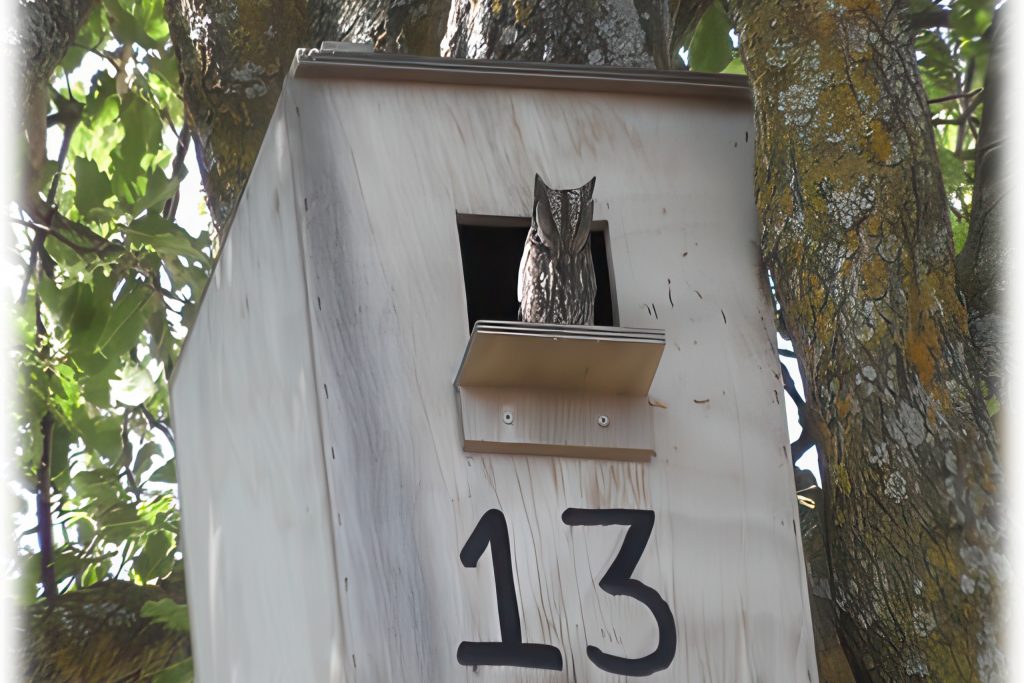
For the Cyprus Scops Owl, a predominantly forest and farmland bird, conservation translates to conserving the Cypriot traditional agricultural landscape – a complex mosaic that has been shown to be beneficial to farmland birds and biodiversity in general.
How and Where to Experience the Thoupi
The Cyprus Scops Owl requires no expedition, no specialist equipment, and no particular birdwatching skill to experience. What it requires is simply a warm spring evening and a willingness to stand still and listen.
The best time to hear it is from March to June, when the males sing persistently to establish territory. Almost any olive grove, garden with mature trees, or forested village path on the island will do. The Cyprus Scops Owl can be seen all over the island in forests, gardens, olive groves, farms and open spaces with some trees. The Troodos foothills, the Akamas Peninsula, the Paphos Forest, and the villages of the Limassol and Larnaca districts are all excellent locations.
If you want to actually see one – which is considerably harder – the best approach is to walk quietly with a torch along a forest path after dark and listen for the call, then move slowly towards it. During the day, it may occasionally be spotted roosting motionless against a tree trunk, its cryptic markings making it almost invisible. The experience of standing in a Cypriot garden on a spring night, surrounded by the soft insistent calling of this tiny, ancient bird, is one of those simple, unforgettable encounters with the living world that stays with you long after you leave the island.
Why This Small Owl Matters More Than Its Size Suggests
The Cyprus Scops Owl is not a dramatic bird. It does not soar like the Griffon Vulture or flash colour like the Roller. It is tiny, brown, and mostly nocturnal. But it carries something rare and precious: it is a life form that exists on this island and nowhere else on the planet. Its two-note call drifting through a Cypriot olive grove on a spring night is not just a beautiful sound, it is the sound of a unique evolutionary journey, millions of years in the making, playing out tonight in someone’s garden.
In a world where species are lost faster than they are discovered, Cyprus has something to be proud of and to protect: a small owl with bright yellow eyes, a haunting double call, and a story that belongs entirely to this island.