Somewhere between February and April each year, a flash of cinnamon, black, and white appears in the olive groves and pine forests of Cyprus, and a soft, rhythmic call drifts across the hillsides: oop-oop-oop. The bird has arrived. The Hoopoe is back – and if you have ever seen one raise its magnificent feathered crown, you will understand why this bird has captivated people for thousands of years.
Meet the Bird That Named Itself
The Eurasian Hoopoe (Upupa epops) is a medium-sized bird found across Europe, Asia, and Africa. It is one of the most colourful birds found across Afro-Eurasia, notable for its distinctive “crown” of feathers. Despite its flamboyant appearance, it is not a parrot, a pheasant, or anything from those familiar groups. The hoopoe belongs to its own family, Upupidae, and is now considered part of the order Bucerotiformes – the same broad group as hornbills. This is a bird in a category all its own: ancient, distinctive, and utterly unmistakable.
A Name Born From a Song – and a Story as Old as Civilisation
Both Upupa and epops – the Latin and Ancient Greek names for the bird – are onomatopoeic, imitating the call of the bird, just as the English word “hoopoe” does. Across languages and cultures, almost every civilisation named this bird the same way: by listening to what it actually says.
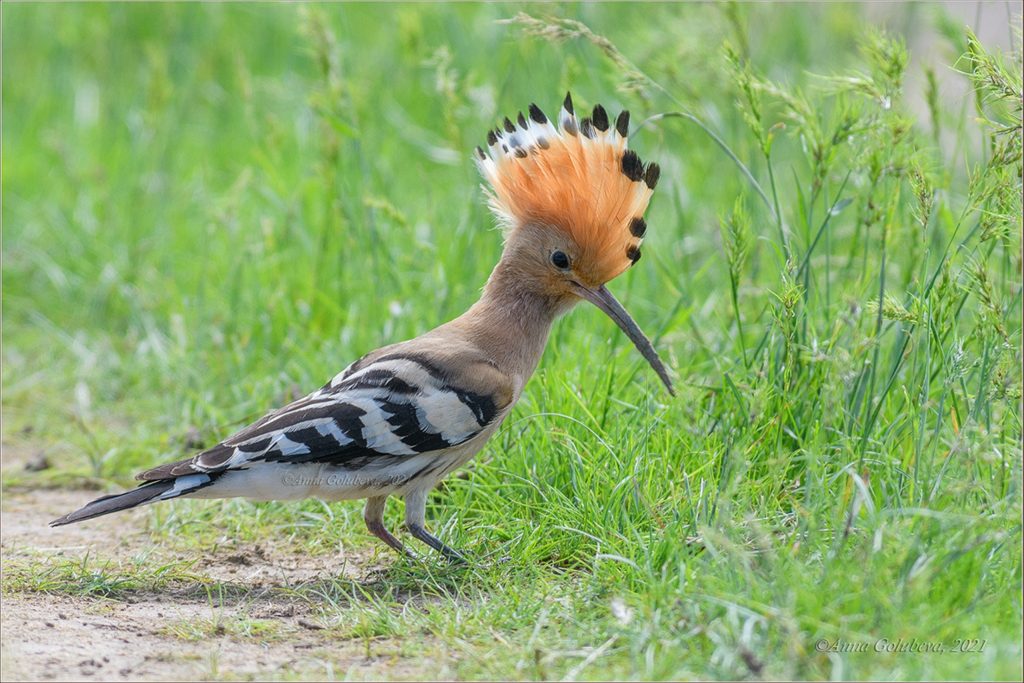
In Cyprus, the bird carries two names that tell a similar story. In standard Greek it is the Τσαλαπετεινός (Tsalapetinos) literally meaning “those who flies in the bushes”. In the Cypriot dialect it is lovingly called the Πουπούξιος (Poupouxios) – clearly echoing that soft, repetitive call that rolls across the Cypriot countryside on warm spring mornings. Actually, the locals gave it not one but several affectionate variations: Πουπούξιος (Poupouxios), Πουπούτσης (Poupoutsis), Τρουλλόκουτσος (Troullókoutsos) — a delightful compound name possibly alluding to its domed crest — and Πουρτουκούξιος (Pourtoukоúxios), a regional variant still heard in some villages today. Fittingly, the ancient Greeks knew this very same bird as the Έποψ (Epops) – a name recorded by Aristotle, Aelian, and other classical writers who were clearly just as charmed by its song as anyone listening to it today.
The Hoopoe’s history in human culture is extraordinary. In the Qur’an, the hoopoe serves the Prophet Solomon, discovering the kingdom of Sheba and carrying messages between rulers. In the Persian poem “The Conference of the Birds” by Attar, the hoopoe leads all birds on a spiritual quest toward the divine. In Ovid’s Metamorphoses, the Thracian King Tereus is transformed into a hoopoe – his dramatic crest signalling his royal status. And in the Ancient Greek comedy “The Birds” by Aristophanes, the hoopoe is crowned King of the Birds. In Ancient Egypt, it was considered a sacred animal and was depicted in hieroglyphics and religious carvings. A crown it has worn, in one form or another, for millennia.
A Living Work of Art
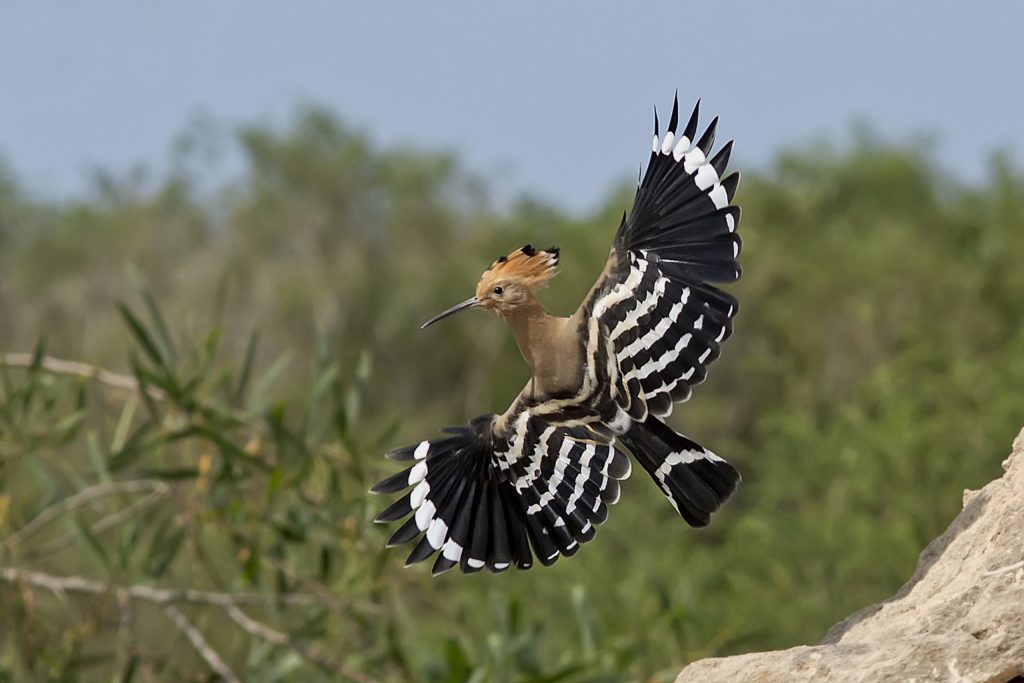
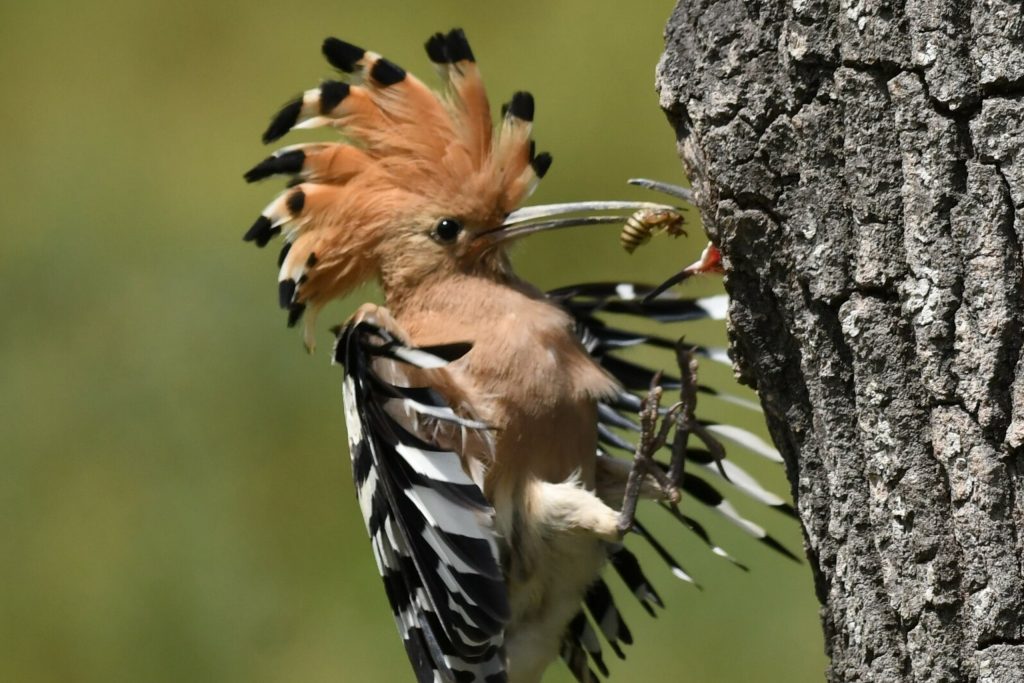
The Hoopoe is approximately 28 centimetres in length, warm cinnamon in colour, with bold black-and-white striped wings and a black tail crossed by a clean white band. But its defining feature is, of course, the crest. When the bird senses danger, it raises those fan-tipped feathers fully open – suddenly transforming from a compact, elegant walker into something resembling an elaborate carnival mask. Local Cypriot tradition has its own vivid description for this: the crest opens “σαν φυσερό ή βεντάλια” – like a bellows, or a fan. It is an unforgettable sight.
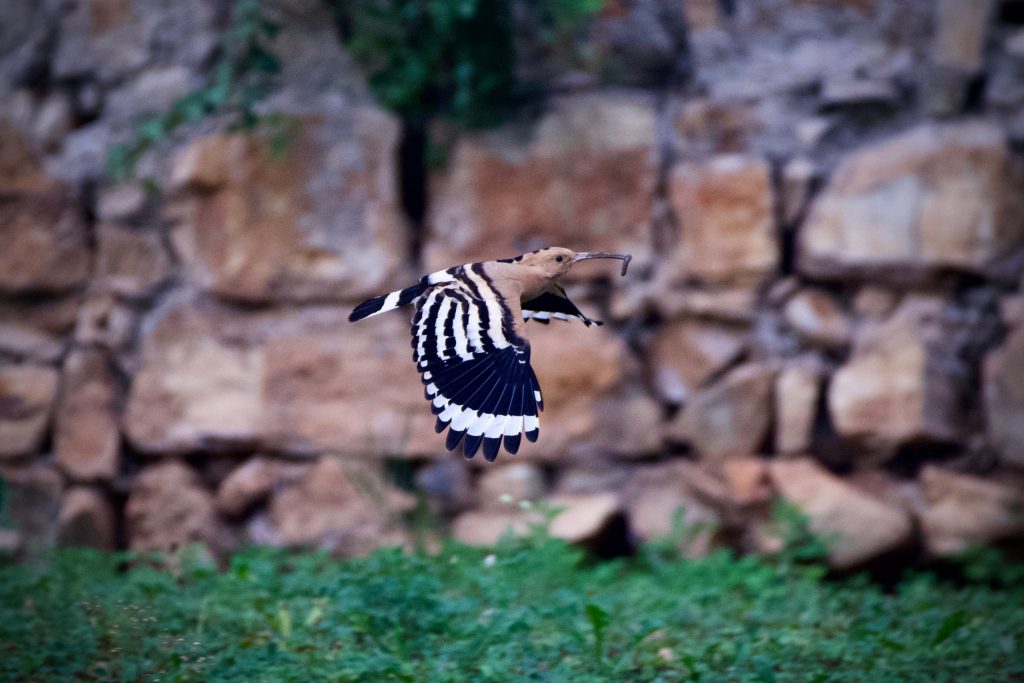
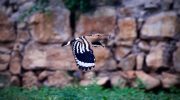
The musculature of the head is specially strengthened to allow the bill to be opened while probing deep inside soil. That long, curved bill is the bird’s primary tool, used to probe and scratch the earth in search of insects and grubs. In flight, the broad black-and-white wings give it a slightly butterfly-like appearance, unlike almost any other European bird.
The Hoopoe is a largely solitary creature. It is only during the breeding season that a pair can be found together. It nests in holes in trees, old stone walls, and rocky crevices, typically laying around five eggs. It arrives in Cyprus in March and departs around October.
Fun Facts Worth Remembering
- It is the national bird of Israel. The Eurasian Hoopoe was chosen as Israel’s national bird in May 2008, following a national survey of 155,000 citizens.
- It has been recorded at extraordinary altitudes. One individual was recorded at approximately 6,400 metres during the first Mount Everest expedition.
- It sunbathes in a very unusual way. Hoopoes spread out their wings and tail low against the ground and tilt their head up. They also enjoy taking dust and sand baths.
- It has a famously untidy nest. Aristotle himself remarked upon the hoopoe’s notoriously unkempt home. The ancient belief, recorded with evident fascination, was that the bird deliberately built its nest from foul-smelling materials to drive away curious humans – a natural deterrent worthy of admiration. The truth is more prosaic: the Hoopoe simply does not bother to clean its nest, and the accumulated droppings develop a very powerful odour. What Aristotle found scandalous, modern ecologists might call efficient.
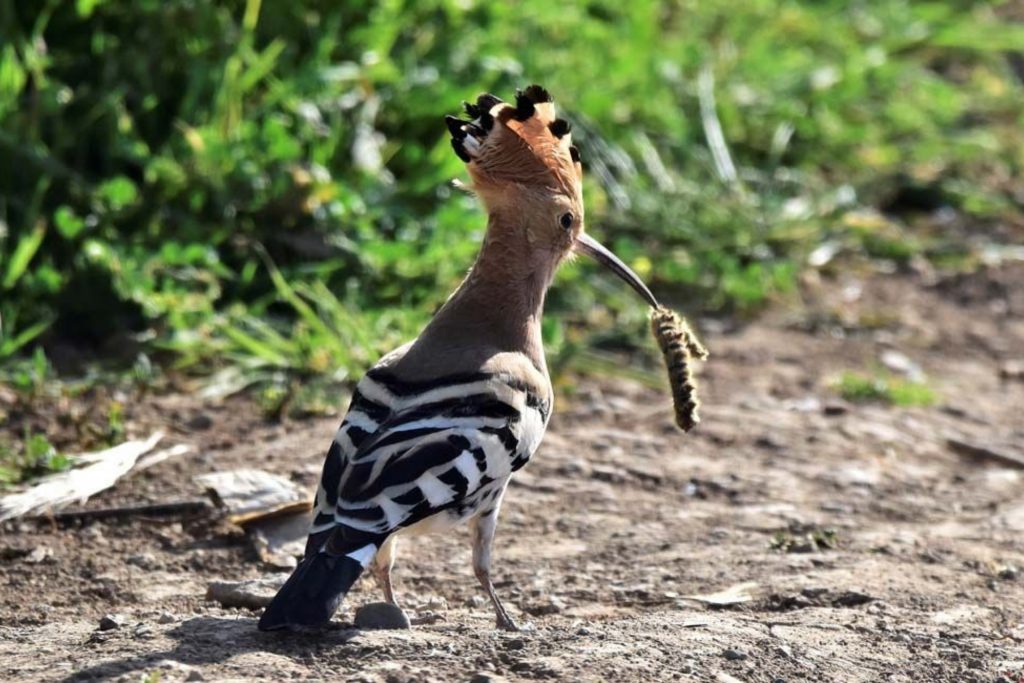
- It is a secret guardian of the pine forest. The Hoopoe is known to prey regularly on the larvae and pupae of the pine processionary caterpillar (Thaumetopoea pityocampa), the most important defoliator of pine trees across Southern Europe and North Africa. These caterpillars are protected by severely irritating hairs that repel almost every predator – but not the Hoopoe. It uses its long curved bill to probe the soil and dig out buried pupae, then grabs the caterpillars and repeatedly strikes them against the ground to remove part of their stinging hairs before swallowing them.
Magic Bones and Folklore: The Cyprus Connection
No other bird in Cypriot popular tradition carries quite the same weight of superstition and wonder as the Πουπούξιος. In Cyprus, a well-known saying – “έχει κοκκαλούιν του πουπούξιου” – is used to describe someone remarkably lucky, or someone who manages to escape from impossible situations. Translated literally, it means: he has the little bone of the hoopoe.
The belief behind it is extraordinary. According to Cypriot folk tradition, the small bones of the hoopoe possessed near-magical powers: the man who carried one could win the heart of the woman he loved, be acquitted in court, and overcome any obstacle life placed before him. But the power only worked under very specific – and rather demanding – conditions. The bird had to be killed personally, without a weapon. It then had to be buried in the earth for forty days. After that, the skeleton was to be dug up, the bone extracted, and then washed in forty separate springs – each one facing east.
Whether anyone in Cyprus ever actually fulfilled these requirements is a question best left open. But the fact that the folklore existed at all tells us something important: this bird, with its royal crest, its mysterious habits, its strange nest, and its uncanny call, was felt to contain something beyond the ordinary. Connected, as the saying goes, with myths, magic, and superstitions since ancient times.
The Hoopoe in Cyprus Today
In Cyprus, the Hoopoe is a migrant breeder, typically arriving as one of the very first signs of spring – sometimes as early as February. It is widely described as a protected species precisely because of its ecological value: it is a bird that feeds almost entirely on insects, keeping natural pest populations in balance. In the pine forests of Troodos and Paphos, its quiet role in managing processionary caterpillar numbers makes it an ally of the forest itself. As climate change allows the processionary moth to expand its range across the Mediterranean, the Hoopoe’s importance as a natural regulator is only growing.
Where to Find One
The best time to encounter a Hoopoe in Cyprus is from March through May, when the birds are actively breeding and the males are calling frequently. Look for them:
– In the Troodos foothills and forest villages – particularly around Platres, Kakopetria, and Kykkos, where old stone walls and mature trees provide ideal nesting spots
– In farmland and olive groves – the Hoopoe prefers open ground for foraging, and orchards with old trees are among its favourite haunts
– On the Akamas Peninsula – where scrubland and open areas provide excellent foraging ground
The experience is not a difficult one to have. Simply sit quietly near the edge of a Cypriot pine forest on a warm spring morning, listen for that soft, rolling oup-oup-oup, and wait. When the bird appears – walking deliberately across a stony clearing, crest raised, wings folded in black-and-white geometry – the effect is immediate. It is a bird that stops you in your tracks.
A Bird Worth Knowing, an Island Worth Protecting
The Hoopoe is one of those species that carry a disproportionate amount of the world’s cultural memory. It has been a king, a prophet’s messenger, a poet’s symbol, an object of Egyptian reverence, a subject of Aristotle’s curiosity, and a keeper of Cypriot magical tradition – all while quietly striding across the Mediterranean soil, probing for grubs with its curved bill and raising its spectacular crest to the morning sky.
In Cyprus, it is woven into the fabric of spring. To hear the Πουπούξιος call from the edge of a pine-scented hillside as the first wildflowers open is to feel connected – however briefly – to something that has been happening on this island for a very, very long time indeed.