Religious celebrations in Cyprus are not confined to church interiors or specific dates. They shape the pace of the year, the movement of villages, and the shared memory of communities across the island. Rooted primarily in the traditions of the Orthodox Church, these celebrations blend formal liturgy with local customs, seasonal rhythms, and deeply human moments of gathering, mourning, and joy. To understand Cyprus is to understand how sacred time is lived here, not as an abstraction, but as part of everyday life.
Time measured in faith, not months
In Cyprus, time has long been understood through a sacred rhythm rather than a purely civil one. The Orthodox liturgical calendar does not simply mark holidays; it structures the year around cycles of preparation, anticipation, and renewal. Days begin at sunset rather than sunrise, and weeks unfold with specific spiritual themes attached to each day.
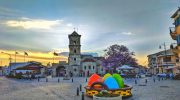
This layered sense of time creates continuity. Even those who are not regular churchgoers often know when Lent begins, when Easter approaches, or when a village panigyri is near. Sacred time quietly runs alongside modern schedules, shaping habits and expectations without demanding constant attention.
Easter as a season, not a single day
Pascha, or Easter, is the emotional and spiritual centre of the Cypriot year. It is not experienced as a single celebration, but as a long journey that unfolds over months. The period leading up to Easter gradually slows down daily life. Fasting becomes more common, social events are subdued, and attention turns inward.
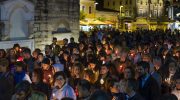
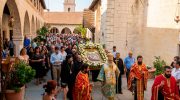
Holy Week brings this intensity into full focus. Churches fill nightly. Bells fall silent. Streets quieten. On Good Friday, the sense of collective mourning is unmistakable as communities gather for candlelit processions accompanying the Epitaphios, a symbolic representation of Christ’s tomb, carried slowly through towns and villages.
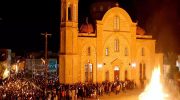
When midnight arrives on Holy Saturday, the atmosphere changes completely. Darkness gives way to light, silence to bells, and restraint to celebration. Families return home carrying candle flames, cracking red eggs, and sharing soup to gently end the fast. Easter Sunday completes the transition with food, open courtyards, and long communal meals.
Water, blessing, and the turning of the year
While Easter dominates the spring, January introduces another moment that reshapes the rhythm of the year: Theophany, the blessing of the waters. On this day, the sacred calendar reaches beyond church walls and into the natural world, as priests lead processions to seas, lakes, and rivers. A cross is cast into the water and retrieved by swimmers, an act that combines ritual, endurance, and devotion.
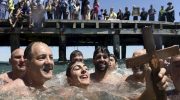
The ceremony carries both theological and symbolic weight. It marks spiritual renewal at the beginning of the year and reflects Cyprus’s longstanding relationship with the sea as provider, boundary, and passageway. In mountain villages far from the coast, springs and village fountains take on the same sacred role, showing how tradition adapts to geography without losing its essence.
Folklore quietly coexists with doctrine during this time. Stories of spirits driven away by holy water remain part of rural memory, revealing how faith in Cyprus has always absorbed local imagination alongside formal belief.
When saints bring villages to life
Beyond the major feasts, Cyprus’s sacred rhythm is punctuated by local celebrations dedicated to patron saints. Each village honours its protector with a panigyri, a feast day that transforms the community.
The celebrations begin in churches with liturgy and processions, but soon spill into village squares and courtyards. Music fills the air. Food stalls appear. Children play traditional games while older generations reconnect. People who have moved away often return home for these days, aligning travel plans with sacred calendars rather than civil holidays.
These gatherings are not performances staged for visitors. They are familiar, cyclical moments where faith and social life merge. Generations overlap, memory is renewed, and local identity is quietly reaffirmed through shared presence and ritual.
Sacred places that anchor belief
Cyprus’s religious calendar is inseparable from its sacred landscape. Monasteries and churches are not simply historical monuments. They act as living anchors around which belief and celebration continue to orbit.
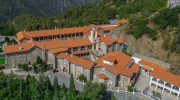
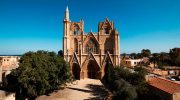
High in the Troodos Mountains, Kykkos Monastery draws pilgrims during major Marian feasts, its location reinforcing the sense of ascent and devotion. In Larnaca, the Church of Saint Lazarus becomes a focal point during pre-Easter rituals, connecting biblical narrative with urban life. Villages such as Omodos turn entire weekends into acts of devotion and festivity, while in Ayia Napa, the medieval monastery remains a spiritual reference beneath modern tourism layers.
These sites are not preserved as relics of the past. They remain active spaces where belief is practiced, negotiated, and renewed in real time.
Sound, movement, and shared expression
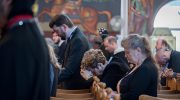
Religious life in Cyprus is not silent or static. Chant flows through churches in long melodic lines designed to carry meaning and emotion. Outside, faith often unfolds through movement and voice, with poetry competitions, traditional dances, and spontaneous performances following formal rituals.
These expressions extend faith into the body and the community. They allow participation beyond prayer, inviting those who may not engage deeply with liturgy to still belong to the sacred moment. Sound and movement become bridges between belief and everyday life.
Visiting with awareness
For visitors, Cyprus’s religious rhythm is open and visible, but it requires respect. Churches and monasteries remain active places of worship, not attractions alone. Modest clothing, quiet observation, and sensitivity during services are essential, and photography may be restricted, especially during major rituals.
Those who slow down and observe often discover something rare: a living tradition that has not been reduced to spectacle, but continues to shape daily experience.
Why these celebrations still matter
Religious celebrations in Cyprus endure because they are living systems rather than frozen customs. They adapt to social change while preserving structure, offering continuity amid political shifts, economic pressures, and modern lifestyles.
Faith in Cyprus does not exist only in belief. It shapes time, space, sound, and community. Through candles, processions, fasting, music, and shared meals, the sacred remains woven into everyday life, marking the year not by dates alone, but by memory, anticipation, and shared presence.