Every autumn, a sleek and fearless falcon arrives on the sunbaked limestone cliffs of Cyprus, riding in from a journey that spans half the world. It is not the largest bird of prey in the skies above the island, nor the most famous – but those who have watched it hunt, twist, and dive over the crashing waves below will tell you it may well be the most thrilling. This is Eleonora’s Falcon, and its story is stranger, older, and more remarkable than you might ever expect.
- Cousin of the Peregrine, Child of the Mediterranean
- Named for a Queen, Beloved by Naturalists
- Two Faces, One Falcon
- Things That Will Surprise You
- The Cleverest Hunting Calendar in the Bird World
- On the Cliffs of Cyprus, It Still Happens Every Year
- The Falcon That Became a Film
- Where to Stand and Watch the Sky Fill with Falcons
- Practical Tips
- A Bird That Belongs to the Whole Mediterranean World
Cousin of the Peregrine, Child of the Mediterranean
Eleonora’s Falcon belongs to the family Falconidae, a group of birds that includes peregrines, kestrels, and hobbies. Within this family, it sits in the so-called “hobby group,” a set of swift and elegant falcons sometimes grouped under the subgenus Hypotriorchis. Its closest relative is thought to be the Sooty Falcon of North Africa and the Middle East, though the two are not considered true sister species. Think of them more as distant cousins who share a taste for speed and open skies.
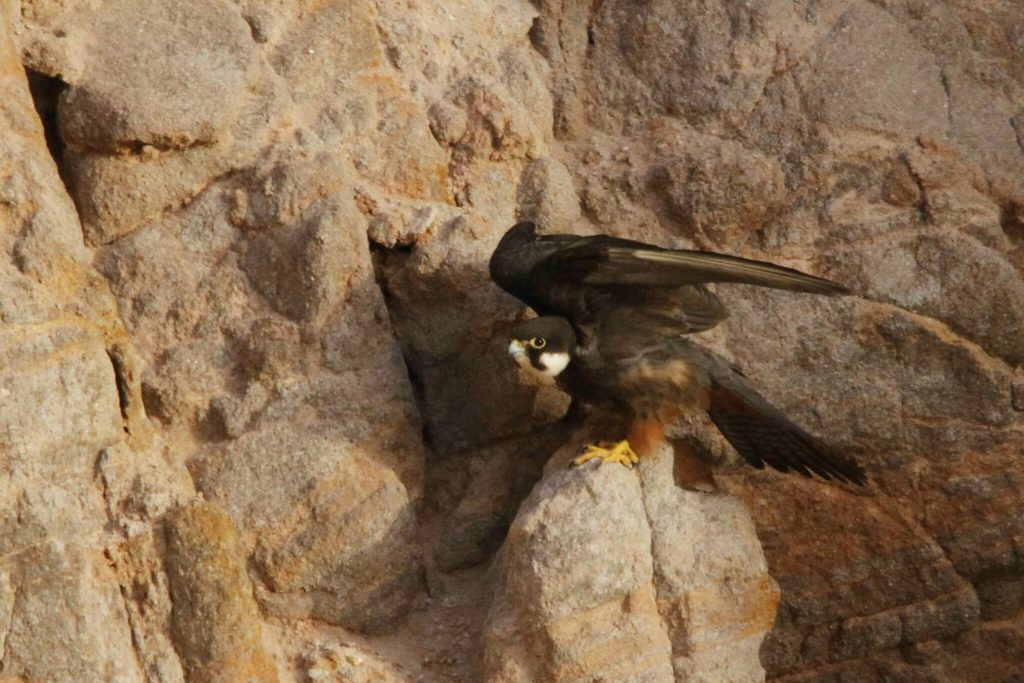
Falcons as a group are not built for brute strength – they are built for precision. Their long pointed wings and slim bodies make them masters of high-speed flight, capable of dramatic aerial strikes that few other birds can match. Eleonora’s Falcon is a perfect expression of that design: slender, fast, and beautifully adapted to life on the wing over open sea.
Named for a Queen, Beloved by Naturalists
The falcon carries the name of one of history’s most remarkable women: Eleonora of Arborea, a medieval Sardinian ruler who lived in the 14th century and is considered a national heroine of Sardinia to this day. She is best remembered for the Carta de Logu – a legal code she issued around 1392 that was extraordinarily progressive for its era, covering everything from property rights to the protection of women. Remarkably, this same code included protections for the Peregrine Falcon and other birds of prey, making Eleonora one of the earliest known advocates for wildlife conservation in European history.
It was the Italian naturalist Alberto della Marmora who formally described the species in 1839 and named it in her honour – a tribute that has proved wonderfully fitting, because this falcon’s stronghold is the very Mediterranean world that Eleonora herself governed and loved.
“She protected raptors in law eight centuries ago. It seems only right that one now carries her name across the sea.”
Two Faces, One Falcon
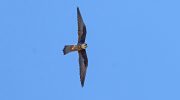
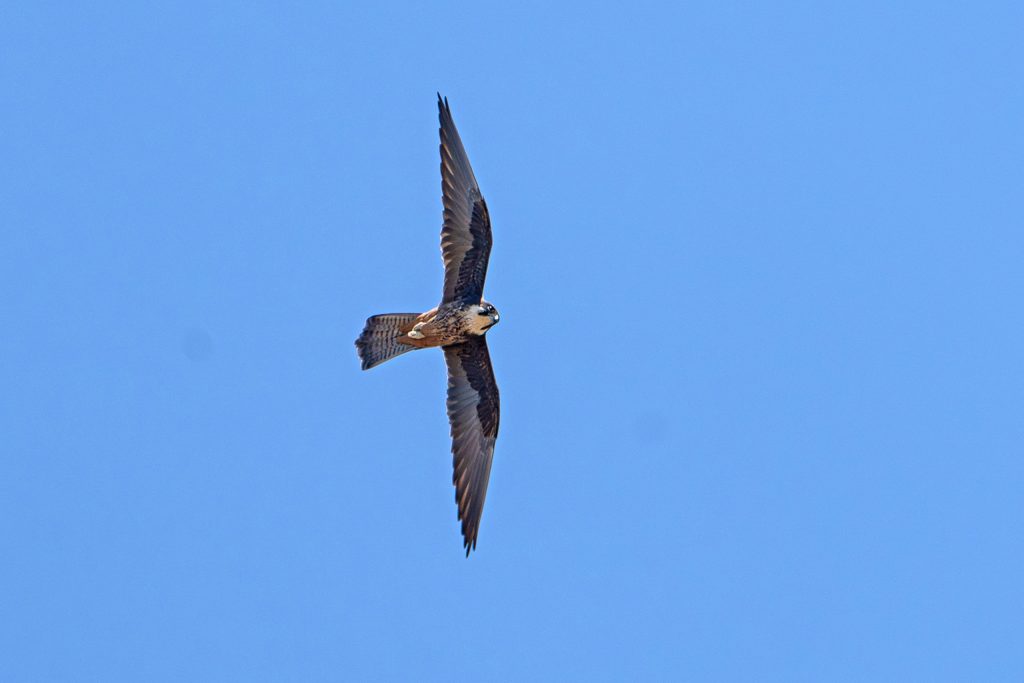
At 36 to 42 centimetres long with a wingspan between 87 and 104 centimetres, Eleonora’s Falcon is a medium-sized raptor – larger than a Common Kestrel but more slender than a Peregrine. Its long, swept-back wings and distinctively long tail give it a silhouette that birdwatchers often describe as resembling a large, elongated Eurasian Hobby.
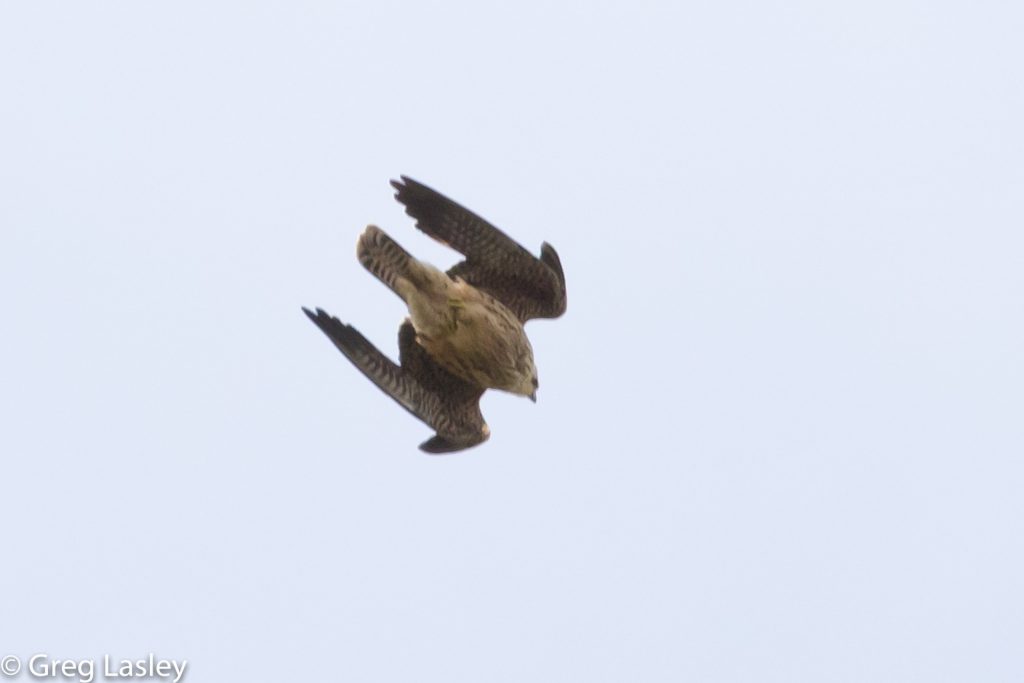
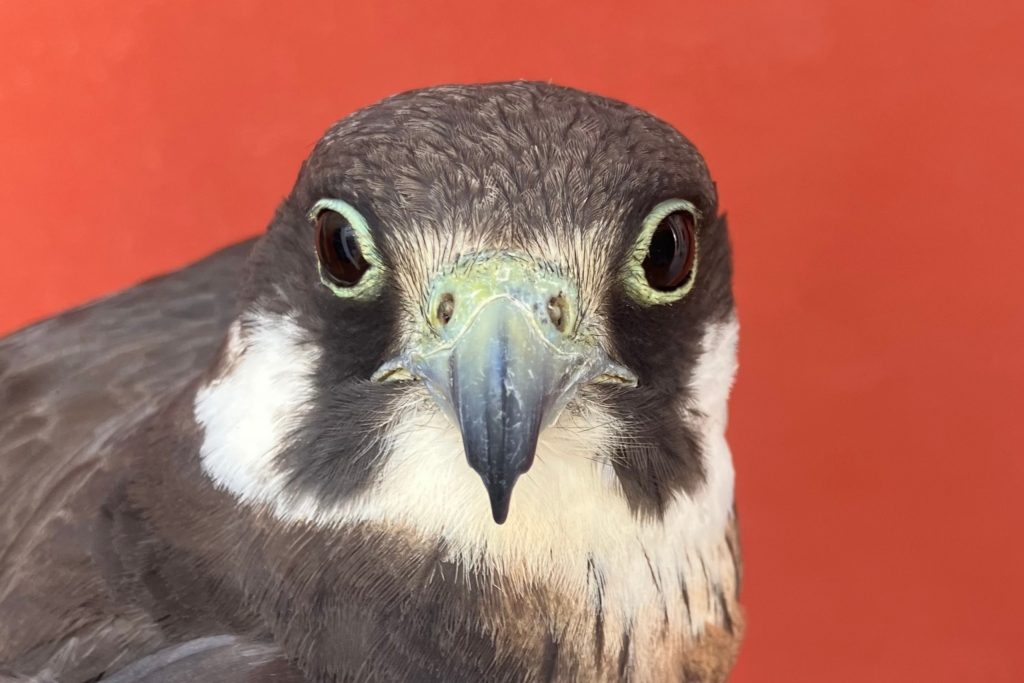
One of the most striking things about this bird is that it comes in two completely different colour forms, known as morphs. The dark morph is an almost uniform sooty brown from head to tail, with black underwing coverts – a deeply dramatic bird against a blue sky. The light morph is paler and more streaked below, showing a lovely contrast between its darker wingtips and the buff-coloured underparts. Both forms are perfectly beautiful; they simply chose different wardrobes. Young birds resemble a large Eurasian Hobby with pale underparts and darker wing markings.
When it calls, the falcon gives a sharp, typical falcon cry – a rapid kek-kek-kek that cuts cleanly through the sound of breaking waves.
Things That Will Surprise You
- A 9,000-kilometre commute. Each winter, Eleonora’s Falcons migrate to Madagascar – one of the longest journeys of any Mediterranean bird – covering up to 9,000 km in a single one-way trip. The route was a mystery. For decades scientists assumed the birds flew along the African coast. Satellite tracking eventually revealed they travel inland, cutting straight through the Sahara Desert and equatorial rainforests.
- Living larder. Researchers in Morocco discovered that Eleonora’s Falcons imprison live prey – small birds – in rock crevices, keeping them alive to be eaten fresh later. A refrigerator carved into cliff-face.
- An autumn baby. Almost uniquely among European raptors, Eleonora’s Falcon deliberately breeds in late summer and early autumn – timed precisely so that its chicks hatch when millions of small migrating birds are passing through the Mediterranean.
- Falcons that like neighbours. Unlike most falcons, which are fiercely solitary nesters, Eleonora’s Falcon forms breeding colonies on sea-cliffs – sometimes with hundreds of pairs nesting close together.
- Insect snacks on the wing. Between breeding seasons, it feeds largely on large insects like dragonflies, transferring them from talon to beak and eating them in mid-air without ever needing to land.
- nocturnal hunters: Eleonora’s Falcons night hunting is more common than previously assumed and occurs preferably, but not exclusively, at above-average moon illumination on wintering grounds or near artificial lights during the breeding period.
The Cleverest Hunting Calendar in the Bird World
What truly sets Eleonora’s Falcon apart is its extraordinarily clever relationship with time. Most birds of prey nest in spring when prey is abundant. This falcon does the opposite. It arrives in the Mediterranean in late spring, spends months feeding on insects and honing its fitness, and then begins breeding in July and August – later than almost any other European bird of prey.
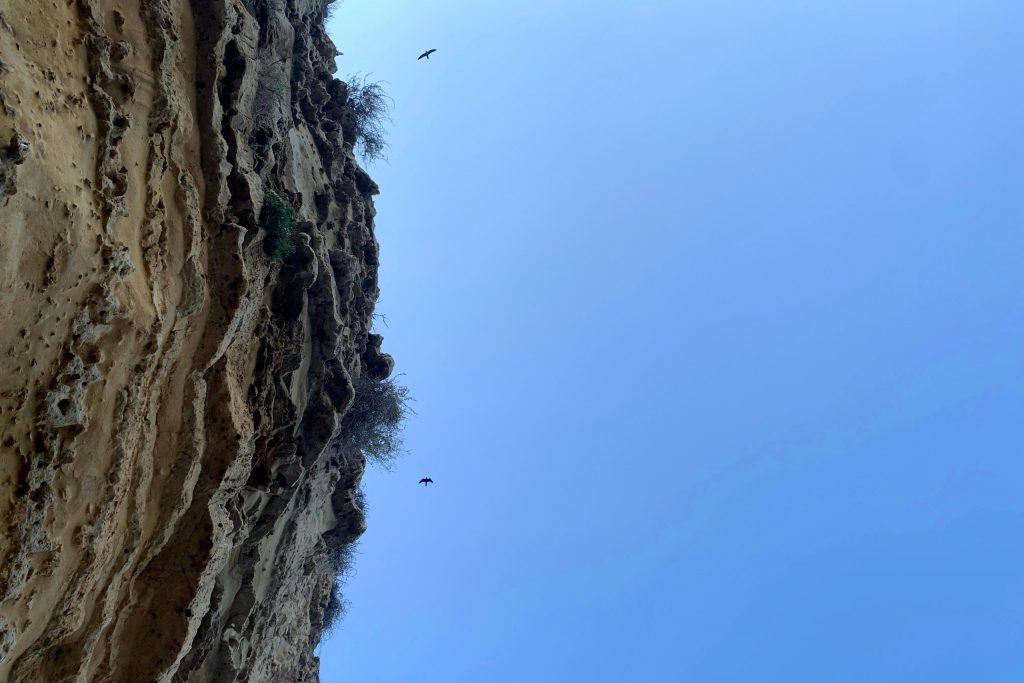
The reason is almost diabolical in its precision. By the time its eggs hatch – typically in September and October – enormous numbers of small migratory birds such as warblers, flycatchers, and redstarts are flooding southward through the Mediterranean on their way to Africa. These tired, disoriented travellers become the primary food source for the falcon’s growing chicks. The adults hunt in cooperative aerial chains, forming lines along coastal cliffs, intercepting migrants as they attempt to cross open water. The chicks, meanwhile, are fed a diet of freshly caught small birds – a far more protein-rich food than insects alone could provide.
It is a strategy so precisely timed to the rhythms of the wider natural world that it reads less like animal instinct and more like something designed by a brilliant naturalist.
On the Cliffs of Cyprus, It Still Happens Every Year
The Mediterranean is the heartland of Eleonora’s Falcon. Around two-thirds of the world’s entire population – estimated at between 12,000 and 17,000 breeding pairs – nests on Greek islands, with Tilos alone hosting around 10% of the global population. Cyprus sits near the eastern edge of its breeding range, and the island’s limestone sea-cliffs provide exactly the kind of habitat the bird needs: sheer, sun-warmed, shadow-offering rock faces overlooking open sea.
One of the most celebrated spots in Cyprus is the bay of Zapalo near Episkopi, on the southern coast – a dramatic, largely inaccessible cove flanked by white limestone cliffs. Here, Eleonora’s Falcons nest alongside Peregrine Falcons and Griffon Vultures, creating one of the most spectacular concentrations of cliff-nesting raptors in the Eastern Mediterranean. The area sits partly within British Sovereign Base territory, which – whether by design or accident – has helped keep it undisturbed.
The species is listed on the Bern Convention and is protected under Cypriot and EU law. Its global conservation status is currently listed as Least Concern, though habitat disturbance, illegal trapping of migratory birds, and the broader pressures of migration still pose risks.
The Falcon That Became a Film
In 2022, the story of Eleonora’s Falcon and its relationship with the Akrotiri Peninsula received a tribute it thoroughly deserved: a dedicated documentary film. Eleonora’s Falcon: Life in the Balance, directed by Madelaine Westwood and produced in partnership with Nutshell Productions, BirdLife Cyprus, and the RSPB, uses the falcon’s perspective as its narrative thread – following the bird across the Akrotiri Peninsula and letting its seasonal story become a lens through which the extraordinary biodiversity of the area is revealed.
The film received its world premiere in April 2022, with screenings in both Nicosia and Limassol – a fitting debut for a story so deeply rooted in Cyprus itself. Available on Vimeo https://vimeo.com/643215663
Where to Stand and Watch the Sky Fill with Falcons
Seeing Eleonora’s Falcon in Cyprus is one of the more rewarding wildlife experiences the island offers – and it requires little more than patience, a pair of binoculars, and the willingness to find yourself standing on the edge of a limestone cliff in the golden light of early autumn.
Practical Tips
Best time: Late August to mid-October, when birds are actively feeding chicks and intercepting migrants.
Best locations: The cliffs at Episkopi / Zapalo Bay (near the Sanctuary of Apollo Hylates), and the coastal cliffs around the Akrotiri Peninsula.
What to look for: Watch for fast, narrow-winged silhouettes cruising along cliff-tops, sometimes in groups – a behaviour rarely seen in other falcons.
Access note: Parts of the Zapalo cliff area are within British Base territory; access via the dirt track from the Sanctuary of Apollo is typically possible but can be variable.
The experience: On a good morning you may see dark morph and pale morph birds side by side, performing aerial acrobatics as they intercept passing warblers. It is genuinely breathtaking.
Guided visits: Contact BirdLife Cyprus (birdlifecyprus.org) for guided birdwatching tours and up-to-date sighting information.
A Bird That Belongs to the Whole Mediterranean World
Cyprus sits at a crossroads – between continents, between seasons, between the human world and the wild one. Eleonora’s Falcon embodies that position perfectly. It arrives from an ocean away, breeds on cliffs shaped by millions of years of Mediterranean geology, feeds on birds that themselves have flown from Finland or Russia, and departs again for Madagascar before the last warm days are gone.
To watch it hunt above the white cliffs of southern Cyprus is to witness the island as something larger than a tourist destination or a political boundary – as a vital node in a living network that stretches from the tropics to the Arctic. The falcon does not know borders. It knows wind, rock, and the rhythm of seasons. And in that knowledge, it carries a quiet reminder of how connected this island truly is to the rest of the world.
It is named for a queen who protected birds with the force of law. Perhaps the most fitting tribute we can offer in return is simply to keep the cliffs wild, the skies open, and the welcome ready – every autumn, when it comes back again.