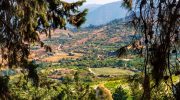
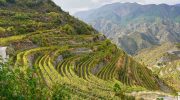
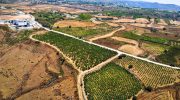
Across the slopes of Cyprus, especially in the Troodos Mountains, vineyards climb in careful steps supported by dry stone walls. These terraces were not built for beauty alone. They were shaped over centuries to manage steep land, scarce water, and intense sun. Today, they form one of the island’s most distinctive cultural landscapes, where wine, village life, and traditional craftsmanship remain visibly connected to the terrain.
Cyprus’s terraced vineyards are not a natural feature you simply stumble upon. They are the result of long, patient work, repeated generation after generation.
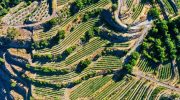
On the southern and western slopes of the Troodos Mountains, hillsides that would otherwise be too steep or fragile for farming have been transformed into narrow, horizontal bands. Each terrace creates just enough flat ground to support vines, olives, or carobs, while the stone walls beneath them hold soil in place and slow the movement of water downhill.
Seen from a distance, these terraces read almost like contour lines drawn across the mountains. Up close, they feel more intimate: low walls, uneven stones, and vines planted by hand in spaces machines could never reach.
Why terracing mattered in Cyprus
Terracing in Cyprus was never an aesthetic choice. It was a practical response to geography.
The island’s interior is rugged, with thin soils and long dry seasons broken by sudden winter rains. Without terraces, fertile earth would wash downhill in a single storm. By breaking slopes into steps, farmers reduced erosion, trapped moisture, and made agriculture possible where it otherwise would not have survived.
This system allowed vineyards to exist at elevations ranging from a few hundred meters above sea level to well over 1,000 meters in highland regions such as Pitsilia. In some areas, Cyprus hosts among the highest vineyards in Europe, where cooler nights help preserve acidity and aroma in grapes.
The quiet logic of dry stone walls
The defining feature of these landscapes is not the vines themselves, but the dry stone walls that support them. Built without mortar, these walls rely entirely on balance, gravity, and careful placement. Stones are selected from the surrounding land, meaning the walls visually blend into the geology of each region. Small gaps between stones allow rainwater to pass through instead of building pressure behind the wall, reducing collapse during heavy weather.
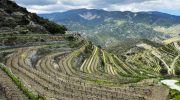
Because the stones are not fixed, the walls can shift slightly over time, settling rather than cracking. This flexibility has allowed many terraces to survive for centuries with minimal repair. In 2018, the craft of dry stone walling was recognised by UNESCO as Intangible Cultural Heritage, acknowledging not just the structures themselves, but the accumulated knowledge required to build and maintain them.
Where these vineyard landscapes are most visible
Terraced vineyards appear across much of Cyprus, but their presence becomes especially legible in certain regions, where the relationship between land, labour, and settlement is written clearly into the hills.
The Commandaria villages
North of Limassol, a cluster of villages long associated with Commandaria wine occupies some of the island’s most densely terraced terrain. Here, vineyards have been cultivated continuously since medieval times, shaped by international demand during the Crusader period and sustained by local knowledge long after global attention faded. The terraces in this region feel compact and purposeful, tightly fitted to slopes that have been worked for centuries without interruption.
The Krasochoria of Limassol
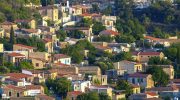
Further west, villages such as Omodos, Koilani, and Lofou sit within layered vineyard landscapes that wrap around hills and descend into narrow valleys. White limestone soils and sharp changes in elevation give this area a strong visual rhythm, where terraces seem to cascade downward, responding precisely to the contours beneath them rather than imposing a rigid pattern.
High-altitude Pitsilia and Marathasa

On the eastern and northern slopes of the Troodos range, terraces extend into cooler, forested terrain. Here, vineyards are often interwoven with pine trees and orchards, producing a landscape that feels quieter and more sheltered. The terraces climb gradually, following temperature and light as much as slope, reflecting careful adaptation to altitude rather than scale.
The Laona and Akamas plateau
In the northwest, terraced vineyards occupy gentler uplands with long, open views toward the Mediterranean. These terraces feel less enclosed, framed by sky and distant sea. Their spacing reflects broader slopes and stronger winds, giving the landscape a sense of openness that contrasts with the tighter valleys of central wine regions.
Vines that grow close to the ground
Traditional Cypriot vineyards often differ markedly from modern European wine landscapes. Instead of uniform rows supported by wires, many vines are grown as low bush vines, positioned close to the soil.
This approach reduces exposure to wind, limits moisture loss during hot summers, and suits the irregular shapes of terraced plots where machinery cannot operate. It also reflects a long familiarity with local conditions, favouring resilience over efficiency.
Cyprus is further distinguished by vineyards that were largely untouched by phylloxera, the pest that devastated much of Europe’s wine industry in the nineteenth century. As a result, many vines grow on their own roots, preserving ancient varieties such as Xynisteri, Mavro, Maratheftiko, and Promara, each shaped by place as much as by genetics.
A seasonal landscape that never stands still
The terraced vineyards of Cyprus are not static scenery. Their appearance shifts with the year, revealing different aspects of their structure and purpose as seasons change.
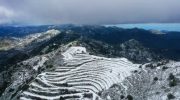
Spring brings fresh growth, with bright green vines standing out against pale stone walls and wildflowers filling the spaces between terraces. Summer deepens colour and contrast, casting long shadows across slopes as grapes ripen under intense light. In autumn, harvest transforms the hills into muted golds and reds, when grapes are still cut by hand on steep ground that resists mechanisation. Winter strips the vines back to bare wood, exposing the geometry of terraces themselves and the patient logic beneath the landscape.
This cycle reinforces the sense that these vineyards remain active systems rather than preserved relics.
Village life written into the hills
Terraced vineyards cannot be separated from the villages that surround and maintain them. In wine-growing communities, agriculture has traditionally been communal, tied to shared labour, seasonal rhythms, and local identity.
Harvest periods bring people together not only for work but for collective effort and celebration. Products such as palouze and soutzoukos, made from grape juice, remain part of village tradition, linking modern households to older methods of preservation and use. Even today, small family vineyards exist alongside commercial wineries, keeping household-scale cultivation visible within a changing economy.
In many villages, terraces extend right up to the edge of houses, dissolving any clear boundary between domestic space and cultivated land.
A landscape under pressure, and why it matters
Despite their endurance, Cyprus’s terraced vineyards face growing challenges. Rural depopulation has left many terraces untended, and when dry stone walls collapse, erosion accelerates quickly. Abandoned land also increases fire risk, particularly during prolonged summer heat.
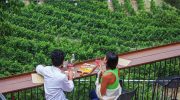
At the same time, restoration efforts are gaining momentum. Community initiatives and European-supported programs are working to repair walls, revive traditional cultivation, and reconnect people with the labour embedded in these landscapes. Such efforts recognise terraces not simply as scenic features, but as functional systems that manage water, support biodiversity, and preserve agricultural knowledge refined over centuries.
Why these vineyards deserve attention
Cyprus’s terraced vineyards do not overwhelm the eye in the way cliffs or beaches do. Their impact is quieter, cumulative, and earned through repetition.
They demonstrate how people adapted to difficult land without dominating it, how farming and construction merged into a single, responsive system, and how beauty emerged from necessity rather than display.
To understand these terraces is to understand Cyprus itself: an island shaped by cooperation with its landscape, where survival required patience, skill, and continuity, and where that relationship remains visible today, stone by stone, vine by vine.