Explore Cyprus with Our Interactive Map

Explore our top stories and discover ideas worth your time.

Temple of Zeus Salaminios

Temple of Zeus Salaminios

The Temple of Zeus Salaminios was one of the most important religious monuments of ancient Salamis. Dedicated to Zeus as the supreme god of the Olympian pantheon, it symbolised the city’s Greek identity, political authority, and connection to divine protection. Through this temple, Salamis expressed its place within the wider Greek world while affirming its own power and prestige. A Temple at the Heart of Salamis The Temple of Zeus Salaminios stood within the great city of Salamis on the eastern coast of Cyprus. As one of the island’s largest and wealthiest cities, Salamis required a religious centre that matched its status. The choice of Zeus was deliberate. As ruler of gods and men, Zeus represented order, authority, and legitimacy. Worshipping him in monumental form reinforced Salamis’s role as a leading city with strong ties to Greek tradition and values. Zeus as Guardian of the City Zeus Salaminios was not a distant or abstract god. He was believed to actively protect the city, its people, and its rulers. His cult emphasised stability, justice, and continuity, qualities essential for a powerful urban centre. Rulers and elites used the sanctuary to demonstrate their devotion and to associate their authority with divine approval. Public ceremonies held at the temple reinforced the idea that Salamis thrived under Zeus’s watchful presence. From Early Cult to…

Read more
Finikoudes Beach Larnaca

Finikoudes Beach Larnaca

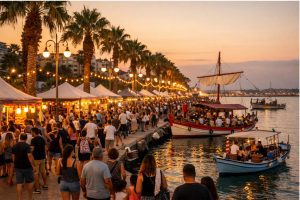
Finikoudes Beach stretches 600 meters along Larnaca's central seafront, backed by a palm-lined promenade that serves as the city's main social gathering space. The beach takes its name from the Greek word for small palm trees, referring to the baby palms planted along the promenade in 1922. Those original trees have now reached full height and stand as defining features of Larnaca's coastal identity. This urban beach offers direct access to the Mediterranean from the heart of Cyprus's third-largest city, with shallow waters that extend 25 to 30 meters from shore before reaching deeper zones. From Fishing Village to Tourist Destination Larnaca sits on the site of ancient Kition, established in the 13th century BC as a Mycenaean settlement. The city served as a copper trading hub and maintained continuous habitation for over 3,000 years. The modern Finikoudes area developed much later as Larnaca transformed from a modest coastal town into an international gateway. Historical records from the 16th and 17th centuries describe Larnaca as containing only around 300 houses, most built from stone and mud brick. The promenade's development fundamentally changed the relationship between Larnaca's old town and its waterfront. The reconstruction and improvement of Piale Pasha Avenue, which connects Finikoudes with the Mackenzie tourist area, was completed on July 29, 2014. This project unified Larnaca's entire seafront through…

Read more
Paralimni Wetlands, Cyprus

Paralimni Wetlands, Cyprus

Located in the southeastern corner of Cyprus near the town that shares its name, Paralimni Lake stands as one of the island's eight remaining natural wetlands. This 350-hectare seasonal wetland hosts an extraordinary variety of bird species and rare reptiles despite severe threats from development and poor management. The name Paralimni translates to "by the lake," a reminder that this wetland once defined the entire region's identity. Paralimni Lake occupies a natural depression between the villages of Paralimni, Sotira, and Deryneia in the Famagusta district. The basin collects rainwater runoff from surrounding areas, primarily through the Plati torrent flowing from the east. During winter and early spring, water accumulates in this shallow pan, creating crucial wetland habitat. By summer, the lake typically dries out completely, leaving exposed mudflats and sparse vegetation. This seasonal pattern might seem problematic, but Mediterranean ecosystems have evolved to function perfectly with such cycles. The wet winter months support migratory birds, while the dry summer period allows different species to thrive. In drought years, the lake may barely collect any water at all. In particularly wet seasons, it can retain moisture for longer periods, sometimes extending bird habitat availability into early summer. Historical records show that in 1893, locals cut drainage channels to reduce humidity around the growing town. These channels dried much of the lake…

Read more