Explore Cyprus with Our Interactive Map

Explore our top stories and discover ideas worth your time.

Black Locust Robinia In Cyprus

Black Locust Robinia In Cyprus

Imagine walking through an older Cypriot village or along a rural roadside in late May, when the air suddenly fills with a sweet, heavy perfume reminiscent of orange blossom. Looking up, you see long, drooping clusters of creamy-white flowers hanging like fragrant tassels from the branches of a graceful, thorny tree. This is the black locust of Cyprus – a fast-growing, nitrogen-fixing beauty that has quietly become part of the island’s living heritage. The False Acacia of the Legume Family Black locust, Robinia pseudoacacia, belongs to the vast Fabaceae (legume) family – the same group as carob, peas and beans. It is a deciduous tree famous for its ability to enrich poor soils by fixing nitrogen from the air. Locally it is known as Ροπίνια η ψευδοακακία (Ropínia i pseudoakakía), literally “false acacia Robinia”, because its pinnate leaves and pea-like flowers resemble true acacias even though it is not closely related. From American Forests to Cypriot Roadsides Native to the Appalachian Mountains and Ozarks of the eastern United States, black locust was one of the first North-American trees brought to Europe in the early 17th century. It reached Cyprus during the British period (late 19th–early 20th century) and was widely planted for durable timber, excellent honey production, erosion control on degraded land, and quick shade in villages and towns. Like…

Read more
Salamis Bathhouse Mosaics

Salamis Bathhouse Mosaics

The Salamis bathhouse mosaics show how Roman Cyprus combined leisure, engineering, and civic identity inside one of the island’s most ambitious public complexes. These floors were designed to shape movement and atmosphere, pairing mythic scenes with technical skill, imported materials, and heated rooms that made bathing a daily performance of status. This article explains how the mosaics worked within the bathhouse system, what their imagery signalled, and why their survival still matters for understanding Roman urban life on Cyprus. A Capital Built to Be Seen Salamis was not an ordinary provincial town. For long periods, it functioned as the administrative and commercial heart of Cyprus, benefiting from trade routes that linked the Aegean, the Levant, and Egypt. When the city was rebuilt after a devastating earthquake in the first century AD 76/77 and a later insurrection in AD 116, Roman emperors invested heavily in its public architecture. The gymnasium and bathhouse complex became one of the most imposing structures in the eastern Mediterranean. Its scale alone communicated status. Wide colonnades, marble-clad halls, and carefully planned water systems transformed bathing into a public performance of Roman order and prosperity. Bathing as a Social Ritual In Roman cities, baths were not private spaces for cleanliness. They were communal environments where physical care, leisure, and social interaction blended into a daily routine. At…

Read more
Sanctuary of the Great Mother (Avdimou)

Sanctuary of the Great Mother (Avdimou)

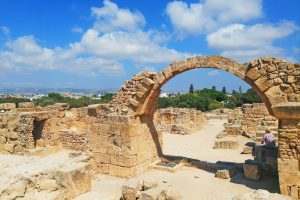
A cult site dedicated to the prehistoric fertility goddess, showing the continuity of worship from pagan fertility rites to later religious forms. The Sanctuary of the Great Mother in Avdimou represents a timeless spiritual hub in Cyprus, where ancient veneration of a fertility goddess evolved into Christian devotion to the Virgin Mary. Located in the rural village of Prastio Avdimou near the south coast, this site embodies the island's layered religious history, blending prehistoric fertility cults with Byzantine and medieval Christian practices. It highlights Cyprus's role as a crossroads of civilizations, where pagan rites centered on life, birth, and renewal transitioned seamlessly into the worship of Panagia, the "All-Holy" mother figure, fostering a enduring tradition of pilgrimage and miracle-seeking that persists today. A Cult Site of Continuity The Sanctuary of the Great Mother, embodied in the Church of Panagia Diakinousa in Prastio Avdimou, stands as a testament to Cyprus's spiritual evolution, nestled in a serene valley amid olive groves and rolling hills. This site, spanning less than a hectare but rich in symbolic depth, draws from prehistoric roots where fertility goddesses were honored for their power over life and nature. In ancient times, Cypriots revered a "Great Goddess" depicted in cruciform statues symbolizing childbirth, with hundreds of artifacts dating to 3000-2500 BC found across the island. The Avdimou area, with…

Read more