Explore Cyprus with Our Interactive Map

Explore our top stories and discover ideas worth your time.

Internet & Telecommunications in Cyprus

Internet & Telecommunications in Cyprus

Cyprus has built a surprisingly strong telecom market for its size, with fiber optic networks expanding rapidly across the island. The Fiber network enables the transmission of data at very fast speeds, with innovative technology providing Internet access at speeds of up to 1 Gbps. In the last five years, operators expanded LTE-Advanced and rolled out 5G to 100 percent of the population, while the island invested in trans-Mediterranean submarine cable projects to strengthen its international connections. This digital infrastructure supports both residents and the growing number of remote workers choosing Cyprus as their base. Major Internet Service Providers ​​Cyta, the state-owned telecommunications company, manages most telecommunications and internet connections on the island and is the country's oldest and largest network operator. It has been providing services for over 70 years and expanded to include fixed PSTN, ISDN, DSL, and FTTH, as well as Cytanet Broadband and mobile communications under the Cytamobile-Vodafone brand. Cyta has the widest 4G and 5G coverage, reaching even remote areas and some points at the open sea. Image Credit: financialmirror.com Following recent liberalization of the telecommunications sector, a few private telecommunications companies have emerged. Cablenet is a local telecommunications company that offers a range of internet services, including fiber optic and cable connections, with a well-developed network in Cyprus and competitive pricing. To contact Cablenet,…

Read more
Pelendri Church

Pelendri Church

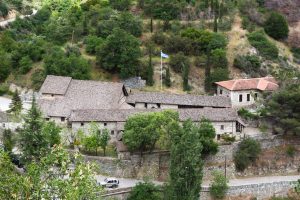
The Church of Timios Stavros in Pelendri is a layered Troodos interior built and repainted between the 12th and 16th centuries, preserving multiple fresco phases within a single working church. Dated inscriptions, shifting styles, and later aisle additions make the building a readable archive of rural devotion, local patronage, and Lusignan-era overlap rather than a single “perfect” moment. This article explains how the structure expanded, how the fresco programs differ by period, and why the church remains one of Cyprus’s clearest examples of belief accumulating without erasing what came before. A Church Shaped by Reuse Pelendri lies high in the Pitsilia region, surrounded by steep slopes and dense forest, far from the coastal cities that usually dominate Cyprus's medieval history. Timios Stavros stands just outside the village core, a placement that suggests it functioned originally as a cemetery church rather than a parish centrepiece. Its position tells an important story. This was not a monument built for display or prestige. It was a working religious space, shaped by generations who returned to it repeatedly for worship, burial, and memory. Over time, necessity and devotion changed their form, resulting in the layered structure that survives today. From Modest Chapel to Complex Basilica The earliest version of the church dates to the mid-12th century, when it existed as a single-aisled domed structure…

Read more
Besparmak Mountains

Besparmak Mountains

The Besparmak Mountains stretch like a limestone backbone along the northern coast of Cyprus, parallel to the Mediterranean for approximately 160 kilometers. Known also as the Kyrenia Mountains or Pentadaktylos, this narrow ridge rises abruptly from the coastal plain to create one of the island's most dramatic landscapes. The name Besparmak translates to five fingers in Turkish, referring to a distinctive peak that resembles an outstretched hand. Ancient Limestone from the Mesozoic Era The range consists primarily of hard crystalline limestone with some dolomite and marble formations dating to the Mesozoic period, formed between 250 and 65 million years ago beneath ancient seas. Unlike the volcanic Troodos Mountains in southern Cyprus, this northern range represents sedimentary formations from the Permian to Middle Miocene periods, pushed upward by collision of African and Eurasian tectonic plates. The highest peak, Mount Selvili Tepe, reaches 1,024 meters near Lapta. While only half the height of Troodos, the Kyrenia Mountains appear more imposing because they rise suddenly from the flat Mesaoria plain. The porous limestone acts as a natural filter, creating mountain aquifers that supply nearly all towns and villages in northern Cyprus. Endemic Plants on Limestone Cliffs The limestone cliffs support diverse flora. Cyprus hosts 1,750 native plant species, of which 128 are endemic. The Kyrenia range contains 57 endemic species, concentrated at higher…

Read more