Explore Cyprus with Our Interactive Map

Explore our top stories and discover ideas worth your time.

Cyprus Citrus Groves

Cyprus Citrus Groves

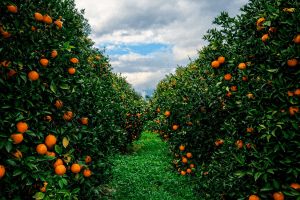
Citrus trees have never been a background crop in Cyprus. They reshaped coastal plains, sustained export economies, scented villages with orange blossom, and anchored everyday cooking. Oranges, lemons, grapefruits, and local hybrids thrive where mild winters meet long sunlight hours, making citrus one of the island's most recognisable and enduring farming traditions. Even as Cyprus modernises, citrus remains a quiet constant, rooted in land, memory, and daily life. Why Citrus Took Hold in Cyprus Citrus farming in Cyprus is defined by geography. The island’s coastal plains provide exactly what citrus trees require: frost-free winters, fertile soils, and long growing seasons. Unlike vineyards that climb into the mountains, citrus orchards stay close to the sea, shaping lowland landscapes around Morphou, Limassol, and Paphos. These groves were never ornamental. They provided reliable harvests, export income, and household staples, becoming as common in village courtyards as in commercial plantations. Over time, citrus trees blurred the boundary between agriculture and domestic life, integrating farming directly into everyday routines. The Coastal Landscapes That Grow Citrus Citrus orchards are closely tied to Cyprus’s coastal geography. The most productive groves sit on fertile alluvial soils where irrigation can be carefully managed. Historically, regions such as Morphou developed reputations as citrus heartlands due to access to natural springs and groundwater flowing from the Troodos foothills. Limassol’s coastal zones…

Read more

Museum of the National Struggle Nicosia

Museum of the National Struggle Nicosia

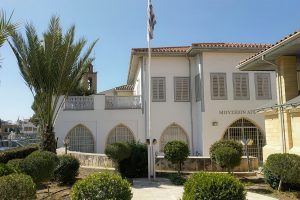
The Museum of National Struggle opened in 1961, just two years after the end of the liberation struggle. Former EOKA fighter Christodoulos Papachrysostomou founded the institution following a decision by the Greek Communal Chamber on January 26, 1961. Shutterstock-com The decision was published in the official newspaper of the Republic on February 23 of the same year. The museum's establishment aimed to spread awareness of the freedom fight, honor fallen fighters, preserve memories for future generations, and collect materials for historical documentation. The museum initially operated from different premises before moving to its current purpose-built facility near the Holy Archbishopric of Cyprus in central Nicosia. The new building was inaugurated on April 30, 2001, with funding provided by the Holy Archbishopric of Cyprus and the Ministry of Education and Culture. The modern facility transformed the museum from a simple archive into a historical and scientific center equipped with new technologies and visual aids. Historical Background The National Organization of Cypriot Fighters, known as EOKA from its Greek initials, was founded on March 07, 1953, by Colonel Georgios Grivas, a Greek Army officer. Grivas had arrived in Cyprus on November 10, 1954, to prepare for the insurgency. The organization received support from Archbishop Makarios III, the Orthodox Archbishop of Cyprus, who had vowed upon his elevation in 1950 not to rest…

Read more
Makronissos Tombs

Makronissos Tombs

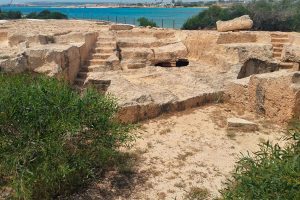
Carved into solid rock on a small peninsula west of Ayia Napa, the Makronissos Tombs are a window into ancient Cyprus. These 19 underground burial chambers date back over 2,000 years and reveal how people lived, died, and honored their dead during the Hellenistic and Roman periods. kiprguru-com The Makronissos Tombs form an ancient necropolis, a city of the dead, where families buried their relatives between the 4th century BCE and the 4th century CE. Each tomb consists of a stepped pathway that descends into the rock, leading to a rectangular chamber sealed by stone slabs. Inside, the chambers feature three stone benches carved along the walls and a central rectangular trench slightly lower than the floor. The site also includes a small sanctuary built from large irregular stone blocks and remnants of an ancient quarry that operated nearby. The quarry unfortunately damaged some tombs, but enough survived to tell us about burial practices in ancient Cyprus. The Ancient Settlement of Thronon According to historical records, an ancient settlement called Thronon existed in the Ayia Napa area, along with several smaller communities. These settlements thrived until the Early Christian period but were abandoned around the 7th century CE during the Arab raids that swept across the Eastern Mediterranean. The tombs at Makronissos served as the final resting place for people…

Read more